

Tectonic Control of Alluvial Stratigraphy
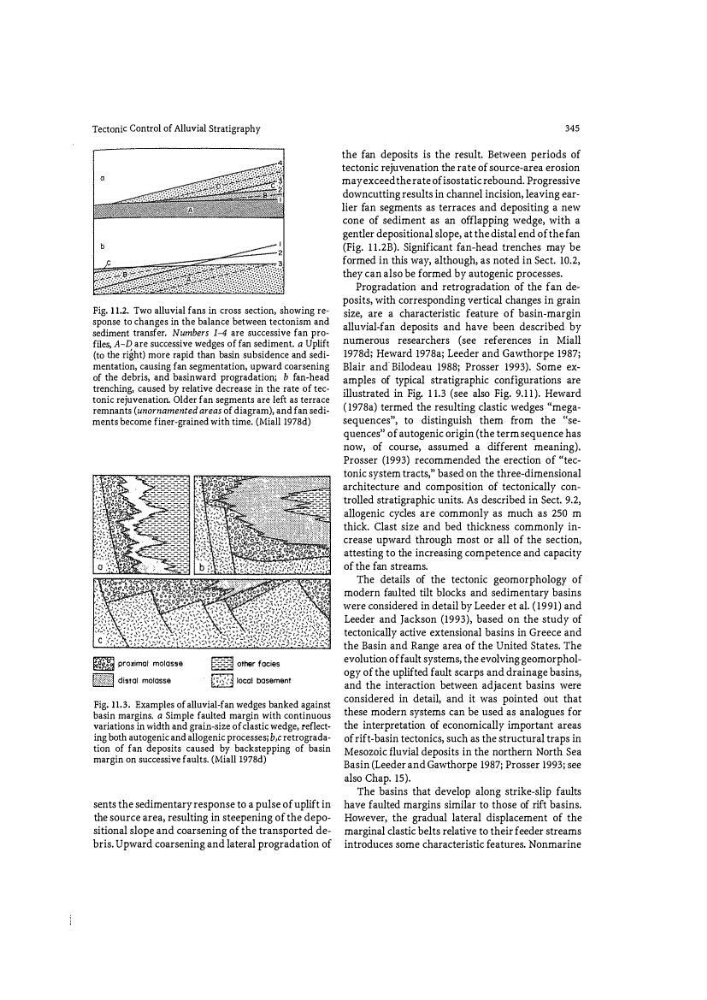
Fig. 11.2. Two alluvial fans in cross section, showing response to changes in the balance between tectonism and
sediment transfer. Numbers 1-4 are successive fan profiles, A-D are successive wedges of fan sediment. a Uplift
(to the right) more rapid than basin subsidence and sedimentation, causing fan segmentation, upward coarsening
of the debris, and basinward progradation; b fan�head
trenching, caused by relative decrease in the rate of tectonic rejuvenation. Older fan segments are left as terrace
remnants (unornamented areas of diagram), and fan sedi�
ments become finer-grained with time. (Miall 1978d)
� proximo! molasse
kt� t:J distal molasse
�=::::j other facies
��;). ' ;1 1 ocol basement
Fig. 11.3. Examples of alluvial-fan wedges banked against
basin margins. a Simple faulted margin with continuous
variations in width and grain-size of clastic wedge, reflect�
ing both autogenic and allogenic processes; b1c retrogradation of fan deposits caused by backstepping of basin
margin on successive faults. (Miall l978d)
sents the sedimentary response to a pulse of uplift in
the source area, resulting in steepening of the depositional slope and coarsening of the transported debris. Upward coarsening and lateral progradation of
345
the fan deposits is the result. Between periods of
tectonic rejuvenation the rate of source-area erosion
may exceed the rate of isostatic rebound. Progressive
downcutting results in channel incision, leaving ear�
lier fa n segments as terraces and depositing a new
cone of sediment as an offlapping wedge, with a
gentler depositional slope, at the distal end of the fan
(Fig. 11.2B). Significant fa n-head trenches may be
formed in this way, although, as noted in Sect. 10.2,
they can also be formed by autogenic processes.
Progradation and retrogradation of the fan deposits, with corresponding vertical changes in grain
size, are a characteristic feature of basin-margin
alluvial-fan deposits and have been described by
numerous researchers (see references in Miall
1978d; Heward 1978a; Leeder and Gawthorpe 1987;
Blair. and. Bilodeau 1988; Prosser 1993). Some examples of typical stratigraphic configurations are
illustrated in Fig. 11.3 (see also Fig. 9.11). Heward
(1978a) termed the resulting clastic wedges "megasequences", to distinguish them from the ''sequences'' of autogenic origin (the term sequence has
now, of course, assumed a different meaning).
Prosser (1993) recommended the erection of "tectonic system tracts," based on the three-dimensional
architecture and composition of tectonically controlled stratigraphic units. As described in Sect. 9.2,
allogenic cycles are commonly as much as 250 m
thick. Clast size and bed thickness commonly increase upward through most or all of the section,
attesting to the increasing competence and capacity
of the fan streams.
The details of the tectonic geomorphology of
modern fau lted tilt blocks and sedimentary basins
were considered in detail by Leeder et al. ( 1991) and
Leeder and jackson (1993), based on the study of
tectonically active extensional basins in Greece and
the Basin and Range area of the United States. The
evolution of fault systems, the evolving geomorphology of the uplifted fault scarps and drainage basins,
and the interaction between adjacent basins were
considered in detail, and it was pointed out that
these modern systems can be used as analogues for
the interpretation of economically important areas
of rift-basin tectonics, such as the structural traps in
Mesozoic fluvial deposits in the northern North Sea
Basin (Leeder and Gawthorpe 1987; Prosser 1993; see
also Chap. 15).
The basins that develop along strike-slip faults
have faulted margins similar to those of rift basins.
However, the gradual lateral displacement of the
marginal clastic belts relative to their feeder streams
introduces some characteristic fe atures. Nonmarine
Fig. 11.2. Two alluvial fans in cross section, showing response to changes in the balance between tectonism and
sediment transfer. Numbers 1-4 are successive fan profiles, A-D are successive wedges of fan sediment. a Uplift
(to the right) more rapid than basin subsidence and sedimentation, causing fan segmentation, upward coarsening
of the debris, and basinward progradation; b fan�head
trenching, caused by relative decrease in the rate of tectonic rejuvenation. Older fan segments are left as terrace
remnants (unornamented areas of diagram), and fan sedi�
ments become finer-grained with time. (Miall 1978d)
� proximo! molasse
kt� t:J distal molasse
�=::::j other facies
��;). ' ;1 1 ocol basement
Fig. 11.3. Examples of alluvial-fan wedges banked against
basin margins. a Simple faulted margin with continuous
variations in width and grain-size of clastic wedge, reflect�
ing both autogenic and allogenic processes; b1c retrogradation of fan deposits caused by backstepping of basin
margin on successive faults. (Miall l978d)
sents the sedimentary response to a pulse of uplift in
the source area, resulting in steepening of the depositional slope and coarsening of the transported debris. Upward coarsening and lateral progradation of
345
the fan deposits is the result. Between periods of
tectonic rejuvenation the rate of source-area erosion
may exceed the rate of isostatic rebound. Progressive
downcutting results in channel incision, leaving ear�
lier fa n segments as terraces and depositing a new
cone of sediment as an offlapping wedge, with a
gentler depositional slope, at the distal end of the fan
(Fig. 11.2B). Significant fa n-head trenches may be
formed in this way, although, as noted in Sect. 10.2,
they can also be formed by autogenic processes.
Progradation and retrogradation of the fan deposits, with corresponding vertical changes in grain
size, are a characteristic feature of basin-margin
alluvial-fan deposits and have been described by
numerous researchers (see references in Miall
1978d; Heward 1978a; Leeder and Gawthorpe 1987;
Blair. and. Bilodeau 1988; Prosser 1993). Some examples of typical stratigraphic configurations are
illustrated in Fig. 11.3 (see also Fig. 9.11). Heward
(1978a) termed the resulting clastic wedges "megasequences", to distinguish them from the ''sequences'' of autogenic origin (the term sequence has
now, of course, assumed a different meaning).
Prosser (1993) recommended the erection of "tectonic system tracts," based on the three-dimensional
architecture and composition of tectonically controlled stratigraphic units. As described in Sect. 9.2,
allogenic cycles are commonly as much as 250 m
thick. Clast size and bed thickness commonly increase upward through most or all of the section,
attesting to the increasing competence and capacity
of the fan streams.
The details of the tectonic geomorphology of
modern fau lted tilt blocks and sedimentary basins
were considered in detail by Leeder et al. ( 1991) and
Leeder and jackson (1993), based on the study of
tectonically active extensional basins in Greece and
the Basin and Range area of the United States. The
evolution of fault systems, the evolving geomorphology of the uplifted fault scarps and drainage basins,
and the interaction between adjacent basins were
considered in detail, and it was pointed out that
these modern systems can be used as analogues for
the interpretation of economically important areas
of rift-basin tectonics, such as the structural traps in
Mesozoic fluvial deposits in the northern North Sea
Basin (Leeder and Gawthorpe 1987; Prosser 1993; see
also Chap. 15).
The basins that develop along strike-slip faults
have faulted margins similar to those of rift basins.
However, the gradual lateral displacement of the
marginal clastic belts relative to their feeder streams
introduces some characteristic fe atures. Nonmarine