

334
Fluvial Depositional Systems and Autogenic Sedimentary Controls
100
•
.. .
•
•
18
0 MEANOEfUNG
CHANNEL
II LOW SINUOSITY )
• aRAIOEO
MORPHOLOGY
"' ANASTOMOSED
X CHANNEL MORPHOLOGY
NOT KNOWN
2A
, .
"
100
1000
CHANNEL BELT WIDTH (m)
10000
100000
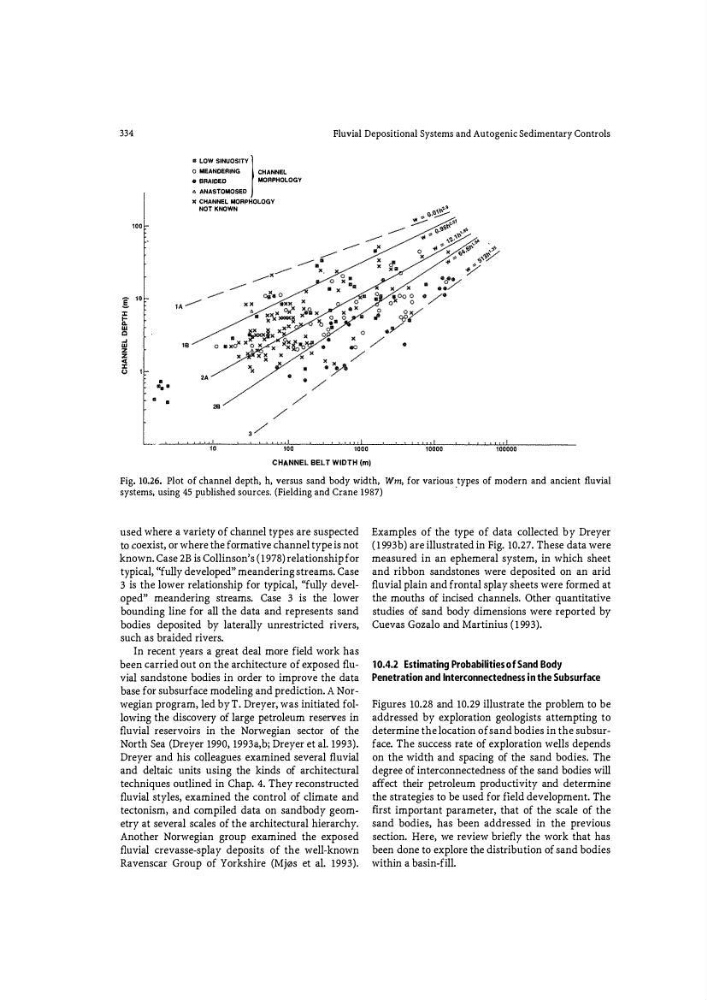
Fig. 10.26. Plot of channel depth, h, versus sand body width, Wm, for various types of modern and ancient fluvial
systems, using 45 published sources. (Fielding and Crane 1987)
·
used where a variety of channel types are suspected
to coexist, or where the formative channel type is not
known. Case 2B is Collinson's (1978) relationship for
typical, "fully developed" meandering streams. Case
3 is the lower relationship for typical, ''fully developed" meandering streams. Case 3 is the lower
bounding line for all the data and represents sand
bodies deposited by laterally unrestricted rivers,
such as braided rivers.
In recent years a great deal more field work has
been carried out on the architecture of exposed fluvial sandstone bodies in order to improve the data
base for subsurface modeling and prediction. A Norwegian program, led by T. Dreyer, was initiated following the discovery of large petroleum reserves in
fluvial reservoirs in the Norwegian sector of the
North Sea (Dreyer 1990, 1993a,b; Dreyer et al. 1993).
Dreyer and his colleagues examined several fluvial
and deltaic units using the kinds of architectural
techniques outlined in Chap. 4. They reconstructed
fluvial styles, examined the control of climate and
tectonism) and compiled data on sandbody geom�
etry at several scales of the architectural hierarchy.
Another Norwegian group examined the exposed
fluvial crevasse-splay deposits of the well-known
Ravenscar Group of Yorkshire (Mj0s et al. 1993).
Examples of the type of data collected by Dreyer
(1993b) are illustrated in Fig. 10.27. These data were
measured in an ephemeral system, in which sheet
and ribbon sandstones were deposited on an arid
fluvial plain and frontal splay sheets were fo rmed at
the mouths of incised channels. Other quantitative
studies of sand body dimensions were reported by
Cuevas Gozalo and Martinius (1993).
1 0.4.2 Estimating Probabilities of Sand Body
Penetration and Interconnectedness in the Subsurface
Figures 10.28 and 10.29 illustrate the problem to be
addressed by exploration geologists attempting to
determine the location of sand bodies in the subsurface. The success rate of exploration wells depends
on the width and spacing of the sand bodies. The
degree of interconnectedness of the sand bodies will
affect their petroleum productivity and determine
the strategies to be used for field development. The
first important parameter, that of the scale of the
sand bodies, has been addressed in the previous
section. Here, we review briefly the work that has
been done to explore the distribution of sand bodies
within a basin-fill.
Fluvial Depositional Systems and Autogenic Sedimentary Controls
100
•
.. .
•
•
18
0 MEANOEfUNG
CHANNEL
II LOW SINUOSITY )
• aRAIOEO
MORPHOLOGY
"' ANASTOMOSED
X CHANNEL MORPHOLOGY
NOT KNOWN
2A
, .
"
100
1000
CHANNEL BELT WIDTH (m)
10000
100000
Fig. 10.26. Plot of channel depth, h, versus sand body width, Wm, for various types of modern and ancient fluvial
systems, using 45 published sources. (Fielding and Crane 1987)
·
used where a variety of channel types are suspected
to coexist, or where the formative channel type is not
known. Case 2B is Collinson's (1978) relationship for
typical, "fully developed" meandering streams. Case
3 is the lower relationship for typical, ''fully developed" meandering streams. Case 3 is the lower
bounding line for all the data and represents sand
bodies deposited by laterally unrestricted rivers,
such as braided rivers.
In recent years a great deal more field work has
been carried out on the architecture of exposed fluvial sandstone bodies in order to improve the data
base for subsurface modeling and prediction. A Norwegian program, led by T. Dreyer, was initiated following the discovery of large petroleum reserves in
fluvial reservoirs in the Norwegian sector of the
North Sea (Dreyer 1990, 1993a,b; Dreyer et al. 1993).
Dreyer and his colleagues examined several fluvial
and deltaic units using the kinds of architectural
techniques outlined in Chap. 4. They reconstructed
fluvial styles, examined the control of climate and
tectonism) and compiled data on sandbody geom�
etry at several scales of the architectural hierarchy.
Another Norwegian group examined the exposed
fluvial crevasse-splay deposits of the well-known
Ravenscar Group of Yorkshire (Mj0s et al. 1993).
Examples of the type of data collected by Dreyer
(1993b) are illustrated in Fig. 10.27. These data were
measured in an ephemeral system, in which sheet
and ribbon sandstones were deposited on an arid
fluvial plain and frontal splay sheets were fo rmed at
the mouths of incised channels. Other quantitative
studies of sand body dimensions were reported by
Cuevas Gozalo and Martinius (1993).
1 0.4.2 Estimating Probabilities of Sand Body
Penetration and Interconnectedness in the Subsurface
Figures 10.28 and 10.29 illustrate the problem to be
addressed by exploration geologists attempting to
determine the location of sand bodies in the subsurface. The success rate of exploration wells depends
on the width and spacing of the sand bodies. The
degree of interconnectedness of the sand bodies will
affect their petroleum productivity and determine
the strategies to be used for field development. The
first important parameter, that of the scale of the
sand bodies, has been addressed in the previous
section. Here, we review briefly the work that has
been done to explore the distribution of sand bodies
within a basin-fill.