

330
Fluvial Depositional Systems and Autogenic Sedimentary Controls
'0
'0
'0
'0
w m etres
log w
"' 1·54 log h + 0·83
r � 0·9!
Sd � 0·35
sample o/ S7rwe•• where'�
II" b�nlllull depth � lm
w "bM�Iull wtdlh
sinuosHy >1·7
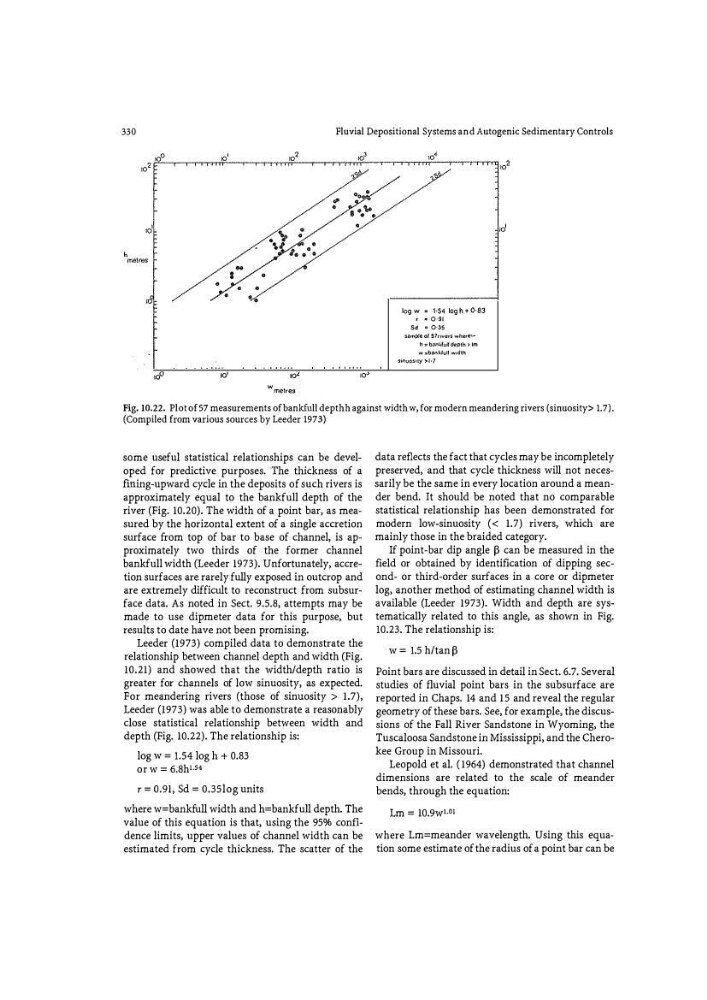
Fig. 10.22. Plot of 57 measurements of bankfull depthh against width w, for modern meandering rivers (sinuosity> 1.7}.
(Compiled from various sources by Leeder 1973)
some useful statistical relationships can be developed for predictive purposes. The thickness of a
fm ing-upward cycle in the deposits of such rivers is
approximately equal to the bankfull depth of the
river (Fig. 10.20). The width of a point bar, as measured by the horizontal extent of a single accretion
surface from top of bar to base of channel, is approximately two thirds of the former channel
bankfull width (Leeder 1973). Unfortunately, accretion surfaces are rarely fully exposed in outcrop and
are extremely difficult to reconstruct from subsur�
face data. As noted in Sect. 9.5.8, attempts may be
made to use dipmeter data for this purpose, but
results to date have not been promising.
Leeder (1973) compiled data to demonstrate the
relationship between channel depth and width (Fig.
10.21) and showed that the width/depth ratio is
greater for channels of low sinuosity, as expected.
For meandering rivers (those of sinUosity > 1.7),
Leeder (1973) was able to demonstrate a reasonably
close statistical relationship between width and
depth (Fig. 10.22). The relationship is:
log w = !.54 log h + 0.83
or w = 6.8h L54
r = 0.91, Sd = 0.35log units
where w=bankfull width and h=bankfull depth. The
value of this equation is that, using the 95% confidence limits, upper values of channel width can be
estimated from cycle thickness. The scatter of the
data reflects the fact that cycles may be incompletely
preserved, and that cycle thickness will not neces�
sarily be the same in every location around a meander bend. It should be noted that no comparable
statistical relationship has been demonstrated for
modern low-sinuosity ( < 1.7) rivers, which are
mainly those in the braided category.
If point-bar dip angle � can be measured in the
field or obtained by identification of dipping second- or third-order surfaces in a core or dipmeter
log, another method of estimating channel width is
available (Leeder 1973). Width and depth are systematically related to this angle, as shown in Fig.
!0.23. The relationship is:
w = !.5 h/tan �
Point bars are discussed in detail in Sect. 6.7. Several
studies of fluvial point bars in the subsurface are
reported in Chaps. 14 and 15 and reveal the regular
geometry of these bars. See, for example, the discussions of the Fall River Sandstone in Wyoming, the
Tuscaloosa Sandstone in Mississippi, and the Cherokee Group in Missouri.
Leopold et al. (1964) demonstrated that channel
dimensions are related to the scale of meander
bends, through the equation:
Lm = 10.9wLot
where Lm=meander wavelength. Using this equation some estimate of the radius of a point bar can be
Fluvial Depositional Systems and Autogenic Sedimentary Controls
'0
'0
'0
'0
w m etres
log w
"' 1·54 log h + 0·83
r � 0·9!
Sd � 0·35
sample o/ S7rwe•• where'�
II" b�nlllull depth � lm
w "bM�Iull wtdlh
sinuosHy >1·7
Fig. 10.22. Plot of 57 measurements of bankfull depthh against width w, for modern meandering rivers (sinuosity> 1.7}.
(Compiled from various sources by Leeder 1973)
some useful statistical relationships can be developed for predictive purposes. The thickness of a
fm ing-upward cycle in the deposits of such rivers is
approximately equal to the bankfull depth of the
river (Fig. 10.20). The width of a point bar, as measured by the horizontal extent of a single accretion
surface from top of bar to base of channel, is approximately two thirds of the former channel
bankfull width (Leeder 1973). Unfortunately, accretion surfaces are rarely fully exposed in outcrop and
are extremely difficult to reconstruct from subsur�
face data. As noted in Sect. 9.5.8, attempts may be
made to use dipmeter data for this purpose, but
results to date have not been promising.
Leeder (1973) compiled data to demonstrate the
relationship between channel depth and width (Fig.
10.21) and showed that the width/depth ratio is
greater for channels of low sinuosity, as expected.
For meandering rivers (those of sinUosity > 1.7),
Leeder (1973) was able to demonstrate a reasonably
close statistical relationship between width and
depth (Fig. 10.22). The relationship is:
log w = !.54 log h + 0.83
or w = 6.8h L54
r = 0.91, Sd = 0.35log units
where w=bankfull width and h=bankfull depth. The
value of this equation is that, using the 95% confidence limits, upper values of channel width can be
estimated from cycle thickness. The scatter of the
data reflects the fact that cycles may be incompletely
preserved, and that cycle thickness will not neces�
sarily be the same in every location around a meander bend. It should be noted that no comparable
statistical relationship has been demonstrated for
modern low-sinuosity ( < 1.7) rivers, which are
mainly those in the braided category.
If point-bar dip angle � can be measured in the
field or obtained by identification of dipping second- or third-order surfaces in a core or dipmeter
log, another method of estimating channel width is
available (Leeder 1973). Width and depth are systematically related to this angle, as shown in Fig.
!0.23. The relationship is:
w = !.5 h/tan �
Point bars are discussed in detail in Sect. 6.7. Several
studies of fluvial point bars in the subsurface are
reported in Chaps. 14 and 15 and reveal the regular
geometry of these bars. See, for example, the discussions of the Fall River Sandstone in Wyoming, the
Tuscaloosa Sandstone in Mississippi, and the Cherokee Group in Missouri.
Leopold et al. (1964) demonstrated that channel
dimensions are related to the scale of meander
bends, through the equation:
Lm = 10.9wLot
where Lm=meander wavelength. Using this equation some estimate of the radius of a point bar can be