

Quantitative Studies of Alluvial Architecture
331
'"' '
>0
d
> O '
, o '
>a'
Iii � p����hame! d,meMIOM r,om
ep�•ton crossl
>0
hmetres
•
> o '
... '): 1{) 18
°
12
°
9°
,.
tan B ·}
, w
>00
> O '
>0
'
•o '
> O '
wmetres
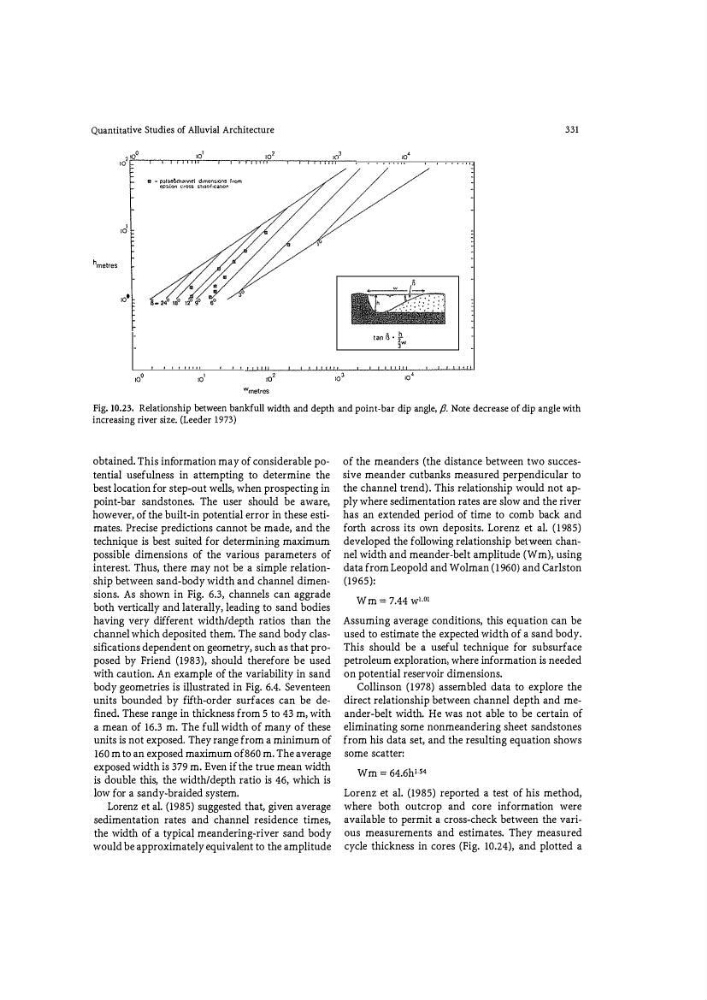
Fig. 10.23. Relationship between bankfull width and depth and point-bar dip angle, fJ. Note decrease of dip angle with
increasing river size. (Leeder 1973)
obtained. This information may of considerable po�
tential usefulness in attempting to determine the
best location for step-out wells, when prospecting in
point-bar sandstones. The user should be aware,
however, of the built-in potential error in these esti�
mates. Precise predictions cannot be made, and the
technique is best suited for determining maximum
possible dimensions of the various parameters of
interest. Thus, there may not be a simple relationship between sand-body width and channel dimensions. As shown in Fig. 6.3, channels can aggrade
both vertically and laterally, leading to sand bodies
having very different width/depth ratios than the
channel which deposited them. The sand body classifications dependent on geometry, such as that proposed by Friend (1983), should therefore be used
"With caution. An example of the variability in sand
body geometries is illustrated in Fig. 6.4. Seventeen
units bounded by fifth-order surfaces can be defined. These range in thickness from 5 to 43 m, with
a mean of 16.3 m. The full width of many of these
units is not exposed. They range from a minimum of
160 m to an exposed maximum of860 m. The average
exposed width is 379 m. Even if the true mean width
is double this, the width/depth ratio is 46, which is
low for a sandy-braided system.
Lorenz et al. (1985) suggested that, given average
sedimentation rates and channel residence times,
the width of a typical meandering-river sand body
would be approximately equivalent to the amplitude
of the meanders (the distance between two successive meander cutbanks measured perpendicular to
the channel trend). This relationship would not apply where sedimentation rates are slow and the river
has an extended period of time to comb back and
forth across its own deposits. Lorenz et al. (1985)
developed the following relationship between channel width and meander-belt amplitude (Wm), using
data from Leopold and Wolman (1960) and Carlston
(1965):
Wm = 7.44 wL01
Assuming average conditions, this equation can be
used to estimate the expected "Width of a sand body.
This should be a useful technique for subsurface
petroleum exploration) where information is needed
on potential reservoir dimensions.
Collinson (1978) assembled data to explore the
direct relationship between channel depth and meander-belt width. He was not able to be certain of
eliminating some nonmeandering sheet sandstones
from his data set, and the resulting equation shows
some scatter:
Wm = 64.6h'-54
Lorenz et al. (1985) reported a test of his method,
where both outcrop and core information were
available to permit a cross-check between the various measurements and estimates. They measured
cycle thickness in cores (Fig. 10.24), and plotted a
331
'"' '
>0
d
> O '
, o '
>a'
Iii � p����hame! d,meMIOM r,om
ep�•ton cross
>0
hmetres
•
> o '
... '): 1{) 18
°
12
°
9°
,.
tan B ·}
, w
>00
> O '
>0
'
•o '
> O '
wmetres
Fig. 10.23. Relationship between bankfull width and depth and point-bar dip angle, fJ. Note decrease of dip angle with
increasing river size. (Leeder 1973)
obtained. This information may of considerable po�
tential usefulness in attempting to determine the
best location for step-out wells, when prospecting in
point-bar sandstones. The user should be aware,
however, of the built-in potential error in these esti�
mates. Precise predictions cannot be made, and the
technique is best suited for determining maximum
possible dimensions of the various parameters of
interest. Thus, there may not be a simple relationship between sand-body width and channel dimensions. As shown in Fig. 6.3, channels can aggrade
both vertically and laterally, leading to sand bodies
having very different width/depth ratios than the
channel which deposited them. The sand body classifications dependent on geometry, such as that proposed by Friend (1983), should therefore be used
"With caution. An example of the variability in sand
body geometries is illustrated in Fig. 6.4. Seventeen
units bounded by fifth-order surfaces can be defined. These range in thickness from 5 to 43 m, with
a mean of 16.3 m. The full width of many of these
units is not exposed. They range from a minimum of
160 m to an exposed maximum of860 m. The average
exposed width is 379 m. Even if the true mean width
is double this, the width/depth ratio is 46, which is
low for a sandy-braided system.
Lorenz et al. (1985) suggested that, given average
sedimentation rates and channel residence times,
the width of a typical meandering-river sand body
would be approximately equivalent to the amplitude
of the meanders (the distance between two successive meander cutbanks measured perpendicular to
the channel trend). This relationship would not apply where sedimentation rates are slow and the river
has an extended period of time to comb back and
forth across its own deposits. Lorenz et al. (1985)
developed the following relationship between channel width and meander-belt amplitude (Wm), using
data from Leopold and Wolman (1960) and Carlston
(1965):
Wm = 7.44 wL01
Assuming average conditions, this equation can be
used to estimate the expected "Width of a sand body.
This should be a useful technique for subsurface
petroleum exploration) where information is needed
on potential reservoir dimensions.
Collinson (1978) assembled data to explore the
direct relationship between channel depth and meander-belt width. He was not able to be certain of
eliminating some nonmeandering sheet sandstones
from his data set, and the resulting equation shows
some scatter:
Wm = 64.6h'-54
Lorenz et al. (1985) reported a test of his method,
where both outcrop and core information were
available to permit a cross-check between the various measurements and estimates. They measured
cycle thickness in cores (Fig. 10.24), and plotted a