

326
Fluvial Depositional Systems and Autogenic Sedimentary Controls
MEASURED VERTICAL SECTIONS
SEDIMENTARY STRUCTURES
� FACIES Sh/SI ·I ow p::: :: ::J FACIES 51- low
� angle to horizontal � angle troughs
� FACIES SIJSt - !ow to r-:1 FACIES SH · large
� normal angle x-strata 1.2::: ::SJ trough x- strata
r-:--:1 FACIES SI-s · small 1:4� ••j FACIES Se · hetero� trough x-strata
0.1 • .• lithic scours
r.;,-;-n FACIES Se · intraclast c:=:::J FACIES FmiFI - over� scour f. acles
c::=.=J bank fines; Une sand
to mud
� FACIES Sp ·p lanar r7;'\l Bounding surface rank
� cross- stratification
D2L:J (from Miall, 1988)
� No st : ucture vis
i b le - � Coset boundarv
� mass!Ve appearance t:... .:. .. .:1
.,
t;;j Undulose contact
SORTING
'w very well
w well
moderately well
m moderately
p poorly
'P very poorly
ROUNDING
� well w""ded
rounded
subrounded
subangular
angular
LITHOLOGY
fioe• · m"d"one
fines - siltstone
sandstone
pebbly sandstone
extraclasts
intiaclasts
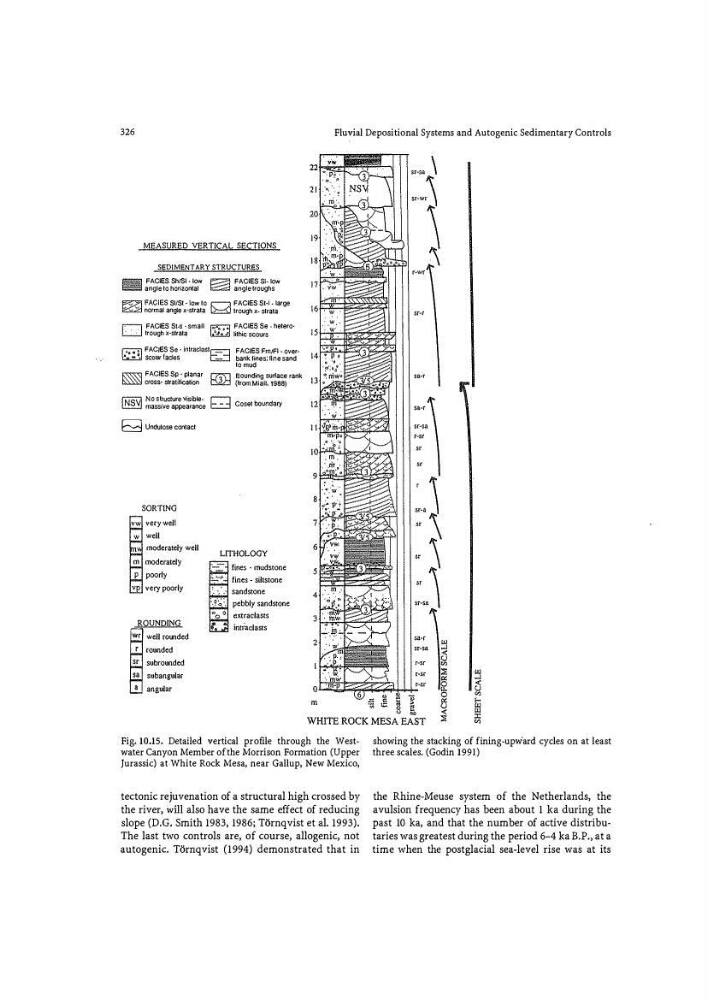
Fig. 10.15. Detailed vertical profile through the West�
water Canyon Member of the Morrison Formation (Upper
Jurassic) at White Rock Mesa, near Gallup, New Mexico,
tectonic rejuvenation of a structural high crossed by
the river, will also have the same effect of reducing
slope (D.G. Smith 1983, 1986; Tornqvist et al. 1993).
The last two controls are, of course, allogenic, not
autogenic. Tornqvist (1994) demonstrated that in
showing the stacking of fining�upw'ard cycles on at least
three scales. (Godin 1991)
the Rhine-Meuse system of the Netherlands, the
avulsion frequency has been about 1 ka during the
past 10 ka, and that the number of active distributaries was greatest during the period 6-4 ka B.P., at a
time when the postglacial sea-level rise was at its
Fluvial Depositional Systems and Autogenic Sedimentary Controls
MEASURED VERTICAL SECTIONS
SEDIMENTARY STRUCTURES
� FACIES Sh/SI ·I ow p::: :: ::J FACIES 51- low
� angle to horizontal � angle troughs
� FACIES SIJSt - !ow to r-:1 FACIES SH · large
� normal angle x-strata 1.2::: ::SJ trough x- strata
r-:--:1 FACIES SI-s · small 1:4� ••j FACIES Se · hetero� trough x-strata
0.1 • .• lithic scours
r.;,-;-n FACIES Se · intraclast c:=:::J FACIES FmiFI - over� scour f. acles
c::=.=J bank fines; Une sand
to mud
� FACIES Sp ·p lanar r7;'\l Bounding surface rank
� cross- stratification
D2L:J (from Miall, 1988)
� No st : ucture vis
i b le - � Coset boundarv
� mass!Ve appearance t:... .:. .. .:1
.,
t;;j Undulose contact
SORTING
'w very well
w well
moderately well
m moderately
p poorly
'P very poorly
ROUNDING
� well w""ded
rounded
subrounded
subangular
angular
LITHOLOGY
fioe• · m"d"one
fines - siltstone
sandstone
pebbly sandstone
extraclasts
intiaclasts
Fig. 10.15. Detailed vertical profile through the West�
water Canyon Member of the Morrison Formation (Upper
Jurassic) at White Rock Mesa, near Gallup, New Mexico,
tectonic rejuvenation of a structural high crossed by
the river, will also have the same effect of reducing
slope (D.G. Smith 1983, 1986; Tornqvist et al. 1993).
The last two controls are, of course, allogenic, not
autogenic. Tornqvist (1994) demonstrated that in
showing the stacking of fining�upw'ard cycles on at least
three scales. (Godin 1991)
the Rhine-Meuse system of the Netherlands, the
avulsion frequency has been about 1 ka during the
past 10 ka, and that the number of active distributaries was greatest during the period 6-4 ka B.P., at a
time when the postglacial sea-level rise was at its