

l
The Evolution of Distributary Fluvial Systems
Plan view of orluviol fan
�x focotion of vertical $Cqvence e�
surface Intersection
I
pdol \ Dopo
Fonhead
trench profile
tongiludinol section
(after Hooke 1967)
· .. .
315
gradual progradation of active Fan segment followed by rapid abandonment
ovvlsive initio/ion of aclive fan segment followed by gradual abandonment
sequen;' scale �
m-10'sm '
gradual progrado lion and abandonment of active fon ��menl
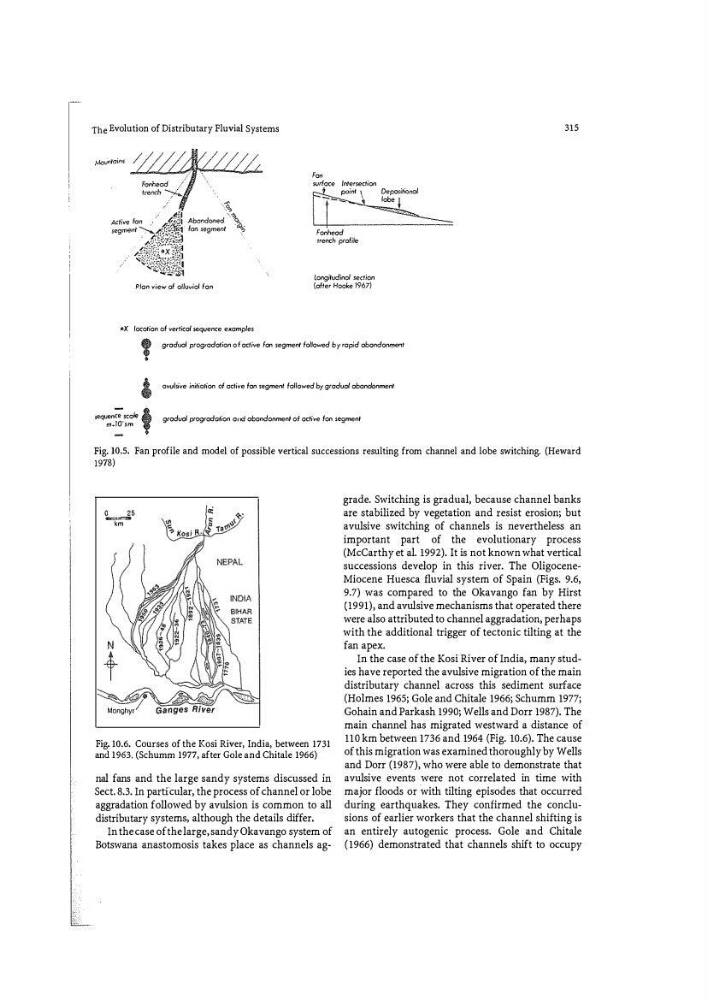
Fig. 10.5. Fan profile and model of possible vertical successions resulting from channel and lobe switching. (Heward
!978)
0
25
�
km
Fig. 10.6. Courses of the Kosi River, India, between 1731
and 1963. (Schumm 1977, after Gole and Chitale 1966)
nal fans and the large sandy systems discussed in
Sect. 8.3. In particular, the process of channel or lobe
aggradation followed by avulsion is common to all
distributary systems, although the details differ.
In the case of the large, sandy Okavango system of
Botswana anastomosis takes place as channels aggrade. Switching is gradual, because channel banks
are stabilized by vegetation and resist erosion; but
avulsive switching of channels is nevertheless an
important part of the evolutionary process
(McCarthy et al. 1992). It is not known what vertical
successions develop in this river. The OligoceneMiocene Huesca fluvial system of Spain (Figs. 9.6,
9.7) was compared to the Okavango fan by Hirst
(1991), and avulsive mechanisms that operated there
were also attributed to channel aggradation, perhaps
with the additional trigger of tectonic tilting at the
fan apex.
In the case of the Kosi River of India, many studies have reported the avulsive migration of the main
distributary channel across this sediment surface
(Holmes 1965; Gole and Chitale 1966; Schumm 1977;
Gohain and Parkash 1990; Wells and Dorr 1987). The
main channel has migrated westward a distance of
110 km between 1736 and 1964 (Fig. 10.6). The cause
of this migration was examined thoroughly by Wells
and Dorr (1987), who were able to demonstrate that
avulsive events were not correlated in time with
major floods or with tilting episodes that occurred
during earthquakes. They confirmed the conclusions of earlier workers that the channel shifting is
an entirely autogenic process. Gole and Chitale
(1966) demonstrated that channels shift to occupy
The Evolution of Distributary Fluvial Systems
Plan view of orluviol fan
�x focotion of vertical $Cqvence e�
surface Intersection
I
pdol \ Dopo
Fonhead
trench profile
tongiludinol section
(after Hooke 1967)
· .. .
315
gradual progradation of active Fan segment followed by rapid abandonment
ovvlsive initio/ion of aclive fan segment followed by gradual abandonment
sequen;' scale �
m-10'sm '
gradual progrado lion and abandonment of active fon ��menl
Fig. 10.5. Fan profile and model of possible vertical successions resulting from channel and lobe switching. (Heward
!978)
0
25
�
km
Fig. 10.6. Courses of the Kosi River, India, between 1731
and 1963. (Schumm 1977, after Gole and Chitale 1966)
nal fans and the large sandy systems discussed in
Sect. 8.3. In particular, the process of channel or lobe
aggradation followed by avulsion is common to all
distributary systems, although the details differ.
In the case of the large, sandy Okavango system of
Botswana anastomosis takes place as channels aggrade. Switching is gradual, because channel banks
are stabilized by vegetation and resist erosion; but
avulsive switching of channels is nevertheless an
important part of the evolutionary process
(McCarthy et al. 1992). It is not known what vertical
successions develop in this river. The OligoceneMiocene Huesca fluvial system of Spain (Figs. 9.6,
9.7) was compared to the Okavango fan by Hirst
(1991), and avulsive mechanisms that operated there
were also attributed to channel aggradation, perhaps
with the additional trigger of tectonic tilting at the
fan apex.
In the case of the Kosi River of India, many studies have reported the avulsive migration of the main
distributary channel across this sediment surface
(Holmes 1965; Gole and Chitale 1966; Schumm 1977;
Gohain and Parkash 1990; Wells and Dorr 1987). The
main channel has migrated westward a distance of
110 km between 1736 and 1964 (Fig. 10.6). The cause
of this migration was examined thoroughly by Wells
and Dorr (1987), who were able to demonstrate that
avulsive events were not correlated in time with
major floods or with tilting episodes that occurred
during earthquakes. They confirmed the conclusions of earlier workers that the channel shifting is
an entirely autogenic process. Gole and Chitale
(1966) demonstrated that channels shift to occupy