

314
Fluvial Depositional Systems and Autogenic Sedimentary Controls
20
10
om
Heward, 1978ll
Glop pen & Steel, 1981
This Paper,
SecHon 2,
198-218 m
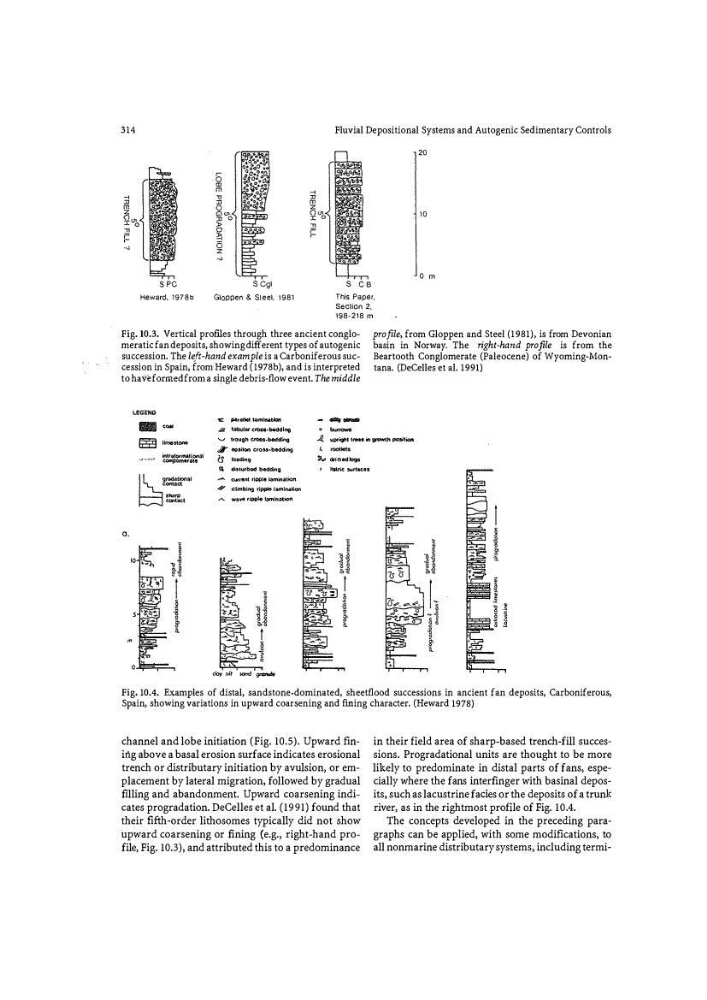
Fig. 10.3. Vertical profll es through three ancient conglo�
meratic fan deposits, showing different types of autogenic
succession. The left�hand example is a Carboniferous sue�
cession in Spain, from-Heward (1978b), and is interpreted
to have formed from a s�ngle debris-flow event. The middle
LEGCNO
.. ...
11: JW�•.ollet l<�m!�tlen
_ ..., _
-profile, from Gloppen and Steel (1981), is from - Devonian
basin in Norway. The right-hand profile is from the
Beartooth Conglomerate (Paleocene) of Wyoming�Mon�
tana. (DeCelles et al. 1991)
� llme3t01>11
.,/It l�h ... <;tOSll. •boiddlng
-...,; trough <:<0$11·b6cldlng
dr &�>:Jilon <:ro$S·bedding
(S looding
.iL upright tme in growth �lion
a.
intralortm�UO<>a!
<:ongiOmotratlt
,,.,., .., ..
<:ontact
.... ..
contact
� dblurbod bfldding
CU
z ... driltedlog!i
• livtrlo:: surl.acu
j
Fig. 10.4. Examples of distal, sandstone�dominated, sheetflood successions in ancient fan deposits, Carboniferous,
Spain, showing variations in upward coarsening and fm ing character. (Heward 1978)
channel and lobe initiation (Fig. 10.5). Upward fining above a basal erosion surface indicates erosional
trench or distributary initiation by avulsion1 or emplacement by lateral migration, followed by gradual
fi lling and abandonment. Upward coarsening indicates progradation. DeCelles et al. (1991) found that
their fifth-order lithosomes typically did not show
upward coarsening or fi ning (e.g., right-hand profile, Fig. 10.3), and attributed this to a predominance
in their field area of sharp-based trench-fill successions. Progradational units are thought to be more
likely to predominate in distal parts of fans, especially where the fans interfinger with basinal deposits, such as lacustrine fades or the deposits of a trunk
river, as in the rightmost profile of Fig. 10.4.
The concepts developed in the preceding paragraphs can be applied, with some modifications, to
all nonmarine distributary systems, including termi-
Fluvial Depositional Systems and Autogenic Sedimentary Controls
20
10
om
Heward, 1978ll
Glop pen & Steel, 1981
This Paper,
SecHon 2,
198-218 m
Fig. 10.3. Vertical profll es through three ancient conglo�
meratic fan deposits, showing different types of autogenic
succession. The left�hand example is a Carboniferous sue�
cession in Spain, from-Heward (1978b), and is interpreted
to have formed from a s�ngle debris-flow event. The middle
LEGCNO
.. ...
11: JW�•.ollet l<�m!�tlen
_ ..., _
-profile, from Gloppen and Steel (1981), is from - Devonian
basin in Norway. The right-hand profile is from the
Beartooth Conglomerate (Paleocene) of Wyoming�Mon�
tana. (DeCelles et al. 1991)
� llme3t01>11
.,/It l�h ... <;tOSll. •boiddlng
-...,; trough <:<0$11·b6cldlng
dr &�>:Jilon <:ro$S·bedding
(S looding
.iL upright tme in growth �lion
a.
intralortm�UO<>a!
<:ongiOmotratlt
,,.,., .., ..
<:ontact
.... ..
contact
� dblurbod bfldding
CU
z ... driltedlog!i
• livtrlo:: surl.acu
j
Fig. 10.4. Examples of distal, sandstone�dominated, sheetflood successions in ancient fan deposits, Carboniferous,
Spain, showing variations in upward coarsening and fm ing character. (Heward 1978)
channel and lobe initiation (Fig. 10.5). Upward fining above a basal erosion surface indicates erosional
trench or distributary initiation by avulsion1 or emplacement by lateral migration, followed by gradual
fi lling and abandonment. Upward coarsening indicates progradation. DeCelles et al. (1991) found that
their fifth-order lithosomes typically did not show
upward coarsening or fi ning (e.g., right-hand profile, Fig. 10.3), and attributed this to a predominance
in their field area of sharp-based trench-fill successions. Progradational units are thought to be more
likely to predominate in distal parts of fans, especially where the fans interfinger with basinal deposits, such as lacustrine fades or the deposits of a trunk
river, as in the rightmost profile of Fig. 10.4.
The concepts developed in the preceding paragraphs can be applied, with some modifications, to
all nonmarine distributary systems, including termi-