

The Evolution of Distributary Fluvial Systems
313
TRENCH INCISION
- - - - �
1
' FAN (6th-ORDER LJTH_D S�
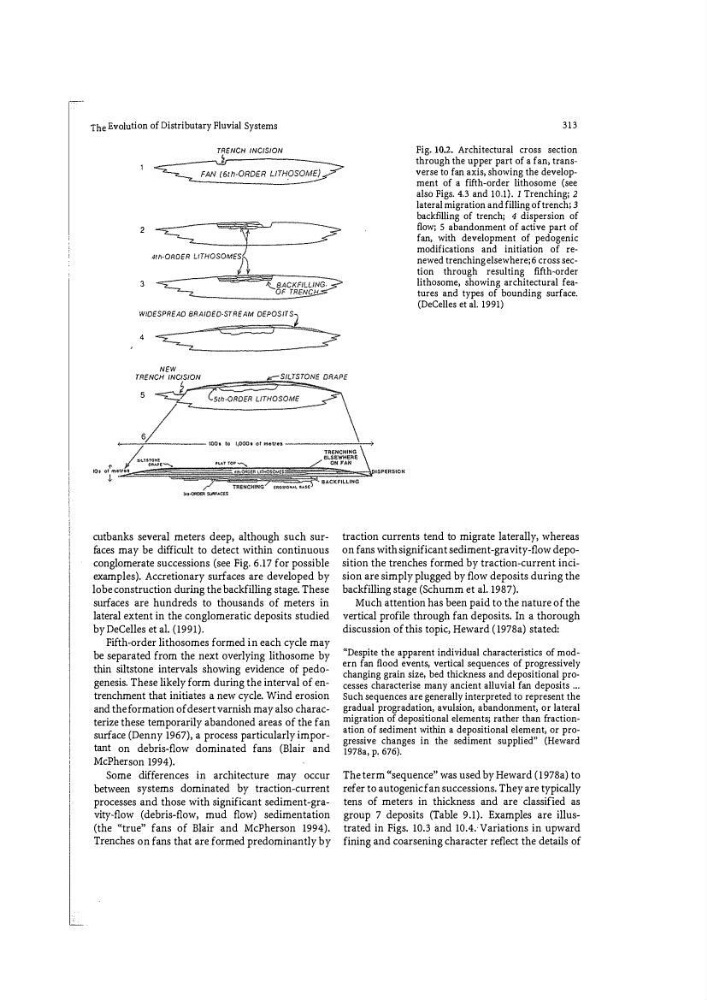
Fig. 1 0.2. Architectural cross section
through the upper part of a fan, transverse to fan axis, showing the development of a fifth-order lithesome (see
also Figs. 4.3 and 10.1). 1 Trenching; 2
lateral migration and filling of trench; 3
backfilling of trench; 4 dispersion of
flow; 5 abandonment of active part of
fan, with development of pedogenic
modifications and initiation of renewed trenching elsewhere; 6 cross section through resulting fifth-order
lithesome, showing architectural fea�
tures and types of bounding surface.
(DeCelles et al. 1991)
2
4th-ORDER LITHOSOME�
3 �
�
k_BACKF �
"'<-_ _____ ___: O
_
F
_
T __ R
�
�
WIDESPREAD BRAIDED-STREAM DEPOSITS�
4
-=z:::z c::: ::s
?
NEW
TRENCH INCISION
5
cutbanks several meters deep, although such surfa ces may be difficult to detect within continuous
conglomerate successions (see Fig. 6.17 for possible
examples). Accretionary surfaces are developed by
lobe construction during the backfilling stage. These
surfaces are hundreds to thousands of meters in
lateral extent in the conglomeratic deposits studied
by DeCelles et a!. (1991).
Fifth-order lithosomes formed in each cycle may
be separated from the next overlying lithesome by
thin siltstone intervals showing evidence of pedogenesis. These likely form during the interval of entrenchment that initiates a new cycle. Wind erosion
and the fo rmation of desert varnish may also characterize these temporarily abandoned areas of the fan
surface (Denny 1967), a process particularly important on debris-flow dominated fans (Blair and
McPherson 1994).
Some differences in architecture may occur
between systems dominated by traction-current
processes and those with significant sediment-gravity-flow (debris-flow, mud flow) sedimentation
(the "true" fans of Blair and McPherson 1994).
Trenches on fans that are formed predominantly by
traction currents tend to migrate laterally, whereas
on fans with significant sediment-gravity-flow deposition the trenches formed by traction-current incision are simply plugged by flow deposits during the
backfilling stage (Schumm et a!. 1987).
Much attention has been paid to the nature of the
vertical profile through fan deposits. In a thorough
discussion of this topic, Heward (1978a) stated:
"Despite the apparent individual characteristics of modern fan flood events, vertical sequences of progressively
changing grain size, bed thickness and depositional processes characterise many ancient alluvial fan deposits ...
Such sequences are generally interpreted to represent the
gradual progradation, avulsion, abandonment, or lateral
migration of depositional elements; rather than fractionation of sediment within a depositional element, or progressive changes in the sediment supplied" (Heward
!978a, p. 676).
The term «sequence" was used by Heward (1978a) to
refer to autogenic fan successions. They are typically
tens of meters in thickness and are classified as
group 7 deposits (Table 9.1). Examples are illustrated in Figs. 10.3 iind 10.4.-Variations in upward
fining and coarsening character reflect the details of
313
TRENCH INCISION
- - - - �
1
' FAN (6th-ORDER LJTH_D S�
Fig. 1 0.2. Architectural cross section
through the upper part of a fan, transverse to fan axis, showing the development of a fifth-order lithesome (see
also Figs. 4.3 and 10.1). 1 Trenching; 2
lateral migration and filling of trench; 3
backfilling of trench; 4 dispersion of
flow; 5 abandonment of active part of
fan, with development of pedogenic
modifications and initiation of renewed trenching elsewhere; 6 cross section through resulting fifth-order
lithesome, showing architectural fea�
tures and types of bounding surface.
(DeCelles et al. 1991)
2
4th-ORDER LITHOSOME�
3 �
�
k_BACKF �
"'<-_ _____ ___: O
_
F
_
T __ R
�
�
WIDESPREAD BRAIDED-STREAM DEPOSITS�
4
-=z:::z c::: ::s
?
NEW
TRENCH INCISION
5
cutbanks several meters deep, although such surfa ces may be difficult to detect within continuous
conglomerate successions (see Fig. 6.17 for possible
examples). Accretionary surfaces are developed by
lobe construction during the backfilling stage. These
surfaces are hundreds to thousands of meters in
lateral extent in the conglomeratic deposits studied
by DeCelles et a!. (1991).
Fifth-order lithosomes formed in each cycle may
be separated from the next overlying lithesome by
thin siltstone intervals showing evidence of pedogenesis. These likely form during the interval of entrenchment that initiates a new cycle. Wind erosion
and the fo rmation of desert varnish may also characterize these temporarily abandoned areas of the fan
surface (Denny 1967), a process particularly important on debris-flow dominated fans (Blair and
McPherson 1994).
Some differences in architecture may occur
between systems dominated by traction-current
processes and those with significant sediment-gravity-flow (debris-flow, mud flow) sedimentation
(the "true" fans of Blair and McPherson 1994).
Trenches on fans that are formed predominantly by
traction currents tend to migrate laterally, whereas
on fans with significant sediment-gravity-flow deposition the trenches formed by traction-current incision are simply plugged by flow deposits during the
backfilling stage (Schumm et a!. 1987).
Much attention has been paid to the nature of the
vertical profile through fan deposits. In a thorough
discussion of this topic, Heward (1978a) stated:
"Despite the apparent individual characteristics of modern fan flood events, vertical sequences of progressively
changing grain size, bed thickness and depositional processes characterise many ancient alluvial fan deposits ...
Such sequences are generally interpreted to represent the
gradual progradation, avulsion, abandonment, or lateral
migration of depositional elements; rather than fractionation of sediment within a depositional element, or progressive changes in the sediment supplied" (Heward
!978a, p. 676).
The term «sequence" was used by Heward (1978a) to
refer to autogenic fan successions. They are typically
tens of meters in thickness and are classified as
group 7 deposits (Table 9.1). Examples are illustrated in Figs. 10.3 iind 10.4.-Variations in upward
fining and coarsening character reflect the details of