

316
Fluvial Depositional Systems and Autogenic Sedimentary Controls
87• 0'
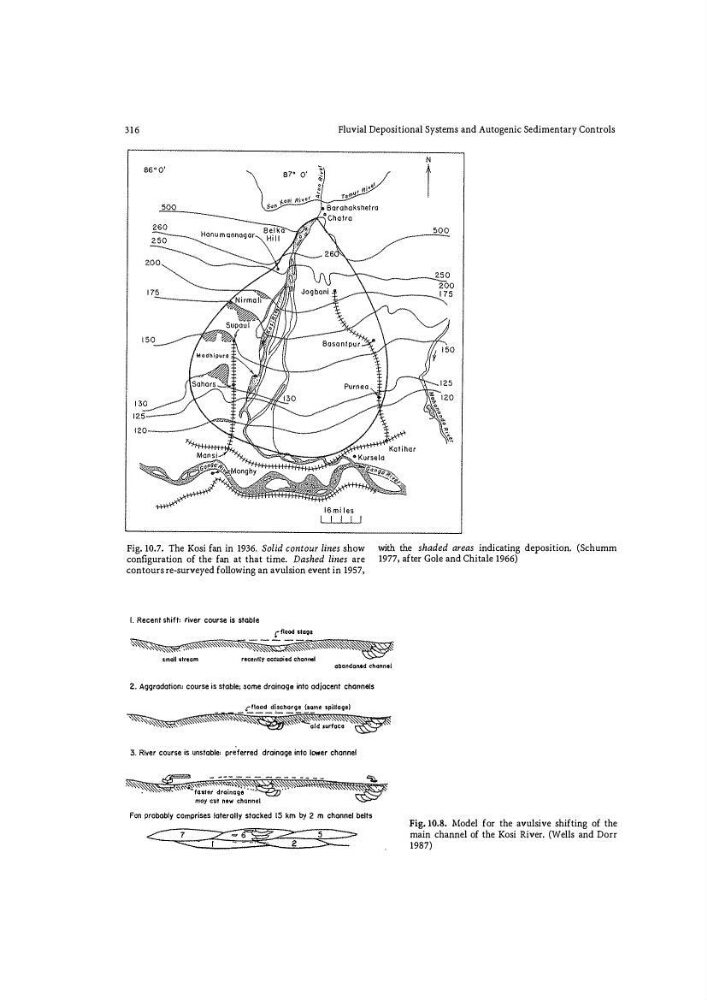
Fig. 10.7. The Kosi fan in 1936. Solid contour lines show
configuration of the- fan at that time. Dashed lines are
contours re�surveyed following an avulsion event in 1957,
I. Recent shift: river course is stable
!ma!l &!ream
re<:ently oecupi�d ehon!'Hil
with the shaded areas indicating deposition. (Schumm
1977, after Gole and Chitale 1966)
'
'
old •urloec
3. Rl'ier course is unstable• pr�ferred drainage into lower channel
Fan probably comprises laterally stacked 15 km by 2 m channel belts
Fig. 10.8. Model for the avulsive shifting of the
main channel of the Kosi River. (Wells and Dorr
1987)
Fluvial Depositional Systems and Autogenic Sedimentary Controls
87• 0'
Fig. 10.7. The Kosi fan in 1936. Solid contour lines show
configuration of the- fan at that time. Dashed lines are
contours re�surveyed following an avulsion event in 1957,
I. Recent shift: river course is stable
!ma!l &!ream
re<:ently oecupi�d ehon!'Hil
with the shaded areas indicating deposition. (Schumm
1977, after Gole and Chitale 1966)
'
'
old •urloec
3. Rl'ier course is unstable• pr�ferred drainage into lower channel
Fan probably comprises laterally stacked 15 km by 2 m channel belts
Fig. 10.8. Model for the avulsive shifting of the
main channel of the Kosi River. (Wells and Dorr
1987)