

306
The Stratigraphic Architecture of Fluvial Depositional Systems
(1991), who examined the flow ofpentachlorphenol
in groundwaters around a chemical plant.
Information on reservoir architecture and fluid
movement patterns is used in production simulation
models, as discussed in Chaps. 14 and 15. Field
checking of these models against measured data on
pressures and fluid contents is a process called history matching. Examples are described in Sneider et
al. (1991) and Martin (1993).
9.6 Stratigraphic Nomenclature
The methods of lithostratigraphy have served sedimentologists and basin analysts well in the establishment of the broad stratigraphic and paleogeographic
subdivisions of a basin f ill . These are standard methods and are described in several textbooks (e.g.,
Miall 1990, Sect. 3.4). However, the advent of sequence stratigraphy and a renewed emphasis on the
importance of breaks in sedimentation have created
the opportunity for a much more refined approach
to stratigraphic documentation. The current North
American Code of Stratigraphic Nomenclature
(North American Commission on Stratigraphic Nomenclature 1983) includes proposals for a new class
EXPLANATION
of stratigraphic units and a new method of defining
and mapping them. This is the method of
allostratigraphy. «An allostratigraphic unit is a mappable stratiform body of sedimentary rock that is
defined and identified on the basis of its bounding
discontinuities." (NACSN 1983, p. 865) A hierarchy
of units, including the allogroup, alloformation, and
allomember, was proposed, and rules were established for defining and naming these various types of
units. Allostratigraphic methods enable the erection
of a sequence framework that avoids the cumbersome and inappropriate rules of lithostratigraphy,
whereby lateral changes in facies "'Within a unit of
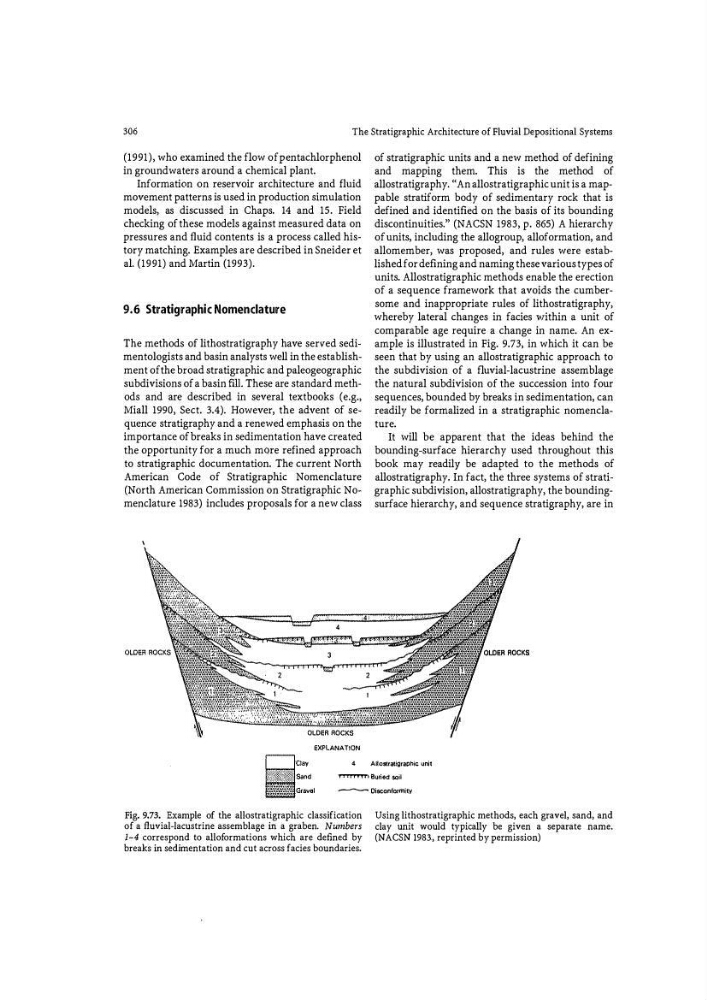
comparable age require a change in name. An example is illustrated in Fig. 9.73, in which it can be
seen that by using an allostratigraphic approach to
the subdivision of a fluvial-lacustrine assemblage
the natural subdivision of the succession into four
sequences, bounded by breaks in sedimentation, can
readily be formalized in a stratigraphic nomenclature.
It will be apparent that the ideas behind the
bounding-surface hierarchy used throughout this
book may readily be adapted to the methods of
allostratigraphy. In fact, the three systems of stratigraphic subdivision, allostratigraphy, the boundingsurface hierarchy, and sequence stratigraphy, are in
4
Al!ostratigraphic unit
TTt'T'I"'T"i' Buried soil
..--- - Disconlotmitv
Fig. 9.73. Example of the allostratigraphic classification
of a fluvial-lacustrine assemblage in a graben. Numbers
1-4 correspond to alloformations which are defined by
breaks in sedimentation and cut across facies boundaries.
Using lithostratigraphic methods, each gravel, sand, and
clay unit would typically be given a separate name.
(NACSN 1983., reprinted by permission)
The Stratigraphic Architecture of Fluvial Depositional Systems
(1991), who examined the flow ofpentachlorphenol
in groundwaters around a chemical plant.
Information on reservoir architecture and fluid
movement patterns is used in production simulation
models, as discussed in Chaps. 14 and 15. Field
checking of these models against measured data on
pressures and fluid contents is a process called history matching. Examples are described in Sneider et
al. (1991) and Martin (1993).
9.6 Stratigraphic Nomenclature
The methods of lithostratigraphy have served sedimentologists and basin analysts well in the establishment of the broad stratigraphic and paleogeographic
subdivisions of a basin f ill . These are standard methods and are described in several textbooks (e.g.,
Miall 1990, Sect. 3.4). However, the advent of sequence stratigraphy and a renewed emphasis on the
importance of breaks in sedimentation have created
the opportunity for a much more refined approach
to stratigraphic documentation. The current North
American Code of Stratigraphic Nomenclature
(North American Commission on Stratigraphic Nomenclature 1983) includes proposals for a new class
EXPLANATION
of stratigraphic units and a new method of defining
and mapping them. This is the method of
allostratigraphy. «An allostratigraphic unit is a mappable stratiform body of sedimentary rock that is
defined and identified on the basis of its bounding
discontinuities." (NACSN 1983, p. 865) A hierarchy
of units, including the allogroup, alloformation, and
allomember, was proposed, and rules were established for defining and naming these various types of
units. Allostratigraphic methods enable the erection
of a sequence framework that avoids the cumbersome and inappropriate rules of lithostratigraphy,
whereby lateral changes in facies "'Within a unit of
comparable age require a change in name. An example is illustrated in Fig. 9.73, in which it can be
seen that by using an allostratigraphic approach to
the subdivision of a fluvial-lacustrine assemblage
the natural subdivision of the succession into four
sequences, bounded by breaks in sedimentation, can
readily be formalized in a stratigraphic nomenclature.
It will be apparent that the ideas behind the
bounding-surface hierarchy used throughout this
book may readily be adapted to the methods of
allostratigraphy. In fact, the three systems of stratigraphic subdivision, allostratigraphy, the boundingsurface hierarchy, and sequence stratigraphy, are in
4
Al!ostratigraphic unit
TTt'T'I"'T"i' Buried soil
..--- - Disconlotmitv
Fig. 9.73. Example of the allostratigraphic classification
of a fluvial-lacustrine assemblage in a graben. Numbers
1-4 correspond to alloformations which are defined by
breaks in sedimentation and cut across facies boundaries.
Using lithostratigraphic methods, each gravel, sand, and
clay unit would typically be given a separate name.
(NACSN 1983., reprinted by permission)