

Methods of Correlation and Mapping
297
VGP LATITUDE
-flf -Yf
+W' +60"
1.8
1.6
1.4
0.8
0.6
0.4
DHOK PAT HAN FM.
1
r
NAGRI FM.
t
CHINJI
FM.
I
'
'
'
KAMLIAL/MURREE
FM.
j
VGP LATITUDE
-f.J:/ -30°
+ 30�� 60�
0.1
�
j
ri
1 -
�
EOCENE LMS.
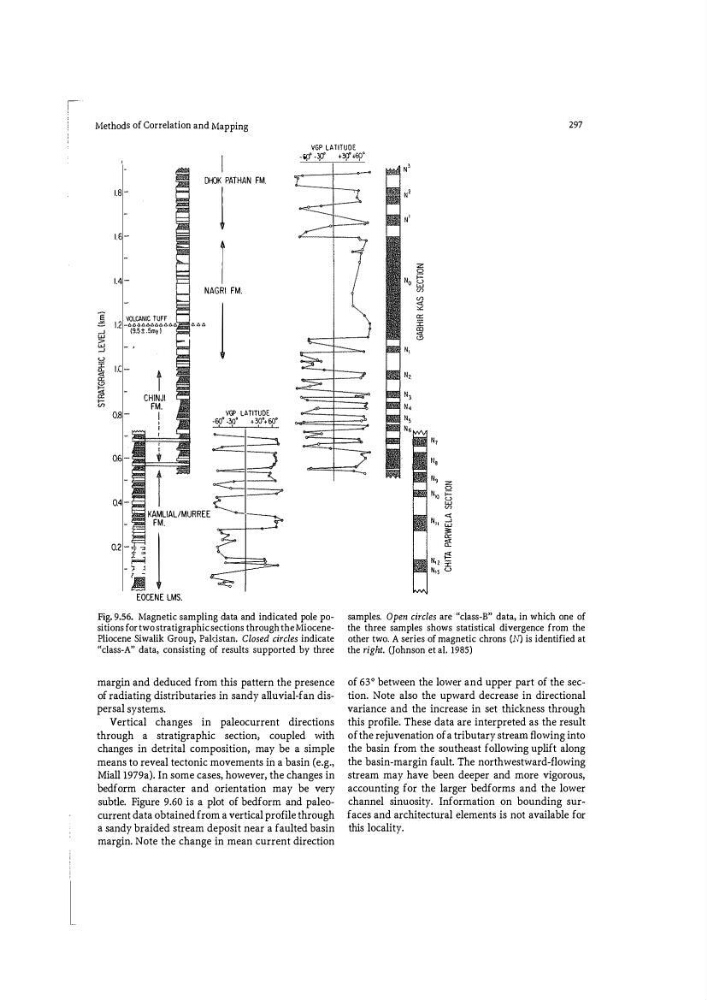
Fig. 9.56. Magnetic sampling data and indicated pole positions for two stratigraphic sections through the Miocene�
Pliocene Siwalik Group, Paldstan. Closed circles indicate
"class-A" data, consisting of results supported by three
margin and deduced from this pattern the presence
of radiating distributaries in sandy alluvial-fan dispersal systems.
Vertical changes in paleocurrent directions
through a stratigraphic section, coupled with
changes in detrital composition, may be a simple
means to reveal tectonic movements in a basin (e.g.,
Miall l979a). In some cases, however, the changes in
bedform character and orientation may be very
subtle. Figure 9.60 is a plot of bedform and paleocurrent data obtained from a vertical profile through
a sandy braided stream deposit near a faulted basin
margin. Note the change in mean current direction
samples. Open circles are "class-B" data, in whkh one of
the three samples shows statistical divergence from the
other two. A series of magnetic chrons (N) is identified at
the right. (Johnson et al. 1985)
of 63" between the lower and upper part of the section. Note also the upwar-d decrease in directional
variance and the increase in set thickness through
this profile. These data are interpreted as the result
of the rejuvenation of a tributary stream flowing into
the basin from the southeast following uplift along
the basin-margin fault. The northwestward-flowing
stream may have been deeper and more vigorous,
accounting for the larger bedforms and the lower
channel sinuosity. Information on bounding surfaces and architectural elements is not available for
this locality.
297
VGP LATITUDE
-flf -Yf
+W' +60"
1.8
1.6
1.4
0.8
0.6
0.4
DHOK PAT HAN FM.
1
r
NAGRI FM.
t
CHINJI
FM.
I
'
'
'
KAMLIAL/MURREE
FM.
j
VGP LATITUDE
-f.J:/ -30°
+ 30�� 60�
0.1
�
j
ri
1 -
�
EOCENE LMS.
Fig. 9.56. Magnetic sampling data and indicated pole positions for two stratigraphic sections through the Miocene�
Pliocene Siwalik Group, Paldstan. Closed circles indicate
"class-A" data, consisting of results supported by three
margin and deduced from this pattern the presence
of radiating distributaries in sandy alluvial-fan dispersal systems.
Vertical changes in paleocurrent directions
through a stratigraphic section, coupled with
changes in detrital composition, may be a simple
means to reveal tectonic movements in a basin (e.g.,
Miall l979a). In some cases, however, the changes in
bedform character and orientation may be very
subtle. Figure 9.60 is a plot of bedform and paleocurrent data obtained from a vertical profile through
a sandy braided stream deposit near a faulted basin
margin. Note the change in mean current direction
samples. Open circles are "class-B" data, in whkh one of
the three samples shows statistical divergence from the
other two. A series of magnetic chrons (N) is identified at
the right. (Johnson et al. 1985)
of 63" between the lower and upper part of the section. Note also the upwar-d decrease in directional
variance and the increase in set thickness through
this profile. These data are interpreted as the result
of the rejuvenation of a tributary stream flowing into
the basin from the southeast following uplift along
the basin-margin fault. The northwestward-flowing
stream may have been deeper and more vigorous,
accounting for the larger bedforms and the lower
channel sinuosity. Information on bounding surfaces and architectural elements is not available for
this locality.