

l
Methods of Correlation and Mapping
GEOGRA PHICAL SCALE
Son
Juon
Basin
L_j
50 km
DEPOSITIONAL ELEMENT
<-- lsd ( 1320 It I 402 m ouoss )
100 m
fifth-order surfaces, recording successive positions
of a channel as it migrated laterally, or they may be
third-order surfaces, indicating erosional breaks in
the filling of the channel by lateral or downstream
accretion.
9.5.4 Seismic Methods
Many of the major structural features typically associated with fluvial deposits are readily detectable on
reflection-seismic records. For example, as shown in
Chap. 11, thick clastic wedges are likely to be associated with rift faults or fold-thrust belts, and regional
unconformities may be crossed by incised paleovalleys filled with fluvial deposits. These large-scale
SUBSURFACE
MAPPING
METHODS
correlation
of
wireline
logs
correlation
of
core ?
283
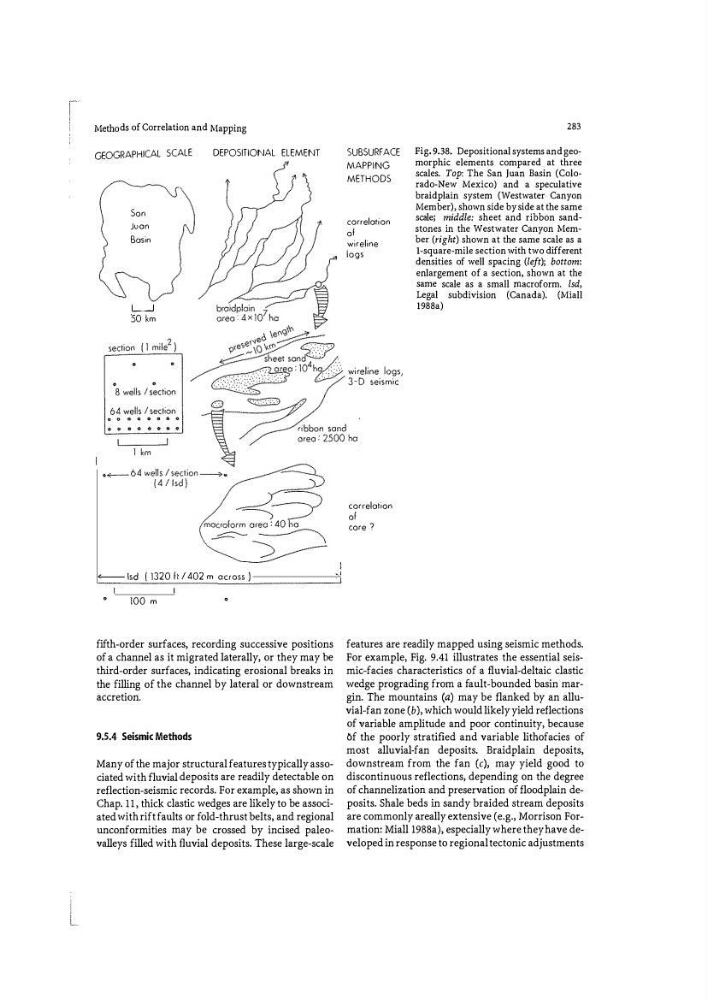
Fig. 9.38. Depositional systems and geomorphic elements compared at three
scales. Top: The San Juan Basin (Colorado-New Mexico) and a speculative
braidplain system (Westwater Canyon
Member), shown side by side at the same
scale; middle: sheet and ribbon sandstones in the Westwater Canyon Member (right) shown at the same scale as a
1-square-mile section with two different
densities of well spacing (left); bottom:
enlargement of a section, shown at the
same scale as a small rnacroform. lsd,
Legal subdivision (Canada). (Miall
1988a)
features are readily mapped using seismic methods.
For example, Fig. 9.41 illustrates the essential seis�
mic-facies characteristics of a fl uvial-deltaic clastic
wedge prograding from a fa ult-bounded basin margin. The mountains (a) may be flanked by an alluvial-fan zone (b), which would likely yield reflections
of variable amplitude and poor continuity, because
bf the poorly stratified and variable lithofacies of
most alluvial"fan deposits. Braidplain deposits,
downstream from the fan (c), may yield good to
discontinuous reflections, depending on the degree
of channelization and preservation of floodplain deposits. Shale beds in sandy braided stream deposits
are commonly areally extensive (e.g., Morrison Formation: Miall 1988a), especially where they have developed in response to regional tectonic adjustments
Methods of Correlation and Mapping
GEOGRA PHICAL SCALE
Son
Juon
Basin
L_j
50 km
DEPOSITIONAL ELEMENT
<-- lsd ( 1320 It I 402 m ouoss )
100 m
fifth-order surfaces, recording successive positions
of a channel as it migrated laterally, or they may be
third-order surfaces, indicating erosional breaks in
the filling of the channel by lateral or downstream
accretion.
9.5.4 Seismic Methods
Many of the major structural features typically associated with fluvial deposits are readily detectable on
reflection-seismic records. For example, as shown in
Chap. 11, thick clastic wedges are likely to be associated with rift faults or fold-thrust belts, and regional
unconformities may be crossed by incised paleovalleys filled with fluvial deposits. These large-scale
SUBSURFACE
MAPPING
METHODS
correlation
of
wireline
logs
correlation
of
core ?
283
Fig. 9.38. Depositional systems and geomorphic elements compared at three
scales. Top: The San Juan Basin (Colorado-New Mexico) and a speculative
braidplain system (Westwater Canyon
Member), shown side by side at the same
scale; middle: sheet and ribbon sandstones in the Westwater Canyon Member (right) shown at the same scale as a
1-square-mile section with two different
densities of well spacing (left); bottom:
enlargement of a section, shown at the
same scale as a small rnacroform. lsd,
Legal subdivision (Canada). (Miall
1988a)
features are readily mapped using seismic methods.
For example, Fig. 9.41 illustrates the essential seis�
mic-facies characteristics of a fl uvial-deltaic clastic
wedge prograding from a fa ult-bounded basin margin. The mountains (a) may be flanked by an alluvial-fan zone (b), which would likely yield reflections
of variable amplitude and poor continuity, because
bf the poorly stratified and variable lithofacies of
most alluvial"fan deposits. Braidplain deposits,
downstream from the fan (c), may yield good to
discontinuous reflections, depending on the degree
of channelization and preservation of floodplain deposits. Shale beds in sandy braided stream deposits
are commonly areally extensive (e.g., Morrison Formation: Miall 1988a), especially where they have developed in response to regional tectonic adjustments