

284
The Stratigraphic Architecture of Fluvial Depositional Systems
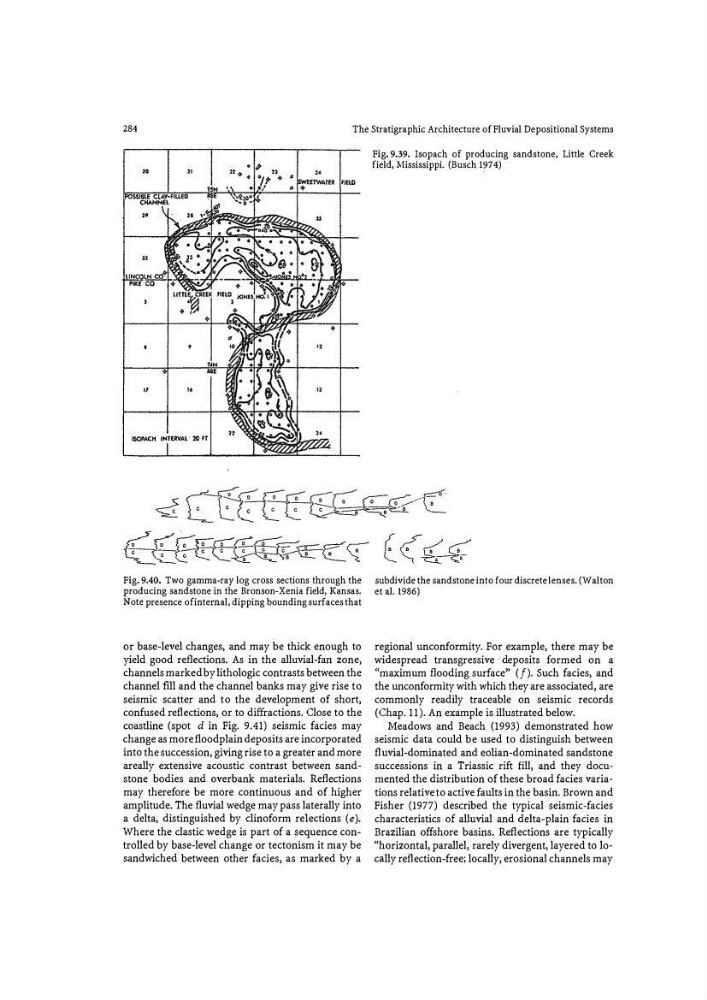
Fig. 9.40. Two gamma�ray log cross sections through the
producing sandstone in the Bronson-Xenia field, Kansas.
Note presence of internal, dipping bounding surfaces that
or base-level changes, and may be thick enough to
yield good reflections. As in the alluvial-fan zone,
channels marked by lithologic contrasts between the
channel fill and the channel banks may give rise to
seismic scatter and to the development of short,
confused reflections, or to diffractions. Close to the
coastline (spot d in Fig. 9.41) seismic facies may
change as more floodplain deposits are incorporated
into the succession, giving rise to a greater and more
areally extensive acoustic contrast between sandstone bodies and overbank materials. Refl ections
may therefore be more continuous and of higher
amplitude. The fluvial wedge may pass laterally into
a delta, distingnished by clinoform reJections (e).
Where the clastic wedge is part of a sequence controlled by base-level change or tectonism it may be
sandwiched between other facies, as marked by a
Fig. 9.39. Isopach of producing sandstone, Little Creek
field, Mississippi. (Busch 1?74)
subdivide the sandstone into four discrete lenses. (Walton
et al. !986)
regional unconformity. For example, there may be
widespread transgressive ·d eposits formed on a
"maximum flooding surface" (f). Such facies, and
the unconformity with which they are associated1 are
commonly readily traceable on seismic records
(Chap. 11). An example is illustrated below.
Meadows and Beach (1993) demonstrated how
seismic data could be used to distinguish between
fluvial-dominated and eolian-dominated sandstone
successions in a Triassic rift fill, and they documented the distribution of these broad facies variations relative to active faults in the basin. Brown and
Fisher (1977) described the typical seismic-facies
characteristics of alluvial and delta-plain facies in
Brazilian offshore basins. Reflections are typically
"horizontal, parallel, rarely divergent, layered to locally reflection-free; locally, erosional channels may
The Stratigraphic Architecture of Fluvial Depositional Systems
Fig. 9.40. Two gamma�ray log cross sections through the
producing sandstone in the Bronson-Xenia field, Kansas.
Note presence of internal, dipping bounding surfaces that
or base-level changes, and may be thick enough to
yield good reflections. As in the alluvial-fan zone,
channels marked by lithologic contrasts between the
channel fill and the channel banks may give rise to
seismic scatter and to the development of short,
confused reflections, or to diffractions. Close to the
coastline (spot d in Fig. 9.41) seismic facies may
change as more floodplain deposits are incorporated
into the succession, giving rise to a greater and more
areally extensive acoustic contrast between sandstone bodies and overbank materials. Refl ections
may therefore be more continuous and of higher
amplitude. The fluvial wedge may pass laterally into
a delta, distingnished by clinoform reJections (e).
Where the clastic wedge is part of a sequence controlled by base-level change or tectonism it may be
sandwiched between other facies, as marked by a
Fig. 9.39. Isopach of producing sandstone, Little Creek
field, Mississippi. (Busch 1?74)
subdivide the sandstone into four discrete lenses. (Walton
et al. !986)
regional unconformity. For example, there may be
widespread transgressive ·d eposits formed on a
"maximum flooding surface" (f). Such facies, and
the unconformity with which they are associated1 are
commonly readily traceable on seismic records
(Chap. 11). An example is illustrated below.
Meadows and Beach (1993) demonstrated how
seismic data could be used to distinguish between
fluvial-dominated and eolian-dominated sandstone
successions in a Triassic rift fill, and they documented the distribution of these broad facies variations relative to active faults in the basin. Brown and
Fisher (1977) described the typical seismic-facies
characteristics of alluvial and delta-plain facies in
Brazilian offshore basins. Reflections are typically
"horizontal, parallel, rarely divergent, layered to locally reflection-free; locally, erosional channels may