

Methods of Correlation and Mapping
50 km
24
Mapping of ribbon sandstone bodies in the subsurface can cause particularly difficult problems,
because the width of the sandstone bodies is usually
less than well spacing, except in densly drilled fields.
In addition, it may be difficult on wireline logs to
discriminate between channel sandstones and the
various overbank sandy facies, including levees and
splays, which may occupy a much wider belt flanking
the channel than the channel itself. An example of
the problems in interpretation that can arise is the
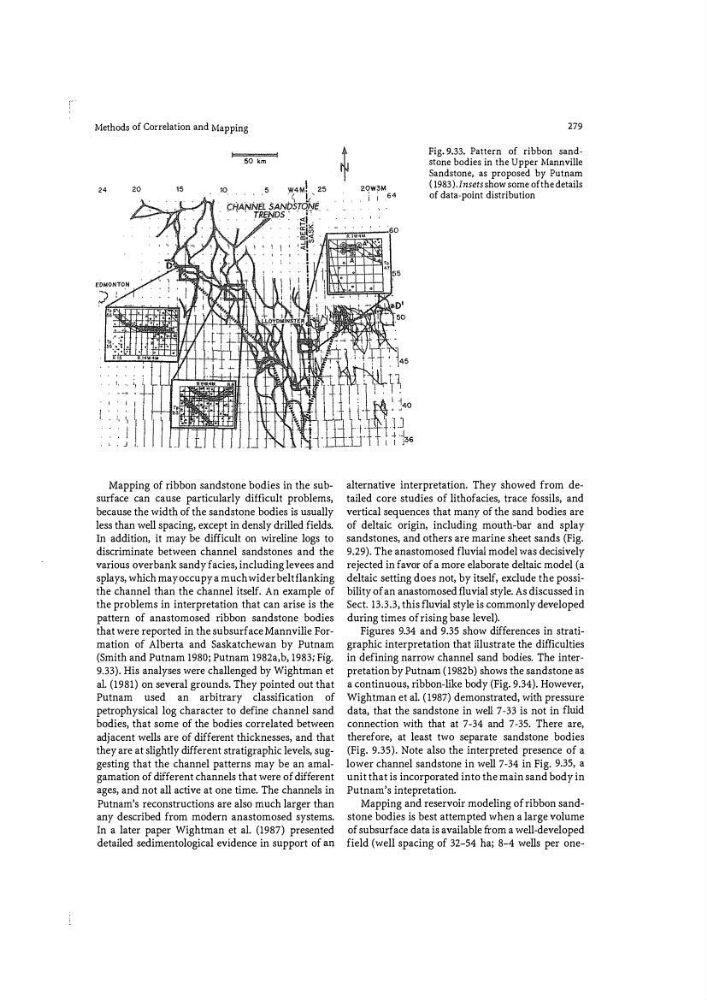
pattern of anastomosed ribbon sandstone bodies
that were reported in the subsurface Mannville Formation of Alberta and Saskatchewan by Putnam
(Smith and Putnam 1980; Putnam 1982a,b, 1983; Fig.
9.33). His analyses were challenged by Wightman et
a!. (1981) on several grounds. They pointed out that
Putnam used an arbitrary classification of
petrophysical log character to define channel sand
bodies, that some of the bodies correlated between
adj acent wells are of different thicknesses, and that
they are at slightly different stratigraphic levels, suggesting that the channel patterns may be an amalgamation of different channels that were of different
ages, and not all active at one time. The channels in
Putnam's reconstructions are also much larger than
any described from modern anastomosed systems.
In a later paper Wightman et a!. (1987) presented
detailed sedimentological evidence in support of an
20W:3M
' i .64
279
Fig. 9.33. Pattern of ribbon sandstone bodies in the Upper Mannville
Sandstone, as proposed by Putnam
( 1983 ), Insets show some of the details
of data-point distribution
alternative interpretation. They showed from detailed core studies of lithofacies, trace fo ssils, and
vertical sequences that many of the sand bodies are
of deltaic origin, including mouth-bar and splay
sandstones, and others are marine sheet sands (Fig.
9.29). The anastomosed fluvial model was decisively
rejected in favor of a more elaborate deltaic model (a
deltaic setting does not, by itself, exclude the possibility of an anastomosed fluvial style. As discussed in
Sect. 13.3.3, this fluvial style is commonly developed
during times of rising base level).
Figures 9.34 and 9.35 show differences in stratigraphic interpretation that illustrate the difficulties
in defining narrow channel sand bodies. The interpretation by Putnam (1982b) shows the sandstone as
a continuous, ribbon-like body (Fig. 9.34). However,
Wightman et al. (1987) demonstrated, with pressure
data, that the sandstone in well 7-33 is not in fluid
connection with that at 7-34 and 7-35. There are,
therefore, at least two separate sandstone bodies
(Fig. 9.35). Note also the interpreted presence of a
lower channel sandstone in well 7-34 in Fig. 9.35, a
unit that is incorporated into the main sand body in
Putnam's intepretation.
Mapping and reservoir modeling of ribbon sandstone bodies is best attempted when a large volume
of subsurface data is available fr om a well-developed
field (well spacing of 32-54 ha; 8-4 wells per one-
50 km
24
Mapping of ribbon sandstone bodies in the subsurface can cause particularly difficult problems,
because the width of the sandstone bodies is usually
less than well spacing, except in densly drilled fields.
In addition, it may be difficult on wireline logs to
discriminate between channel sandstones and the
various overbank sandy facies, including levees and
splays, which may occupy a much wider belt flanking
the channel than the channel itself. An example of
the problems in interpretation that can arise is the
pattern of anastomosed ribbon sandstone bodies
that were reported in the subsurface Mannville Formation of Alberta and Saskatchewan by Putnam
(Smith and Putnam 1980; Putnam 1982a,b, 1983; Fig.
9.33). His analyses were challenged by Wightman et
a!. (1981) on several grounds. They pointed out that
Putnam used an arbitrary classification of
petrophysical log character to define channel sand
bodies, that some of the bodies correlated between
adj acent wells are of different thicknesses, and that
they are at slightly different stratigraphic levels, suggesting that the channel patterns may be an amalgamation of different channels that were of different
ages, and not all active at one time. The channels in
Putnam's reconstructions are also much larger than
any described from modern anastomosed systems.
In a later paper Wightman et a!. (1987) presented
detailed sedimentological evidence in support of an
20W:3M
' i .64
279
Fig. 9.33. Pattern of ribbon sandstone bodies in the Upper Mannville
Sandstone, as proposed by Putnam
( 1983 ), Insets show some of the details
of data-point distribution
alternative interpretation. They showed from detailed core studies of lithofacies, trace fo ssils, and
vertical sequences that many of the sand bodies are
of deltaic origin, including mouth-bar and splay
sandstones, and others are marine sheet sands (Fig.
9.29). The anastomosed fluvial model was decisively
rejected in favor of a more elaborate deltaic model (a
deltaic setting does not, by itself, exclude the possibility of an anastomosed fluvial style. As discussed in
Sect. 13.3.3, this fluvial style is commonly developed
during times of rising base level).
Figures 9.34 and 9.35 show differences in stratigraphic interpretation that illustrate the difficulties
in defining narrow channel sand bodies. The interpretation by Putnam (1982b) shows the sandstone as
a continuous, ribbon-like body (Fig. 9.34). However,
Wightman et al. (1987) demonstrated, with pressure
data, that the sandstone in well 7-33 is not in fluid
connection with that at 7-34 and 7-35. There are,
therefore, at least two separate sandstone bodies
(Fig. 9.35). Note also the interpreted presence of a
lower channel sandstone in well 7-34 in Fig. 9.35, a
unit that is incorporated into the main sand body in
Putnam's intepretation.
Mapping and reservoir modeling of ribbon sandstone bodies is best attempted when a large volume
of subsurface data is available fr om a well-developed
field (well spacing of 32-54 ha; 8-4 wells per one-