

274
The Stratigraphic Architecture of Fluvial Depositional Systems
of"clayeyness'\ which is normally inversely proportional to grain size. However, the presence of clayrich clasts in an otherwise clean, coarse sandstone
may distort the reading (Fig. 9.27), and feldspar-rich
sandstones (e.g., "granite wash") also yield high
gamma-ray readings because of their high potassium content. Other problems with interpretation
are addressed by Rider (1990).
A quite different type of problem is that, as discussed in Chap. 8, fining-upward cycles in fluvial
deposits are not amenable to unique interpretations.
Channel fill and abandonment, point bar growth,
and certain tectonic processes can all yield finingupward cycles and corresponding bell-shaped log
patterns. In the first instance, attention should be
paid to the scale of the cycle. Cycles thicker than
BALD Hli
OPERATIONAL WIT
UPPE R BU..GO
OPERA TfONAL UNfT
G
N
about 20 m are unlikely to be the product of withinchannel (autogenic) processes and are more probably related to allogenic causes, such as sequence
development or tectonic pulses.
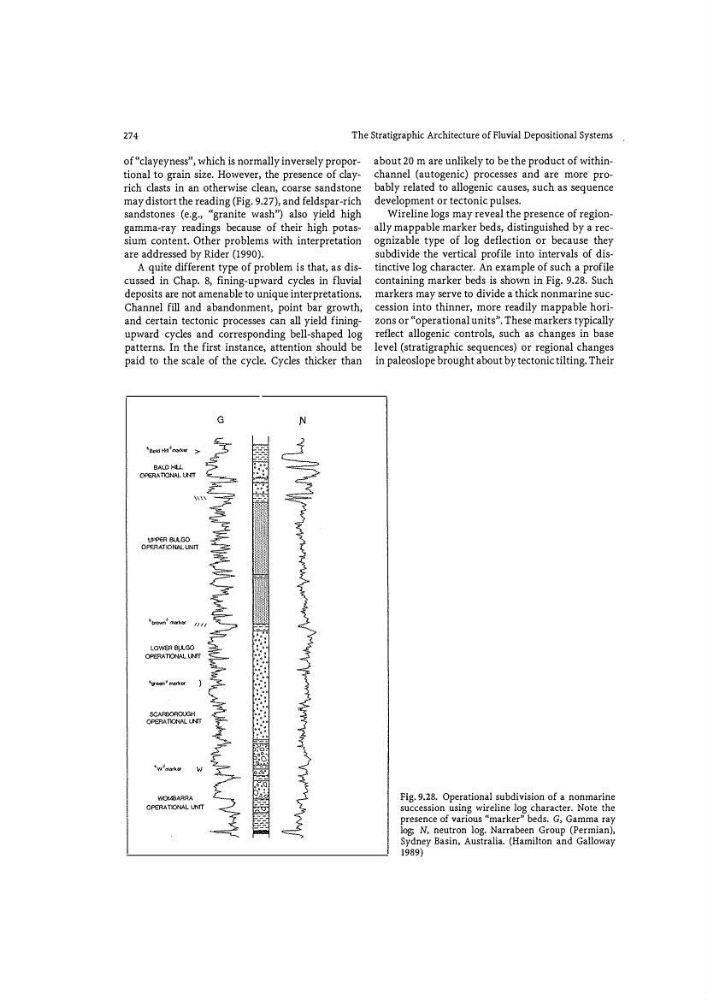
Wireline logs may reveal the presence of region�
ally mappable marker beds, distinguished by a recognizable type of log deflection or because they
subdivide the vertical profile into intervals of distinctive log character. An example of such a profile
containing marker beds is sho'WTI in Fig. 9.28. Such
markers may serve to divide a thick nonmarine sue�
cession into thinner, more readily mappable horizons or "operational units». These markers typically
reflect allogenic controls, such as changes in base
level (stratigraphic sequences) or regional changes
in paleoslope brought about by tectonic tilting. Their
Fig. 9.28. Operational subdivision of a nonmarine
succession using wireline log character. Note the
presence of various "marker" beds. G, Gamma ray
log; N, neutron log. Narrabeen Group (Permian),
Sydney Basin, Australia. (Hamilton and Galloway
1989)
The Stratigraphic Architecture of Fluvial Depositional Systems
of"clayeyness'\ which is normally inversely proportional to grain size. However, the presence of clayrich clasts in an otherwise clean, coarse sandstone
may distort the reading (Fig. 9.27), and feldspar-rich
sandstones (e.g., "granite wash") also yield high
gamma-ray readings because of their high potassium content. Other problems with interpretation
are addressed by Rider (1990).
A quite different type of problem is that, as discussed in Chap. 8, fining-upward cycles in fluvial
deposits are not amenable to unique interpretations.
Channel fill and abandonment, point bar growth,
and certain tectonic processes can all yield finingupward cycles and corresponding bell-shaped log
patterns. In the first instance, attention should be
paid to the scale of the cycle. Cycles thicker than
BALD Hli
OPERATIONAL WIT
UPPE R BU..GO
OPERA TfONAL UNfT
G
N
about 20 m are unlikely to be the product of withinchannel (autogenic) processes and are more probably related to allogenic causes, such as sequence
development or tectonic pulses.
Wireline logs may reveal the presence of region�
ally mappable marker beds, distinguished by a recognizable type of log deflection or because they
subdivide the vertical profile into intervals of distinctive log character. An example of such a profile
containing marker beds is sho'WTI in Fig. 9.28. Such
markers may serve to divide a thick nonmarine sue�
cession into thinner, more readily mappable horizons or "operational units». These markers typically
reflect allogenic controls, such as changes in base
level (stratigraphic sequences) or regional changes
in paleoslope brought about by tectonic tilting. Their
Fig. 9.28. Operational subdivision of a nonmarine
succession using wireline log character. Note the
presence of various "marker" beds. G, Gamma ray
log; N, neutron log. Narrabeen Group (Permian),
Sydney Basin, Australia. (Hamilton and Galloway
1989)