

264
The Stratigraphic Architecture of Fluvial Depositional Systems
book (Table 9.1). They may contain a signifi cant
fluvial component, representing incised valley fi lls
deposited following the period of maximum regression. Two typical Illinois-type cyclothems are illustrated in Fig. 9.16, and their origins are discussed
further in Chap. 13. Similar regressive fl uvial-deltaic
sandstones, termed ''grits
,
' in the older literature,
form regressive units in comparable British
cyclothems (Ramsbottom 1979; Holdsworth and
Collinson 1988). Note the confusion in terminology
for these cycles: In Heckel's (1986) work on the
Pennsylvanian rocks of the Midcontinent of the
United States these cycles constitute the larger scale
of cyclicity, and they are termed "major cycles".
The study by Holdsworth and Collinson (1988) of
similar cyclicity in rocks of broadly comparable age
in Britain refers to cycles of similar lOLyearduration
as «minor cycleS'\ compared with the major cycles,
or ''mesothems" of Ramsbottom (1979).
"'
>
..
"'
>
...
:1>
c:
Q
c:
1<1----------Latot
Simonetta
G
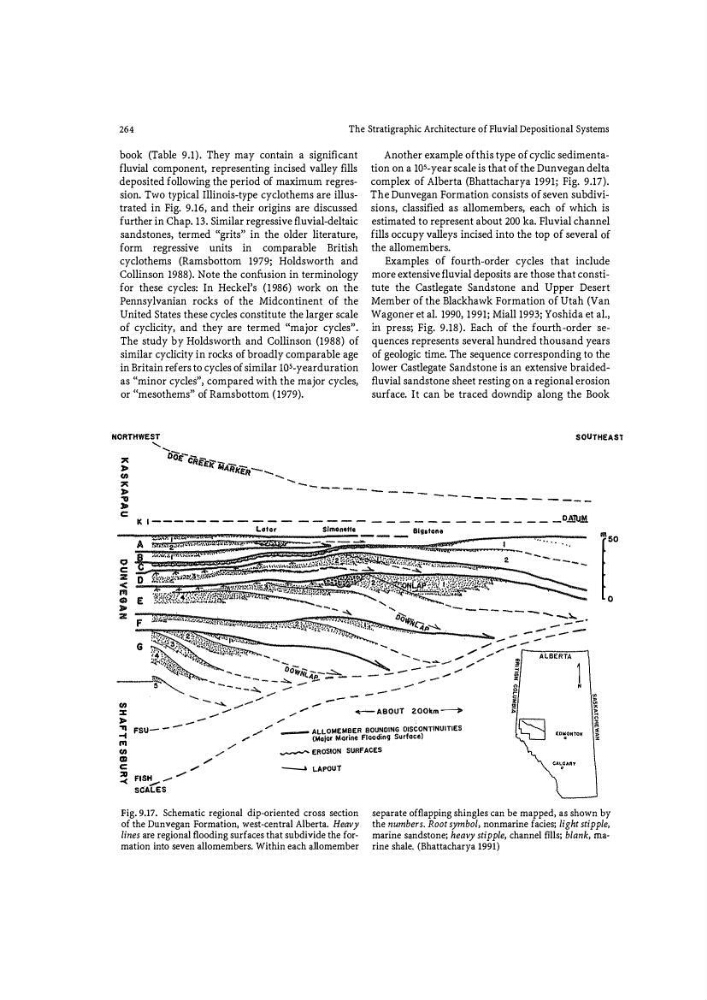
Another example of this type of cyclic sedimentation on a 105-year scale is that of the Dunvegan delta
complex of Alberta (Bhattacharya 1991; Fig. 9.17).
The Dunvegan Formation consists of seven subdivisions, classifi ed as allomembers, each of which is
estimated to represent about 200 ka. Fluvial channel
fills occupy valleys incised into the top of several of
the allomembers.
Examples of fo urth-order cycles that include
more extensive fluvial deposits are those that constitute the Castlegate Sandstone and Upper Desert
Member of the Blackhawk Formation of Utah (Van
Wagoner et al. 1990, 1991; Miall 1993; Yoshida et al.,
in press; Fig. 9.18). Each of the fourth-order sequences represents several hundred thousand years
of geologic time. The sequence corresponding to the
lower Castlegate Sandstone is an extensive braidedfluvial sandstone sheet resting on a regional erosion
surface. It can be traced downdip along the Book
SOUTHEAS'r
--- - - - -- - - -________ __ __ __ O.e,TUji
Blgatone
- - - ---- - - -- -- �
- -
- ·
- - - - -
.... ..
.,... .. - -- -
-
/
.,.. .... .. .
r--,.==,... .....,
-
/
/
ALBERTA
.... .. -:::;: ::- _
/
�
-
- -
_
.... .
i
1
r
-- -
-
"'
"'
/
/
-
-
.... ..,_ ABOUT 200km ---i>'
)>
- -
-
� Fsu- -
/
/
ALLOMEMBER BOUNCING 0\SCONT\NUIT\ ES
/
- (Mojor Morine Flooding Surface)
"'
..
/
/
�E ROSION SURFACES
"'
c
"'
-<
:�:u; '
/
/
----.1 t.. APOUT
Fig. 9.17. Schematic regional dip-oriented cross section
of the Dunvegan Formation, west-central Alberta. Heavy
lines are regional flooding surfaces that subdivide the formation into seven allomembers. Within each allomember
separate offl apping shingles can be mapped, as shown by
the numbers. Root symbol, nonmarine facies; light stipple,
marine sandstone; heavy stipple, channel fi lls; blank, rna�
rine shale. (Bhattacharya 1991)
The Stratigraphic Architecture of Fluvial Depositional Systems
book (Table 9.1). They may contain a signifi cant
fluvial component, representing incised valley fi lls
deposited following the period of maximum regression. Two typical Illinois-type cyclothems are illustrated in Fig. 9.16, and their origins are discussed
further in Chap. 13. Similar regressive fl uvial-deltaic
sandstones, termed ''grits
,
' in the older literature,
form regressive units in comparable British
cyclothems (Ramsbottom 1979; Holdsworth and
Collinson 1988). Note the confusion in terminology
for these cycles: In Heckel's (1986) work on the
Pennsylvanian rocks of the Midcontinent of the
United States these cycles constitute the larger scale
of cyclicity, and they are termed "major cycles".
The study by Holdsworth and Collinson (1988) of
similar cyclicity in rocks of broadly comparable age
in Britain refers to cycles of similar lOLyearduration
as «minor cycleS'\ compared with the major cycles,
or ''mesothems" of Ramsbottom (1979).
"'
>
..
"'
>
...
:1>
c:
Q
c:
1<1----------Latot
Simonetta
G
Another example of this type of cyclic sedimentation on a 105-year scale is that of the Dunvegan delta
complex of Alberta (Bhattacharya 1991; Fig. 9.17).
The Dunvegan Formation consists of seven subdivisions, classifi ed as allomembers, each of which is
estimated to represent about 200 ka. Fluvial channel
fills occupy valleys incised into the top of several of
the allomembers.
Examples of fo urth-order cycles that include
more extensive fluvial deposits are those that constitute the Castlegate Sandstone and Upper Desert
Member of the Blackhawk Formation of Utah (Van
Wagoner et al. 1990, 1991; Miall 1993; Yoshida et al.,
in press; Fig. 9.18). Each of the fourth-order sequences represents several hundred thousand years
of geologic time. The sequence corresponding to the
lower Castlegate Sandstone is an extensive braidedfluvial sandstone sheet resting on a regional erosion
surface. It can be traced downdip along the Book
SOUTHEAS'r
--- - - - -- - - -________ __ __ __ O.e,TUji
Blgatone
- - - ---- - - -- -- �
- -
- ·
- - - - -
.... ..
.,... .. - -- -
-
/
.,.. .... .. .
r--,.==,... .....,
-
/
/
ALBERTA
.... .. -:::;: ::- _
/
�
-
- -
_
.... .
i
1
r
-- -
-
"'
"'
/
/
-
-
.... ..,_ ABOUT 200km ---i>'
)>
- -
-
� Fsu- -
/
/
ALLOMEMBER BOUNCING 0\SCONT\NUIT\ ES
/
- (Mojor Morine Flooding Surface)
"'
..
/
/
�E ROSION SURFACES
"'
c
"'
-<
:�:u; '
/
/
----.1 t.. APOUT
Fig. 9.17. Schematic regional dip-oriented cross section
of the Dunvegan Formation, west-central Alberta. Heavy
lines are regional flooding surfaces that subdivide the formation into seven allomembers. Within each allomember
separate offl apping shingles can be mapped, as shown by
the numbers. Root symbol, nonmarine facies; light stipple,
marine sandstone; heavy stipple, channel fi lls; blank, rna�
rine shale. (Bhattacharya 1991)