

Depositi onal Systems
jzed by stages 1-3, whereas at the top they are typically stages 3) 41 and rarely 5. She termed such longterm changes ''pedofacies megasequences )) and
attributed them to changes in deposition rates. In
the Willwood example it seems likely that the basin
subsidence rate decreased during accumulation of
this formation, permitting individual paleosols to
mature for longer periods before being covered by
overbank flooding. Atkinson (1986) described variations in paleosol character displayed laterally on a
regional scale and interpreted the variations in terms
Shale, marine (contain.!>
near-shore invertebrates}
Coo!
Underclay
Nonmarine shale, commonly
sandy
Nonmarine sandstone
Disconformity ---Shale (marine)
Algal limestone {contains
1���1 near-shore invertebrates)
Limestone (contains far
off-shore invertebrates,
especially fusulinids )·
Limestone, shaly (conto1'ns
intermediate off-shore
invertebrates)
Shale, marine (contains
near-shore invertebrates)
Coo!
Nonmarine
263
of differences in drainage conditions and fl uvial topography related to differential subsidence within a
foreland basin. This is an example of a paleosol
catena controlled by tectonism. Examples from the
Recent were described from the Gangetic plains of
India by Srivastava et a!. (1994), who attributed local
changes in fl uvial style and paleosol character to
neotectonic movements of the basin.
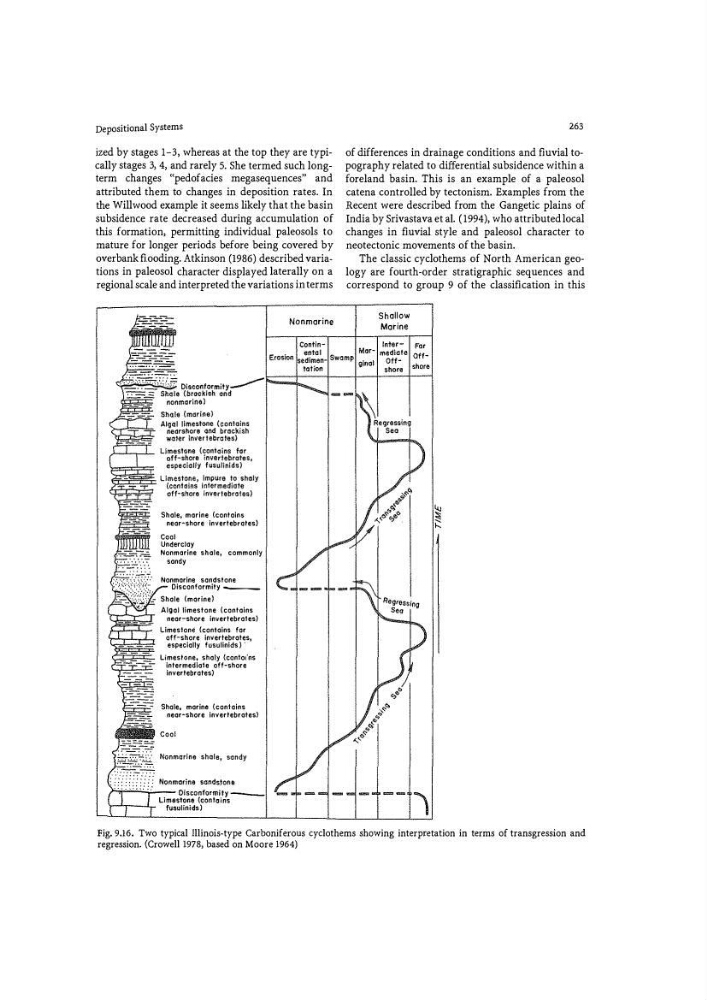
The classic cyclothems of North American geology are fourth-order stratigraphic sequences and
correspond to group 9 of the classification in this
Shallow
Marine
Fig. 9.16. Two typical Illinois-type Carboniferous cyclothems showing interpretation in terms of transgression and
regression. (Crowell l978, based on Moore 1964)
jzed by stages 1-3, whereas at the top they are typically stages 3) 41 and rarely 5. She termed such longterm changes ''pedofacies megasequences )) and
attributed them to changes in deposition rates. In
the Willwood example it seems likely that the basin
subsidence rate decreased during accumulation of
this formation, permitting individual paleosols to
mature for longer periods before being covered by
overbank flooding. Atkinson (1986) described variations in paleosol character displayed laterally on a
regional scale and interpreted the variations in terms
Shale, marine (contain.!>
near-shore invertebrates}
Coo!
Underclay
Nonmarine shale, commonly
sandy
Nonmarine sandstone
Disconformity ---Shale (marine)
Algal limestone {contains
1���1 near-shore invertebrates)
Limestone (contains far
off-shore invertebrates,
especially fusulinids )·
Limestone, shaly (conto1'ns
intermediate off-shore
invertebrates)
Shale, marine (contains
near-shore invertebrates)
Coo!
Nonmarine
263
of differences in drainage conditions and fl uvial topography related to differential subsidence within a
foreland basin. This is an example of a paleosol
catena controlled by tectonism. Examples from the
Recent were described from the Gangetic plains of
India by Srivastava et a!. (1994), who attributed local
changes in fl uvial style and paleosol character to
neotectonic movements of the basin.
The classic cyclothems of North American geology are fourth-order stratigraphic sequences and
correspond to group 9 of the classification in this
Shallow
Marine
Fig. 9.16. Two typical Illinois-type Carboniferous cyclothems showing interpretation in terms of transgression and
regression. (Crowell l978, based on Moore 1964)