

Basin-fi ll Comple xes
265
I LEGEND I
,.- -- -- -- --, LOCATION
PC
60
MAP
grain size
8 Type ! Sequence Boundary ( 3rd order )
@ Type I Sequence Boundary (4th order )
fliil l Highstand systems Lract
ITITJ Transgressive systems Lract
[1§IJ Lowstand systems tract
Environment
� open marine
lliiil l shallow marine
8 estuarine
eiJ deltaic distributary channel
0 coastal plaln /lagoonal
§ tidally- influenced fluvial
a braided fluvial (sand- shale)
r::: :3
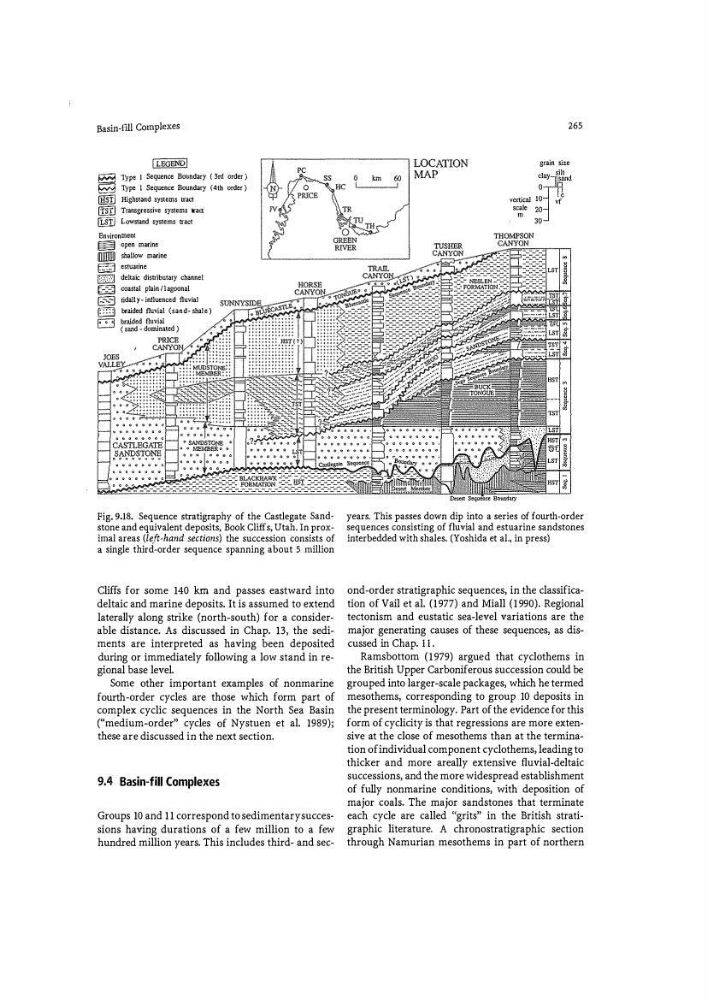
Fig. 9.18. Sequence stratigraphy of the Castlegate Sandstone and equivalent deposits, Book Cliffs, Utah. In proximal areas (left-hand sections) the succession consists of
a single third-order sequence spanning about 5 million
Cliffs for some 140 km and passes eastward into
deltaic and marine deposits. It is assumed to extend
laterally along strike (north-south) for a considerable distance. As discussed in Chap. 13, the sediments are interpreted as having been deposited
during or immediately fo llowing a low stand in regional base level.
Some other important examples of nonmarine
fourth-order cycles are those which form part of
complex cyclic sequences in the North Sea Basin
("medium-order" cycles of Nystuen et al. 1989);
these are discussed in the next section.
9.4 Basin-fill Complexes
Groups 10 and 11 correspond to sedimentary successions having durations of a few million to a few
hundred million years. This includes third- and sec0
in
T � � � ,
vertical 10
v f
c
scale 20
m
30
years. This passes down dip into a series of fourth-order
sequences consisting of fluvial and estuarine sandstones
interbedded with shales. (Yoshida et al., in press)
ond-order stratigraphic sequences, in the classification of Vail et al. (1977) and Miall (1990). Regional
tectonism and eustatic sea-level variations are the
major generating causes of these sequences, as discussed in Chap. ll.
Ramsbottom (1979) argued that cyclothems in
the British Upper Carboniferous succession could be
grouped into larger-scale packages, which he termed
mesothems, corresponding to group 10 deposits in
the present terminology. Part of the evidence for this
form of cyclicity is that regressions are more extensive at the close of mesothems than at the termination of individual component cyclothems, leading to
thicker and more areally extensive fluvial-deltaic
successions, and the more widespread establishment
of fully nonmarine conditions, with deposition of
major coals. The major sandstones that terminate
each cycle are called '(grits" in the British stratigraphic literature. A chronostratigraphic section
through Namurian mesothems in part of northern
265
I LEGEND I
,.- -- -- -- --, LOCATION
PC
60
MAP
grain size
8 Type ! Sequence Boundary ( 3rd order )
@ Type I Sequence Boundary (4th order )
fliil l Highstand systems Lract
ITITJ Transgressive systems Lract
[1§IJ Lowstand systems tract
Environment
� open marine
lliiil l shallow marine
8 estuarine
eiJ deltaic distributary channel
0 coastal plaln /lagoonal
§ tidally- influenced fluvial
a braided fluvial (sand- shale)
r::: :3
Fig. 9.18. Sequence stratigraphy of the Castlegate Sandstone and equivalent deposits, Book Cliffs, Utah. In proximal areas (left-hand sections) the succession consists of
a single third-order sequence spanning about 5 million
Cliffs for some 140 km and passes eastward into
deltaic and marine deposits. It is assumed to extend
laterally along strike (north-south) for a considerable distance. As discussed in Chap. 13, the sediments are interpreted as having been deposited
during or immediately fo llowing a low stand in regional base level.
Some other important examples of nonmarine
fourth-order cycles are those which form part of
complex cyclic sequences in the North Sea Basin
("medium-order" cycles of Nystuen et al. 1989);
these are discussed in the next section.
9.4 Basin-fill Complexes
Groups 10 and 11 correspond to sedimentary successions having durations of a few million to a few
hundred million years. This includes third- and sec0
in
T � � � ,
vertical 10
v f
c
scale 20
m
30
years. This passes down dip into a series of fourth-order
sequences consisting of fluvial and estuarine sandstones
interbedded with shales. (Yoshida et al., in press)
ond-order stratigraphic sequences, in the classification of Vail et al. (1977) and Miall (1990). Regional
tectonism and eustatic sea-level variations are the
major generating causes of these sequences, as discussed in Chap. ll.
Ramsbottom (1979) argued that cyclothems in
the British Upper Carboniferous succession could be
grouped into larger-scale packages, which he termed
mesothems, corresponding to group 10 deposits in
the present terminology. Part of the evidence for this
form of cyclicity is that regressions are more extensive at the close of mesothems than at the termination of individual component cyclothems, leading to
thicker and more areally extensive fluvial-deltaic
successions, and the more widespread establishment
of fully nonmarine conditions, with deposition of
major coals. The major sandstones that terminate
each cycle are called '(grits" in the British stratigraphic literature. A chronostratigraphic section
through Namurian mesothems in part of northern