

Channel Belts
Table 9.1 (Contd. )
Group�
Time scale
year
253
Terminology and examples
References
c�u cycles of L. and M. Siwaliks
Johnson et a!. (1985)
Molenaar and Rice (1988)
Nystuen et a!. (1989)
Formations in U. Cret clastic wedge of Utah
High�order cycles/megasequences of
Triassic� Jurassic, North Sea
Megacycles, Cutler Gp. New Mexico
Red Molasse (Olig), Digne, France
Sequences of Straight Cliffs Fm> Utah
Chinle Sandstone members, Utah
Cafiizar Sandstone sheets, Spain
Steel and Ryseth (1990)
Eberth and Miall (1991)
Crumeyrolle et al. (1991)
Shanley and McCabe (1993)
Dubiel (1991)
L6pez�G6mez and Arche (1993)
11
Basin� fi ll complexes
10'
-108
First�order geomorphic cycles
Second�order stratigraphic sequences
Sloss� type sequences
Schumm (1977)
Vail et a!. (1977)
Sloss (1963)
• As defmed by Miall (1991b): see Table 4.2; c�u=coarsening-upward
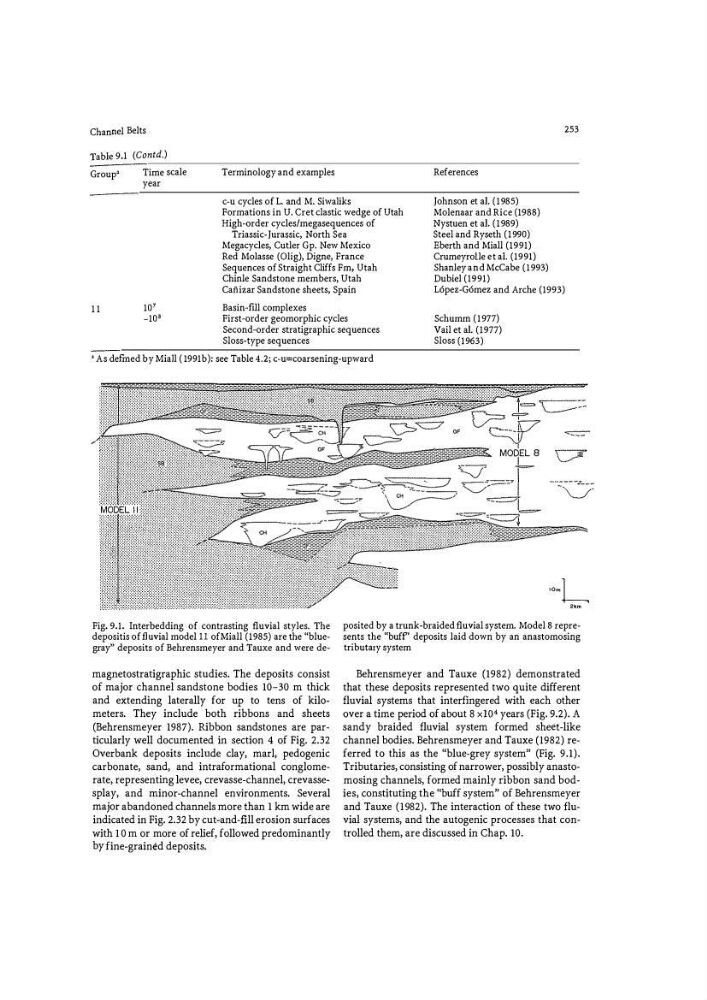
Fig. 9.1. Interbedding of contrasting fluvial styles. The
depositis of fl uvial model ll ofMiall (1985) are the "blue�
gray" deposits of Behrensmeyer and Tauxe and were de�
magnetostratigraphic studies. The deposits consist
of major channel sandstone bodies 10-30 m thick
and extending laterally for up to tens of kilometers. They include both ribbons and sheets
(Behrensmeyer 1987). Ribbon sandstones are particularly well documented in section 4 of Fig. 2.32
Overbank deposits include clay, marl, pedogenic
carbonate, sand, and intraformational conglomerate, representing levee, crevasse-channel, crevassesplay, and minor�channel environments. Several
major abandoned channels more than 1 km wide are
indicated in Fig. 2.32 by cut-and-fill erosion surfaces
with 10m or more of relief, followed predominantly
by fine-grained deposits.
' O·L
,..
posited by a trunk�braided fluvial system. Model S repre�
sents the «buff' deposits laid down by an anastomosing
tributary system
Behrensmeyer and Tauxe (1982) demonstrated
that these deposits represented two quite different
fluvial systems that interfingered with each other
over a time period of about 8 xiO' years (Fig. 9.2). A
sandy braided fluvial system formed sheet-like
channel bodies. Behrensmeyer and Tauxe (1982) referred to this as the "blue-grey system" (Fig. 9.1).
Tributaries, consisting of narrower, possibly anastomosing channels, formed mainly ribbon sand bodies, constituting the (
' of Behrensmeyer
and Tauxe (1982). The interaction of these two fluvial systems, and the autogenic processes that controlled them, are discussed in Chap. 10.
Table 9.1 (Contd. )
Group�
Time scale
year
253
Terminology and examples
References
c�u cycles of L. and M. Siwaliks
Johnson et a!. (1985)
Molenaar and Rice (1988)
Nystuen et a!. (1989)
Formations in U. Cret clastic wedge of Utah
High�order cycles/megasequences of
Triassic� Jurassic, North Sea
Megacycles, Cutler Gp. New Mexico
Red Molasse (Olig), Digne, France
Sequences of Straight Cliffs Fm> Utah
Chinle Sandstone members, Utah
Cafiizar Sandstone sheets, Spain
Steel and Ryseth (1990)
Eberth and Miall (1991)
Crumeyrolle et al. (1991)
Shanley and McCabe (1993)
Dubiel (1991)
L6pez�G6mez and Arche (1993)
11
Basin� fi ll complexes
10'
-108
First�order geomorphic cycles
Second�order stratigraphic sequences
Sloss� type sequences
Schumm (1977)
Vail et a!. (1977)
Sloss (1963)
• As defmed by Miall (1991b): see Table 4.2; c�u=coarsening-upward
Fig. 9.1. Interbedding of contrasting fluvial styles. The
depositis of fl uvial model ll ofMiall (1985) are the "blue�
gray" deposits of Behrensmeyer and Tauxe and were de�
magnetostratigraphic studies. The deposits consist
of major channel sandstone bodies 10-30 m thick
and extending laterally for up to tens of kilometers. They include both ribbons and sheets
(Behrensmeyer 1987). Ribbon sandstones are particularly well documented in section 4 of Fig. 2.32
Overbank deposits include clay, marl, pedogenic
carbonate, sand, and intraformational conglomerate, representing levee, crevasse-channel, crevassesplay, and minor�channel environments. Several
major abandoned channels more than 1 km wide are
indicated in Fig. 2.32 by cut-and-fill erosion surfaces
with 10m or more of relief, followed predominantly
by fine-grained deposits.
' O·L
,..
posited by a trunk�braided fluvial system. Model S repre�
sents the «buff' deposits laid down by an anastomosing
tributary system
Behrensmeyer and Tauxe (1982) demonstrated
that these deposits represented two quite different
fluvial systems that interfingered with each other
over a time period of about 8 xiO' years (Fig. 9.2). A
sandy braided fluvial system formed sheet-like
channel bodies. Behrensmeyer and Tauxe (1982) referred to this as the "blue-grey system" (Fig. 9.1).
Tributaries, consisting of narrower, possibly anastomosing channels, formed mainly ribbon sand bodies, constituting the (
' of Behrensmeyer
and Tauxe (1982). The interaction of these two fluvial systems, and the autogenic processes that controlled them, are discussed in Chap. 10.