

234
Fluvial Styles and Facies Models
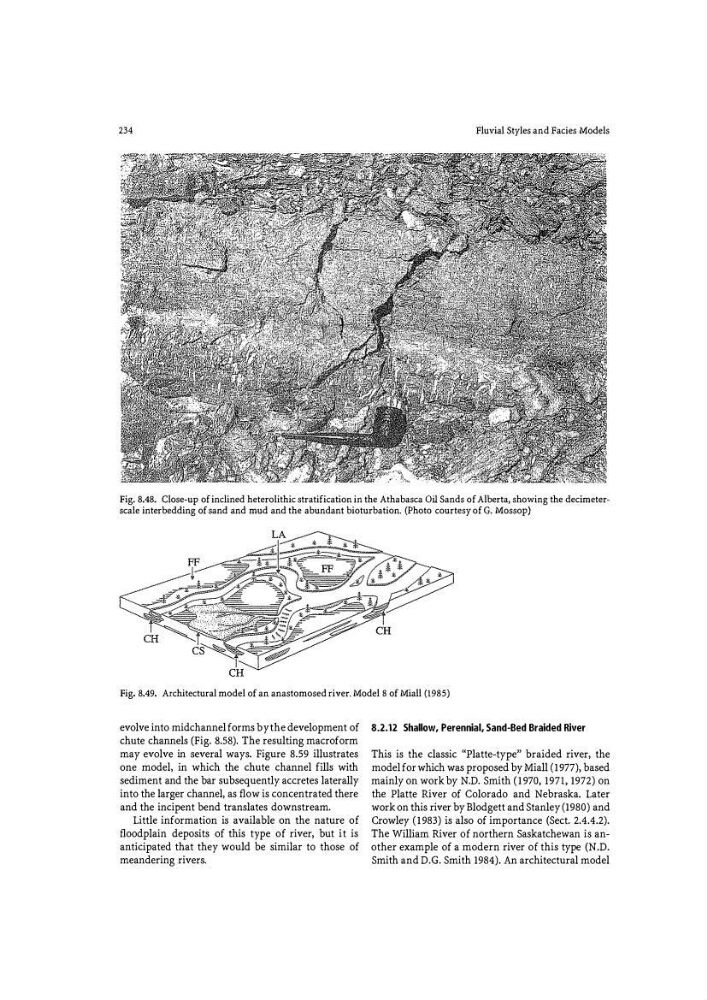
Fig. 8.48. Close-up of inclined heterolithic stratification in the Athabasca Oil Sands of Alberta, showing the decimeterscale interbedding of sand and mud and the abundant bioturbation. (Photo courtesy of G. Mossop}
Fig. 8.49. Architectural model of an anastomosed river. Model S of Miall (1985)
evolve into midchannel forms by the development of
chute channels (Fig. 8.58). The resulting macroform
may evolve in several ways. Figure 8.59 illustrates
one model, in which the chute channel fills with
sediment and the bar subsequently accretes laterally
into the larger channel, as flow is concentrated there
and the incipent bend translates downstream.
Little information is available on the nature of
floodplain deposits of this type of river, but it is
anticipated that they would be similar to those of
meandering rivers.
8.2.12 Shallow, Perennial, Sand-Bed Braided River
This is the classic "Platte-type" braided river, the
model for which was proposed by Miall (1977), based
mainly on work by N.D. Smith (1970, 197!, 1972) on
the Platte River of Colorado and Nebraska. Later
work on this river by Blodgett and Stanley (1980) and
Crowley (1983) is also of importance (Sect. 2.4.4.2).
The William River of northern Saskatchewan is another example of a modern river of this type (N.D.
Smith and D.G. Smith 1984). An architectural model
Fluvial Styles and Facies Models
Fig. 8.48. Close-up of inclined heterolithic stratification in the Athabasca Oil Sands of Alberta, showing the decimeterscale interbedding of sand and mud and the abundant bioturbation. (Photo courtesy of G. Mossop}
Fig. 8.49. Architectural model of an anastomosed river. Model S of Miall (1985)
evolve into midchannel forms by the development of
chute channels (Fig. 8.58). The resulting macroform
may evolve in several ways. Figure 8.59 illustrates
one model, in which the chute channel fills with
sediment and the bar subsequently accretes laterally
into the larger channel, as flow is concentrated there
and the incipent bend translates downstream.
Little information is available on the nature of
floodplain deposits of this type of river, but it is
anticipated that they would be similar to those of
meandering rivers.
8.2.12 Shallow, Perennial, Sand-Bed Braided River
This is the classic "Platte-type" braided river, the
model for which was proposed by Miall (1977), based
mainly on work by N.D. Smith (1970, 197!, 1972) on
the Platte River of Colorado and Nebraska. Later
work on this river by Blodgett and Stanley (1980) and
Crowley (1983) is also of importance (Sect. 2.4.4.2).
The William River of northern Saskatchewan is another example of a modern river of this type (N.D.
Smith and D.G. Smith 1984). An architectural model