

Facies Models
233
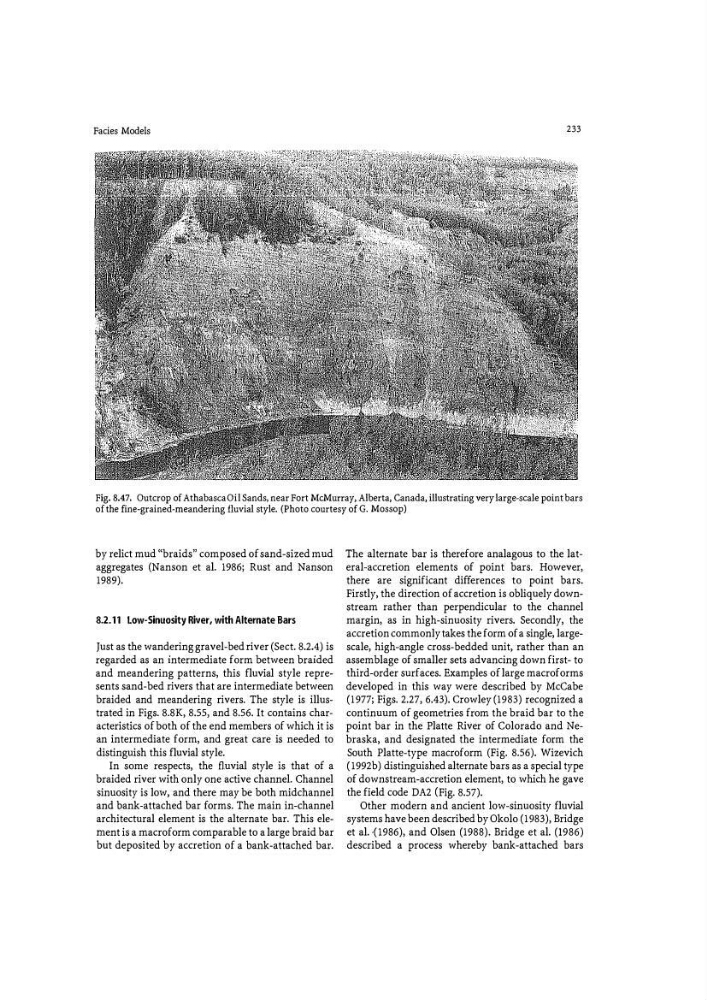
Fig. 8.47. Outcrop of Athabasca Oil Sands, near Fort McMurray, Alberta, Canada, illustrating very large-scale point bars
of the fine-grained-meandering fluvial style. (Photo courtesy of G. Mossop)
by relict mud "braids" composed of sand-sized mud
aggregates (Nanson et al. !986; Rust and Nanson
!989).
8.2.11 low-Sinuosity River, with Alternate Bars
Just as the wandering gravel-bed river (Sect. 8.2.4) is
regarded as an intermediate form between braided
and meandering patterns, this fluvial style represents sand-bed rivers that are intermediate between
braided and meandering rivers. The style is illustrated in Figs. 8.8K, 8.55, and 8.56. It contains characteristics of both of the end members of which it is
an intermediate form, and great care is needed to
distinguish this fluvial style.
In some respects, the fl uvial style is that of a
braided river with only one active channel. Channel
sinuosity is low, and there may be both midchannel
and bank-attached bar forms. The main in-channel
architectural element is the alternate bar. This element is a macro form comparable to a large braid bar
but deposited by accretion of a bank-attached bar.
The alternate bar is therefore analagous to the lateral-accretion elements of point bars. However,
there are significant differences to point bars.
Firstly, the direction of accretion is obliquely downstream rather than perpendicular to the channel
margin, as in high-sinuosity rivers. Secondly, the
accretion commonly takes the form of a single, largescale, high-angle cross-bedded unit, rather than an
assemblage of smaller sets advancing down first- to
third-order surfaces. Examples of large macroforms
developed in this way were described by McCabe
(!977; Figs. 2.27, 6.43). Crowley (!983) recognized a
continuum of geometries from the braid bar to the
point bar in the Platte River of Colorado and Nebraska, and designated the intermediate form the
South Platte-type macroform (Fig. 8.56). Wizevich
(!992b) distinguished alternate bars as a special type
of downstream-accretion element, to which he gave
the field code DA2 (Fig. 8.57).
Other modern and ancient low-sinuosity fluvial
systems have been described by Okolo (!983), Bridge
et al. (!986), and Olsen (!988). Bridge et al. (1986)
described a process whereby bank-attached bars
233
Fig. 8.47. Outcrop of Athabasca Oil Sands, near Fort McMurray, Alberta, Canada, illustrating very large-scale point bars
of the fine-grained-meandering fluvial style. (Photo courtesy of G. Mossop)
by relict mud "braids" composed of sand-sized mud
aggregates (Nanson et al. !986; Rust and Nanson
!989).
8.2.11 low-Sinuosity River, with Alternate Bars
Just as the wandering gravel-bed river (Sect. 8.2.4) is
regarded as an intermediate form between braided
and meandering patterns, this fluvial style represents sand-bed rivers that are intermediate between
braided and meandering rivers. The style is illustrated in Figs. 8.8K, 8.55, and 8.56. It contains characteristics of both of the end members of which it is
an intermediate form, and great care is needed to
distinguish this fluvial style.
In some respects, the fl uvial style is that of a
braided river with only one active channel. Channel
sinuosity is low, and there may be both midchannel
and bank-attached bar forms. The main in-channel
architectural element is the alternate bar. This element is a macro form comparable to a large braid bar
but deposited by accretion of a bank-attached bar.
The alternate bar is therefore analagous to the lateral-accretion elements of point bars. However,
there are significant differences to point bars.
Firstly, the direction of accretion is obliquely downstream rather than perpendicular to the channel
margin, as in high-sinuosity rivers. Secondly, the
accretion commonly takes the form of a single, largescale, high-angle cross-bedded unit, rather than an
assemblage of smaller sets advancing down first- to
third-order surfaces. Examples of large macroforms
developed in this way were described by McCabe
(!977; Figs. 2.27, 6.43). Crowley (!983) recognized a
continuum of geometries from the braid bar to the
point bar in the Platte River of Colorado and Nebraska, and designated the intermediate form the
South Platte-type macroform (Fig. 8.56). Wizevich
(!992b) distinguished alternate bars as a special type
of downstream-accretion element, to which he gave
the field code DA2 (Fig. 8.57).
Other modern and ancient low-sinuosity fluvial
systems have been described by Okolo (!983), Bridge
et al. (!986), and Olsen (!988). Bridge et al. (1986)
described a process whereby bank-attached bars