

232
LEGEND
'"
I
""'
0
"'"
"'·'
6
TIHn ""'� l�yo<;
""�"o"' ' cro,.lono
$ol1>10o�
$01>4""""
S�oo., .. ,, ""'"�'
Buuo .. >
SoM ''"'"'
PloM
wood l
C•o" ·bo40•nq
Crooi · 'Om«�<�I•M
� I Skim�» ol\d ,,.,.,..,.4 !>
� A!\H>I<)I IrOII>
.e:,
OO>O>
=
Fi,.,. roOiiooo
;; I '""" '"""
0
Ql!!J io,..,. .Q ll!! b
Wrror 1CO
B
c ?
D
/
/
Fluvial Styles and Facies Models
/
/
/
/
/
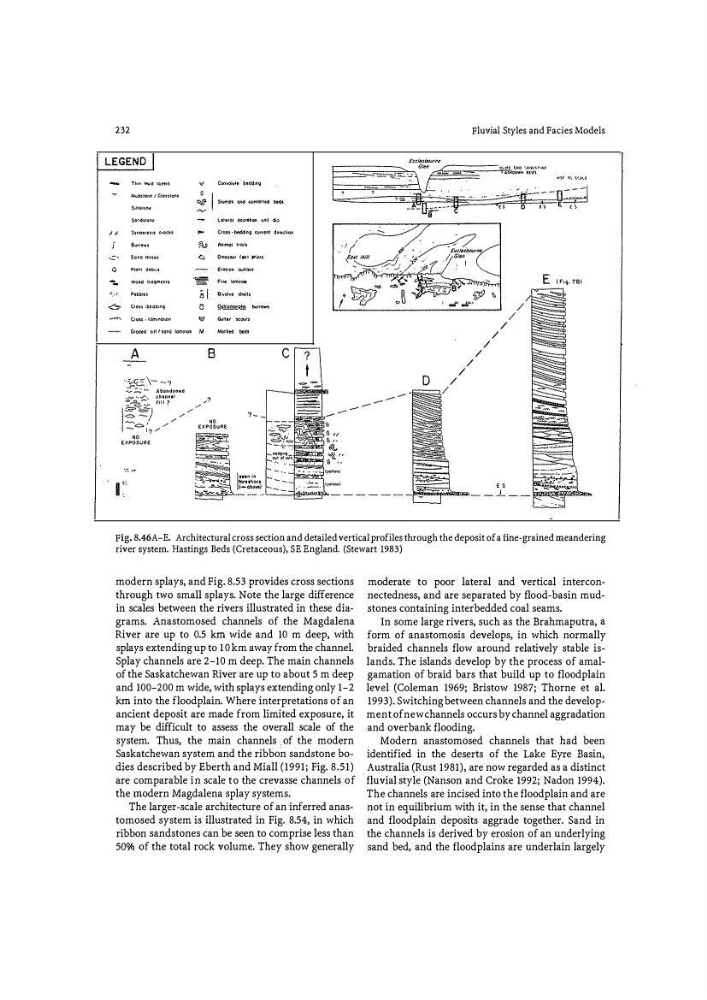
Fig. 8.46A-E. Architectural cross section and detailed vertical profiles through the deposit of a fine-grained meandering
river system. Hastings Beds (Cretaceous), SE England. (Stewart 1983)
modern splays, and Fig. 8.53 provides cross sections
through two small splays. Note the large difference
in scales between the rivers illustrated in these dia�
grams. Anastomosed channels of the Magdalena
River are up to 0.5 km wide and 10 m deep, with
splays extending up to 10 km away from the channel.
Splay channels are 2-10 m deep. The main channels
of the Saskatchewan River are up to about 5 m deep
and 100-200 m wide, with splays extending only 1-2
km into the floodplain. Where interpretations of an
ancient deposit are made from limite� exposure, it
may be difficult to assess the overall scale of the
system. Thus, the main channels of the modern
Saskatchewan system and the ribbon sandstone bodies described by Eberth and Miall (1991; Fig. 8.51)
are comparable in scale to the crevasse channels of
the modern Magdalena splay systems.
The larger-scale architecture of an inferred anastomosed system is -illustrated in Fig. 8.54, in which
ribbon sandstones can be seen to comprise less than
50o/o of the total rock volume. They show generally
moderate to poor lateral and vertical interconnectedness, and are separated by flood-basin mudstones containing interbedded coal seams.
In some large rivers, such as the Brahmaputra, a
form of anastomosis develops, in which normally
braided channels flow around relatively stable islands. The islands develop by the process of amalgamation of braid bars that build up to floodplain
level (Coleman 1969; Bristow 1987; Thorne et al.
1993). Switching between channels and the development of new channels occurs by channel aggradation
and overbank flooding.
Modern anastomosed channels that had been
identified in the deserts of the Lake Eyre Basin,
Australia (Rust 1981), are now regarded as a distinct
fluvial style (Nanson and Croke 1992; Nadon 1994).
The channels are incised into the floodplain and are
not in equilibrium with it, in the sense that channel
and floodplain deposits aggrade together. Sand in
the channels is derived by erosion of an underlying
sand bed, and the floodplains are underlain largely
LEGEND
'"
I
""'
0
"'"
"'·'
6
TIHn ""'� l�yo<;
""�"o"' ' cro,.lono
$ol1>10o�
$01>4""""
S�oo., .. ,, ""'"�'
Buuo .. >
SoM ''"'"'
PloM
wood l
C•o" ·bo40•nq
Crooi · 'Om«�<�I•M
� I Skim�» ol\d ,,.,.,..,.4 !>
� A!\H>I<)I IrOII>
.e:,
OO>O>
=
Fi,.,. roOiiooo
;; I '""" '"""
0
Ql!!J io,..,. .Q ll!! b
Wrror 1CO
B
c ?
D
/
/
Fluvial Styles and Facies Models
/
/
/
/
/
Fig. 8.46A-E. Architectural cross section and detailed vertical profiles through the deposit of a fine-grained meandering
river system. Hastings Beds (Cretaceous), SE England. (Stewart 1983)
modern splays, and Fig. 8.53 provides cross sections
through two small splays. Note the large difference
in scales between the rivers illustrated in these dia�
grams. Anastomosed channels of the Magdalena
River are up to 0.5 km wide and 10 m deep, with
splays extending up to 10 km away from the channel.
Splay channels are 2-10 m deep. The main channels
of the Saskatchewan River are up to about 5 m deep
and 100-200 m wide, with splays extending only 1-2
km into the floodplain. Where interpretations of an
ancient deposit are made from limite� exposure, it
may be difficult to assess the overall scale of the
system. Thus, the main channels of the modern
Saskatchewan system and the ribbon sandstone bodies described by Eberth and Miall (1991; Fig. 8.51)
are comparable in scale to the crevasse channels of
the modern Magdalena splay systems.
The larger-scale architecture of an inferred anastomosed system is -illustrated in Fig. 8.54, in which
ribbon sandstones can be seen to comprise less than
50o/o of the total rock volume. They show generally
moderate to poor lateral and vertical interconnectedness, and are separated by flood-basin mudstones containing interbedded coal seams.
In some large rivers, such as the Brahmaputra, a
form of anastomosis develops, in which normally
braided channels flow around relatively stable islands. The islands develop by the process of amalgamation of braid bars that build up to floodplain
level (Coleman 1969; Bristow 1987; Thorne et al.
1993). Switching between channels and the development of new channels occurs by channel aggradation
and overbank flooding.
Modern anastomosed channels that had been
identified in the deserts of the Lake Eyre Basin,
Australia (Rust 1981), are now regarded as a distinct
fluvial style (Nanson and Croke 1992; Nadon 1994).
The channels are incised into the floodplain and are
not in equilibrium with it, in the sense that channel
and floodplain deposits aggrade together. Sand in
the channels is derived by erosion of an underlying
sand bed, and the floodplains are underlain largely