

Facies Models
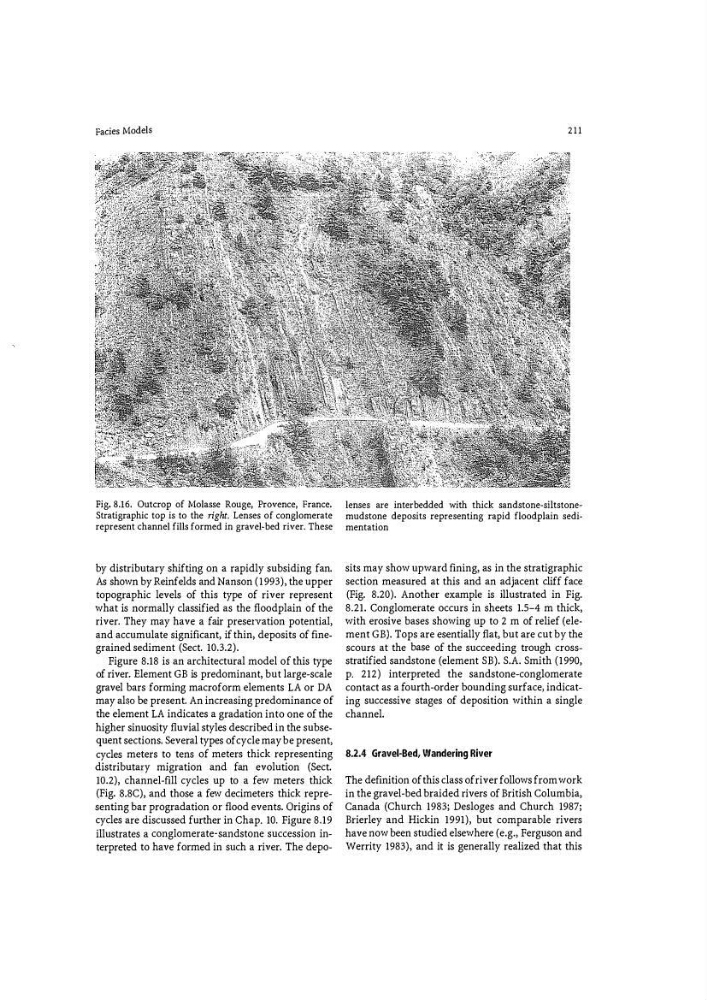
Fig. 8.16. Outcrop of Molasse Rouge, Provence, France.
Stratigraphic top is to the right. Lenses of conglomerate
represent channel fills formed in gravel�bed river. These
by distributary shifting on a rapidly subsiding fan.
As shown by Reinfelds and Nanson (1993), the upper
topographic levels of this type of river represent
what is normally classified as the floodplain of the
river. They may have a fair preservation potential,
and accumulate significant, if thin, deposits of fine�
grained sediment (Sect. 10.3.2).
Figure 8.18 is an architectural model of this type
of river. Element GB is predominant, but large-scale
gravel bars forming macroform elements LA or DA
may al$0 be present. An increasing predominance of
the element LA indicates a gradation into one of the
higher sinuosity fluvial styles described in the subse�
quent sections. Several types of cycle may be present,
cycles meters to tens of meters thick representing
distributary migration and fan evolution (Sect.
10.2), channel-fill cycles up to a few meters thick
(Fig. 8.8C), and those a few decimeters thick representing bar progradation or flood events. Origins of
cycles are discussed further in Chap. 10. Figure 8.19
illustrates a conglomerate � sandstone succession interpreted to have formed in such a river. The depo211
lenses are interbedded with thick sandstone-siltstonemudstone deposits representing rapid floodplain sedimentation
sits may show upward fining, as in the stratigraphic
section measured at this and an adjacent cliff face
(Fig. 8.20). Another example is illustrated in Fig.
8.21. Conglomerate occurs in sheets 1.5-4 m thick,
with erosive bases showing up to 2 m of relief (ele·
ment GB). Tops are esentially flat, but are cut by the
scours at the base of the succeeding trough crossstratified sandstone (element SB). S.A. Smith (1990,
p. 212) interpreted the sandstone-conglomerate
contact as a fo urth-order bounding surface) indicating successive stages of deposition within a single
channel.
8.2.4 Gravel-Bed, Wandering River
The definition of this class of river follows from work
in the gravel-bed braided rivers of British Columbia,
Canada (Church 1983; Desloges and Church 1987;
Brierley and Hickin 1991), but comparable rivers
have now been studied elsewhere (e.g., Ferguson and
Werrity 1983), and it is generally realized that this
Fig. 8.16. Outcrop of Molasse Rouge, Provence, France.
Stratigraphic top is to the right. Lenses of conglomerate
represent channel fills formed in gravel�bed river. These
by distributary shifting on a rapidly subsiding fan.
As shown by Reinfelds and Nanson (1993), the upper
topographic levels of this type of river represent
what is normally classified as the floodplain of the
river. They may have a fair preservation potential,
and accumulate significant, if thin, deposits of fine�
grained sediment (Sect. 10.3.2).
Figure 8.18 is an architectural model of this type
of river. Element GB is predominant, but large-scale
gravel bars forming macroform elements LA or DA
may al$0 be present. An increasing predominance of
the element LA indicates a gradation into one of the
higher sinuosity fluvial styles described in the subse�
quent sections. Several types of cycle may be present,
cycles meters to tens of meters thick representing
distributary migration and fan evolution (Sect.
10.2), channel-fill cycles up to a few meters thick
(Fig. 8.8C), and those a few decimeters thick representing bar progradation or flood events. Origins of
cycles are discussed further in Chap. 10. Figure 8.19
illustrates a conglomerate � sandstone succession interpreted to have formed in such a river. The depo211
lenses are interbedded with thick sandstone-siltstonemudstone deposits representing rapid floodplain sedimentation
sits may show upward fining, as in the stratigraphic
section measured at this and an adjacent cliff face
(Fig. 8.20). Another example is illustrated in Fig.
8.21. Conglomerate occurs in sheets 1.5-4 m thick,
with erosive bases showing up to 2 m of relief (ele·
ment GB). Tops are esentially flat, but are cut by the
scours at the base of the succeeding trough crossstratified sandstone (element SB). S.A. Smith (1990,
p. 212) interpreted the sandstone-conglomerate
contact as a fo urth-order bounding surface) indicating successive stages of deposition within a single
channel.
8.2.4 Gravel-Bed, Wandering River
The definition of this class of river follows from work
in the gravel-bed braided rivers of British Columbia,
Canada (Church 1983; Desloges and Church 1987;
Brierley and Hickin 1991), but comparable rivers
have now been studied elsewhere (e.g., Ferguson and
Werrity 1983), and it is generally realized that this