

208
Rust and Koster (1984) suggested that the presence of debris-flow deposits should be used as a
primary criterion in the recognition of the alluvial
fan environment, a proposal favored by Blair and
McPherson (1994). However, the work of Hooke
(1967), quoted above, on the controls of sedimentgravity-flow processes, suggests that this criterion
could produce misleading results. Also, it would exclude other types of depositional systems that have
traditionally been included in the fan category.
Stanistreet and McCarthy (1993) presented a more
inclusive classification of alluvial fans, as discu$sed
fu rther in Sect. 8.3.
Large-scale autocyclic processeS that control the
development of fourth- and fi fth-brder lithosomes
in alluvial fans are discussed in Sect. 10.2.
8.2.2 Shallow, Gravel-Bed Braided River
Proximal gravel-bed rivers and braid deltas, in
which sediment-gravity fl ows are rare to absent,
consist of a shifting network of unstable, low-sinuosity channels in which a variety of gravel bedforms
Fluvial Styles and Facies Models
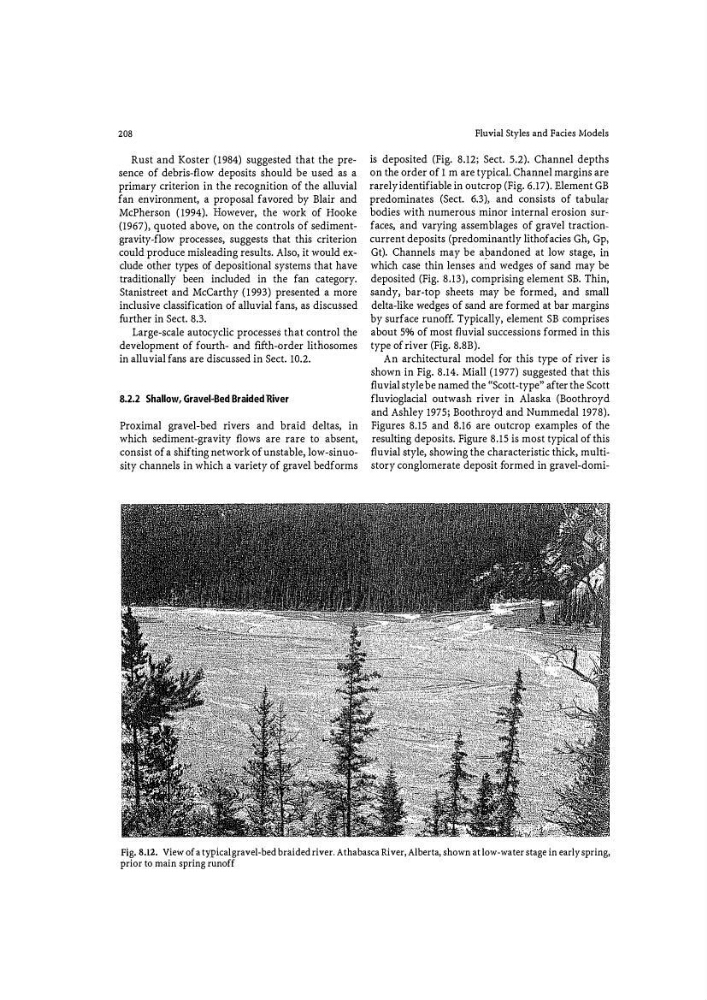
is deposited (Fig. 8.12; Sect. 5.2). Channel depths
on the order of 1 m are typicaL Channel margins are
rarely identifiable in outcrop (Fig. 6.17). Element GB
predominates (Sect. 6.3)1 and consists of tabular
bodies with numerous minor internal erosion sur�
faces, and varying assemblages of gravel traction�
current deposits (predominantly lithofacies Gh, Gp,
Gt). Channels may be abandoned at low stage, in
which case thin lenses a ll d wedges of sand may be
deposited (Fig. 8,13), comprising element SB. Thin,
sandy, bar�top sheets may be fo rmed, and small
delta-like wedges of sand are formed at bar margins
by surface runoff. Typically, element SB comprises
about 5% of most fl uvial successions formed in this
type of river (Fig. 8.8B).
An architectural model for this type of river is
shown in Fig. 8.14. Miall (1977) suggested that this
fl uvial style be named the "Scott-type" after the Scott
fluvioglacial outwash river in Aiaska (Boothroyd
and Ashley 1975; Boothroyd and Nummedal 1978).
Figures 8.15 and 8.16 are outcrop examples of the
resulting deposits. Figure 8.15 is most typical of this
fl uvial style, showing the characteristic thick, multi�
story conglomerate deposit -formed in gravel-domiFlg. 8.12. VieW of a tyPical gravel-bed braided river. Athabasca River, Alberta, shown at low-water stage in early spring,
prior to main spring runoff
Rust and Koster (1984) suggested that the presence of debris-flow deposits should be used as a
primary criterion in the recognition of the alluvial
fan environment, a proposal favored by Blair and
McPherson (1994). However, the work of Hooke
(1967), quoted above, on the controls of sedimentgravity-flow processes, suggests that this criterion
could produce misleading results. Also, it would exclude other types of depositional systems that have
traditionally been included in the fan category.
Stanistreet and McCarthy (1993) presented a more
inclusive classification of alluvial fans, as discu$sed
fu rther in Sect. 8.3.
Large-scale autocyclic processeS that control the
development of fourth- and fi fth-brder lithosomes
in alluvial fans are discussed in Sect. 10.2.
8.2.2 Shallow, Gravel-Bed Braided River
Proximal gravel-bed rivers and braid deltas, in
which sediment-gravity fl ows are rare to absent,
consist of a shifting network of unstable, low-sinuosity channels in which a variety of gravel bedforms
Fluvial Styles and Facies Models
is deposited (Fig. 8.12; Sect. 5.2). Channel depths
on the order of 1 m are typicaL Channel margins are
rarely identifiable in outcrop (Fig. 6.17). Element GB
predominates (Sect. 6.3)1 and consists of tabular
bodies with numerous minor internal erosion sur�
faces, and varying assemblages of gravel traction�
current deposits (predominantly lithofacies Gh, Gp,
Gt). Channels may be abandoned at low stage, in
which case thin lenses a ll d wedges of sand may be
deposited (Fig. 8,13), comprising element SB. Thin,
sandy, bar�top sheets may be fo rmed, and small
delta-like wedges of sand are formed at bar margins
by surface runoff. Typically, element SB comprises
about 5% of most fl uvial successions formed in this
type of river (Fig. 8.8B).
An architectural model for this type of river is
shown in Fig. 8.14. Miall (1977) suggested that this
fl uvial style be named the "Scott-type" after the Scott
fluvioglacial outwash river in Aiaska (Boothroyd
and Ashley 1975; Boothroyd and Nummedal 1978).
Figures 8.15 and 8.16 are outcrop examples of the
resulting deposits. Figure 8.15 is most typical of this
fl uvial style, showing the characteristic thick, multi�
story conglomerate deposit -formed in gravel-domiFlg. 8.12. VieW of a tyPical gravel-bed braided river. Athabasca River, Alberta, shown at low-water stage in early spring,
prior to main spring runoff