

Facies Models
207
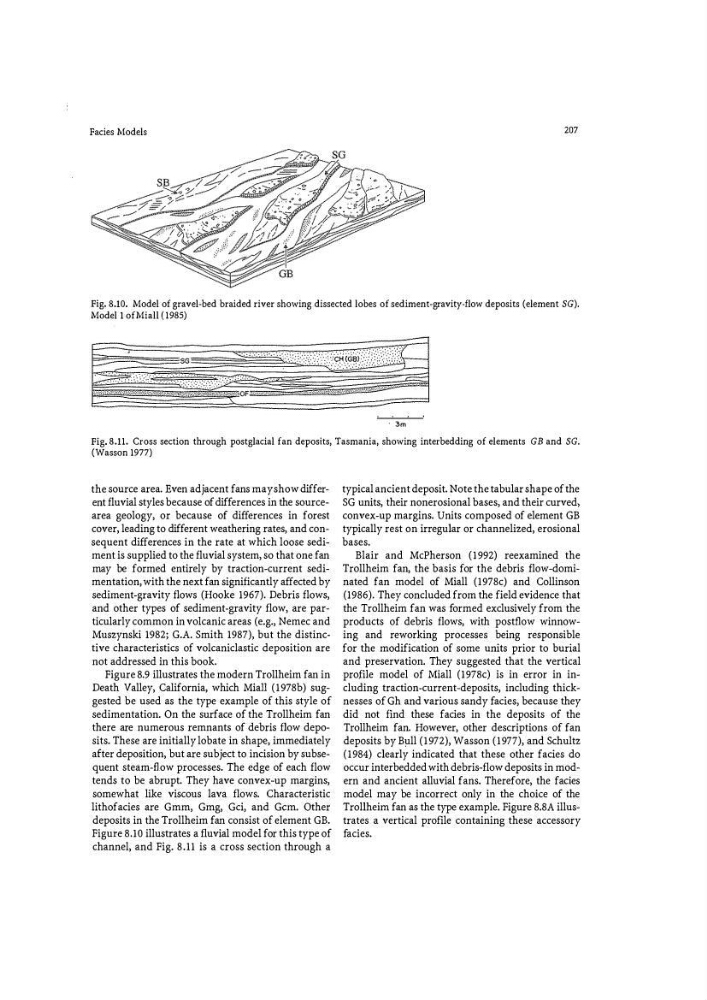
Fig. 8.10. Model of gravel-bed braided river showing dissected lobes of sediment-gravity-flow deposits (element SG).
Model l ofMiall (1985)
3m
Fig. 8.11. Cross section through postglacial fan deposits, Tasmania, showing interbedding of elements GB and SG.
(Wasson 1977)
the source area. Even adjacent fans may show different fluvial styles because of differences in the sourcearea geology, or because of differences in forest
cover, leading to different weathering rates, and consequent differences in the rate at which loose sediment is supplied to the fluvial system, so that one fan
may be formed entirely by traction-current sedimentation, with the next fan significantly affected by
sediment-gravity flows (Hooke 1967). Debris flows,
and other types of sediment-gravity flow, are particularly common in volcanic areas (e.g., Nemec and
Muszynski 1982; G.A. Smith 1987), but the distinctive characteristics of volcaniclastic deposition are
not addressed in this book.
Figure 8.9 illustrates the modern Trollheim fan in
Death Valley, California, which Mia!! (1978b) suggested be used as the type example of this style of
sedimentation. On the surface of the Trollheim fan
there are numerous remnants of debris flow deposits. These are initially lobate in shape, immediately
after deposition, but are subject to incision by subsequent steam-flow processes. The edge of each flow
tends to be abrupt. They have convex-up margins,
somewhat like viscous lava flows. Characteristic
lithofacies are Gmm, Gmg, Gci, and Gem. Other
deposits in the Trollheim fan consist of element GB.
Figure 8.10 illustrates a fluvial model for this type of
channel, and Fig. 8.11 is a cross section through a
typical ancient deposit. Note the tabular shape of the
SG units, their nonerosional bases, and their curved)
convex-up margins. Units composed of element GB
typically rest on irregular or channelized, erosional
bases.
Blair and McPherson (1992) reexamined the
Trollheim fan, the basis for the debris flow-dominated fan model of Miall (1978c) and Collinson
(1986). They concluded from the field evidence that
the Trollheim fan was fo rmed exclusively from the
products of debris flows, with postflow winnowing and reworking processes being responsible
for the modification of some units prior to burial
and preservation. They suggested that the vertical
profile model of Miall (1978c) is in error in including traction-current-deposits, including thicknesses of Gh and various sandy facies, because they
did not find these facies in the deposits of the
Trollheim fan. However, other descriptions of fan
deposits by Bull (1972), Wasson (1977), and Schultz
(1984) clearly indicated that these other facies do
occur interbedded with debris-flow deposits in modern and ancient alluvial fans. Therefore, the fades
model may be incorrect only in the choice of the
Trollheim fan as the type example. Figure 8.8A illustrates a vertical profile containing these accessory
fa cies.
207
Fig. 8.10. Model of gravel-bed braided river showing dissected lobes of sediment-gravity-flow deposits (element SG).
Model l ofMiall (1985)
3m
Fig. 8.11. Cross section through postglacial fan deposits, Tasmania, showing interbedding of elements GB and SG.
(Wasson 1977)
the source area. Even adjacent fans may show different fluvial styles because of differences in the sourcearea geology, or because of differences in forest
cover, leading to different weathering rates, and consequent differences in the rate at which loose sediment is supplied to the fluvial system, so that one fan
may be formed entirely by traction-current sedimentation, with the next fan significantly affected by
sediment-gravity flows (Hooke 1967). Debris flows,
and other types of sediment-gravity flow, are particularly common in volcanic areas (e.g., Nemec and
Muszynski 1982; G.A. Smith 1987), but the distinctive characteristics of volcaniclastic deposition are
not addressed in this book.
Figure 8.9 illustrates the modern Trollheim fan in
Death Valley, California, which Mia!! (1978b) suggested be used as the type example of this style of
sedimentation. On the surface of the Trollheim fan
there are numerous remnants of debris flow deposits. These are initially lobate in shape, immediately
after deposition, but are subject to incision by subsequent steam-flow processes. The edge of each flow
tends to be abrupt. They have convex-up margins,
somewhat like viscous lava flows. Characteristic
lithofacies are Gmm, Gmg, Gci, and Gem. Other
deposits in the Trollheim fan consist of element GB.
Figure 8.10 illustrates a fluvial model for this type of
channel, and Fig. 8.11 is a cross section through a
typical ancient deposit. Note the tabular shape of the
SG units, their nonerosional bases, and their curved)
convex-up margins. Units composed of element GB
typically rest on irregular or channelized, erosional
bases.
Blair and McPherson (1992) reexamined the
Trollheim fan, the basis for the debris flow-dominated fan model of Miall (1978c) and Collinson
(1986). They concluded from the field evidence that
the Trollheim fan was fo rmed exclusively from the
products of debris flows, with postflow winnowing and reworking processes being responsible
for the modification of some units prior to burial
and preservation. They suggested that the vertical
profile model of Miall (1978c) is in error in including traction-current-deposits, including thicknesses of Gh and various sandy facies, because they
did not find these facies in the deposits of the
Trollheim fan. However, other descriptions of fan
deposits by Bull (1972), Wasson (1977), and Schultz
(1984) clearly indicated that these other facies do
occur interbedded with debris-flow deposits in modern and ancient alluvial fans. Therefore, the fades
model may be incorrect only in the choice of the
Trollheim fan as the type example. Figure 8.8A illustrates a vertical profile containing these accessory
fa cies.