

Controls on Channel Style
tially, the same model maybe applied to the development of midchannel braid bars, such as in the sandfl at model of Cant and Walker (1978; Fig. 6.26). The
basic similarities in flow patterns, bedform configurations, and bar development at channel bends in all
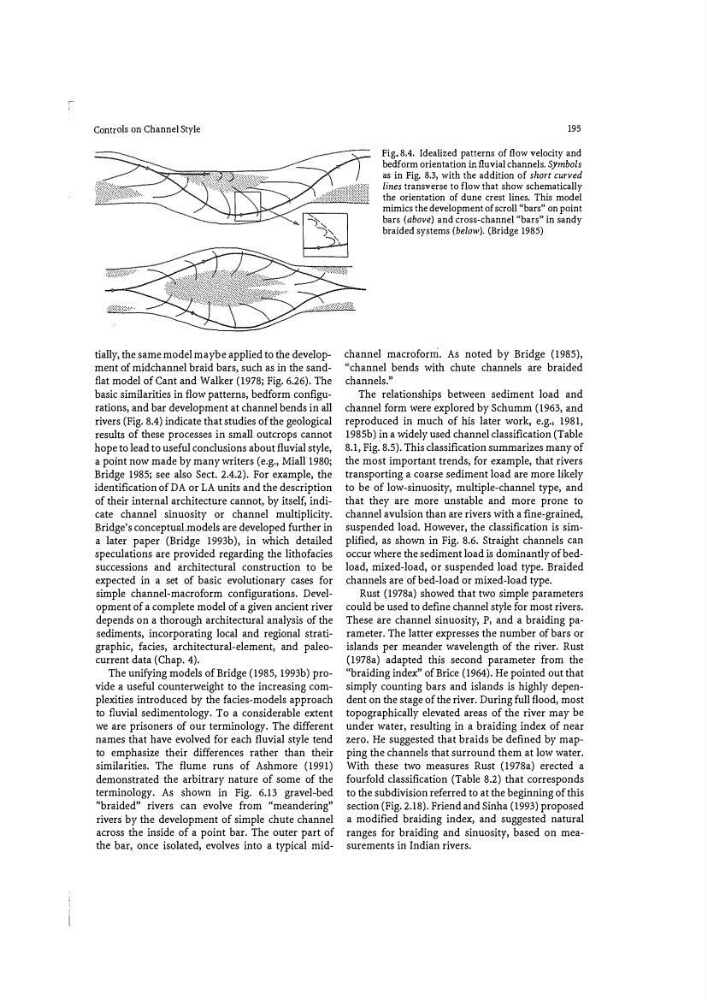
rivers (Fig. 8.4) indicate that studies of the geological
results of these processes in small outcrops cannot
hope to lead to useful conclusions about fluvial style,
a point now made by many writers (e.g., Mialll980;
Bridge 1985; see also Sect. 2.4.2). For example, the
identification of DA or LA units and the description
of their internal architecture cannot, by itself, indicate channel sinuosity or channel multiplicity.
Bridge's conceptuaLmodels are developed further in
a later paper (Bridge 1993b), in which detailed
speculations are provided regarding the lithofacies
successions and architectural construction to be
expected in a set of basic evolutionary cases for
simple channel-macroform configurations. Development of a complete model of a given ancient river
depends on a thorough architectural analysis of the
sediments, incorporating local and regional stratiw
graphic, facies, architectural-element, and paleocurrent data (Chap. 4).
The unifying models of Bridge (1985, 1993b) provide a useful counterweight to the increasing complexities introduced by the facies-models approach
to fl uvial sedimentology. To a considerable extent
we are prisoners of our terminology. The different
names that have evolved for each fluvial style tend
to emphasize their differences rather than their
similarities. The flume runs of Ashmore (1991)
demonstrated the arbitrary nature of some of the
terminology. As shown in Fig. 6.13 gravel-bed
«braided" rivers can evolve from "meandering"
rivers by the development of simple chute channel
across the inside of a point bar. The outer part of
the bar, once isolated, evolves into a typical mid195
Fig. 8.4. Idealized patterns of flow velocity and
bedform orientation in fluvial channels. Symbols
as in Fig. 8.3, with the addition of short curved
lines transverse to flow that show schematically
the orientation of dune crest lines. This model
mimics the development of scroll "bars" on point
bars (above) and cross-channel "bars" in sandy
braided systems (below). (Bridge 1985)
channel macroforrri. As noted by Bridge (1985),
"channel bends with chute channels are braided
channels."
The relationships between sediment load and
channel form were explored by Schumm (1963, and
reproduced in much of his later work, e.g., 1981,
1985b) in a widely used channel classification (Table
8.1, Fig.
· 8.5). This classification summarizes many of
the most important trends, for example, that rivers
transporting a coarse sediment load are more likely
to be of low-sinuosity, multiple-channel type, and
that they are more unstable and more prone to
channel avulsion than are rivers with a fine-grained,
suspended load. However, the classification is simplified, as shown in Fig. 8.6. Straight channels can
occur where the sediment load is dominantly of bedload, mixed-load, or suspended load type. Braided
channels are of bed-load or mixed-load type.
Rust (1978a) showed that two simple parameters
could be used to define channel style for most rivers.
These are channel sinuosity, P, and a braiding parameter. The latter expresses the number of bars or
islands per meander wavelength of the river. Rust
{1978a) adapted this second parameter from the
"braiding index" of Brice (1964). He pointed out that
simply counting bars and islands is highly dependent on the stage of the river. During full flood, most
topographically elevated areas of the river may be
under water, resulting in a braiding index of near
zero. He suggested that braids be defined by mapping the channels that surround them at low water.
With these two measures Rust (1978a) erected a
fourfold classification (Table 8.2) that corresponds
to the subdivision referred to at the beginning of this
section (Fig. 2.18). Friend and Sinha (1993) proposed
a modified braiding index, and suggested natural
ranges for braiding and sinuosity, based on measurements in Indian rivers.
tially, the same model maybe applied to the development of midchannel braid bars, such as in the sandfl at model of Cant and Walker (1978; Fig. 6.26). The
basic similarities in flow patterns, bedform configurations, and bar development at channel bends in all
rivers (Fig. 8.4) indicate that studies of the geological
results of these processes in small outcrops cannot
hope to lead to useful conclusions about fluvial style,
a point now made by many writers (e.g., Mialll980;
Bridge 1985; see also Sect. 2.4.2). For example, the
identification of DA or LA units and the description
of their internal architecture cannot, by itself, indicate channel sinuosity or channel multiplicity.
Bridge's conceptuaLmodels are developed further in
a later paper (Bridge 1993b), in which detailed
speculations are provided regarding the lithofacies
successions and architectural construction to be
expected in a set of basic evolutionary cases for
simple channel-macroform configurations. Development of a complete model of a given ancient river
depends on a thorough architectural analysis of the
sediments, incorporating local and regional stratiw
graphic, facies, architectural-element, and paleocurrent data (Chap. 4).
The unifying models of Bridge (1985, 1993b) provide a useful counterweight to the increasing complexities introduced by the facies-models approach
to fl uvial sedimentology. To a considerable extent
we are prisoners of our terminology. The different
names that have evolved for each fluvial style tend
to emphasize their differences rather than their
similarities. The flume runs of Ashmore (1991)
demonstrated the arbitrary nature of some of the
terminology. As shown in Fig. 6.13 gravel-bed
«braided" rivers can evolve from "meandering"
rivers by the development of simple chute channel
across the inside of a point bar. The outer part of
the bar, once isolated, evolves into a typical mid195
Fig. 8.4. Idealized patterns of flow velocity and
bedform orientation in fluvial channels. Symbols
as in Fig. 8.3, with the addition of short curved
lines transverse to flow that show schematically
the orientation of dune crest lines. This model
mimics the development of scroll "bars" on point
bars (above) and cross-channel "bars" in sandy
braided systems (below). (Bridge 1985)
channel macroforrri. As noted by Bridge (1985),
"channel bends with chute channels are braided
channels."
The relationships between sediment load and
channel form were explored by Schumm (1963, and
reproduced in much of his later work, e.g., 1981,
1985b) in a widely used channel classification (Table
8.1, Fig.
· 8.5). This classification summarizes many of
the most important trends, for example, that rivers
transporting a coarse sediment load are more likely
to be of low-sinuosity, multiple-channel type, and
that they are more unstable and more prone to
channel avulsion than are rivers with a fine-grained,
suspended load. However, the classification is simplified, as shown in Fig. 8.6. Straight channels can
occur where the sediment load is dominantly of bedload, mixed-load, or suspended load type. Braided
channels are of bed-load or mixed-load type.
Rust (1978a) showed that two simple parameters
could be used to define channel style for most rivers.
These are channel sinuosity, P, and a braiding parameter. The latter expresses the number of bars or
islands per meander wavelength of the river. Rust
{1978a) adapted this second parameter from the
"braiding index" of Brice (1964). He pointed out that
simply counting bars and islands is highly dependent on the stage of the river. During full flood, most
topographically elevated areas of the river may be
under water, resulting in a braiding index of near
zero. He suggested that braids be defined by mapping the channels that surround them at low water.
With these two measures Rust (1978a) erected a
fourfold classification (Table 8.2) that corresponds
to the subdivision referred to at the beginning of this
section (Fig. 2.18). Friend and Sinha (1993) proposed
a modified braiding index, and suggested natural
ranges for braiding and sinuosity, based on measurements in Indian rivers.