

194
ried out a test of this proposal, using the Paleozoic
fluvial sedimentary record of the Appalachian basin
as his data base. He was able, from a limited number
of case studies, to confirm that pre-Devonian fl uvial
deposits in this basin were formed in braided fluvial
environments, whereas Devonian and Carboniferous deposits recorded the appearance of meandering fluvial styles. Long (1978) confirmed that
most Proterozoic fluvial deposits were formed in
braided environments.
Bridge (1985, 1993b) disagreed with the idea that
discharge variability is a primary control on braiding, pointing out that "most channel patterns can be
formed in laboratory fl umes at constant discharge,
and many rivers with a given discharge regime show
downstream changes in pattern.)) However, downstream changes in channel pattern may be caused by
variations in bank erodibility and consequent local
changes in bed load, as suggested by the work of
Carson (1984a,b,c). Carson's work, together with
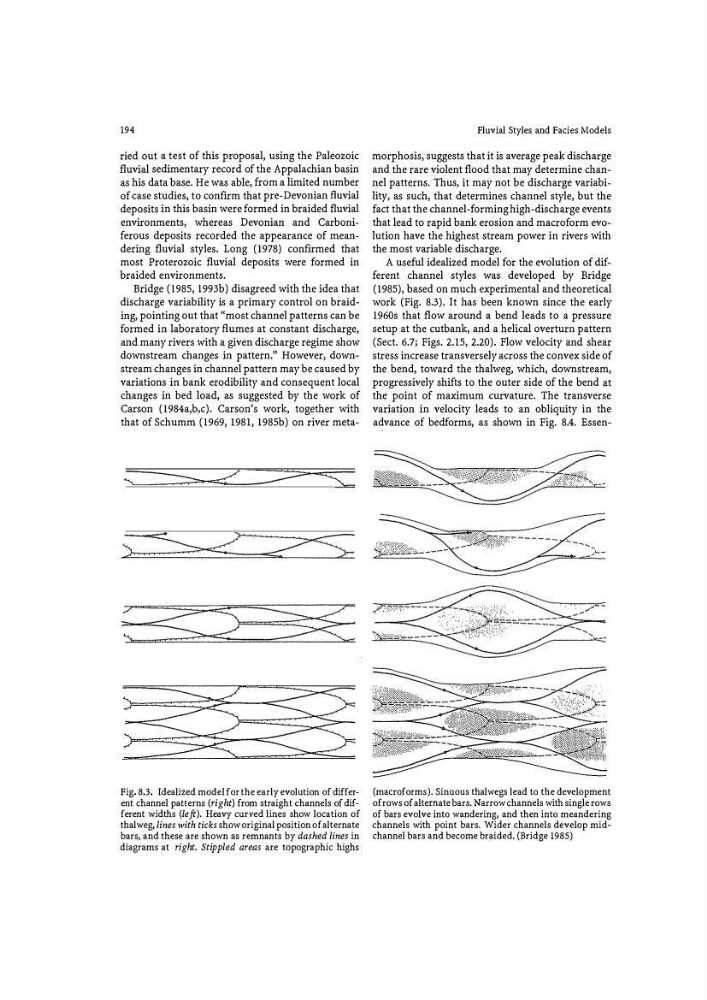
that of Schumm (1969, 1981, 1985b) on river metaFig. 8.3. Idealized model for the early evolution of different channel patterns (right) from straight channels of different widths (left). Heavy curved lines show location of
thalweg, lines with ticks show original position of alternate
bars, and these are shown as remnants by dashed lines in
diagrams at right. Stippled areas are topographic highs
Fluvial Styles and Facies Models
morphosis, suggests that it is average peak discharge
and the rare violent flood that may determine channel patterns. Thus, it may not be discharge variability, as such, that determines channel style, but the
fact that the channel-forming high-discharge events
that lead to rapid bank erosion and macroform evolution have the highest stream power in rivers with
the most variable discharge.
A useful idealized model for the evolution of different channel styles was developed by Bridge
(1985), based on much experimental and theoretical
work (Fig. 8.3). It has been known since the early
1960s that flow around a bend leads to a pressure
setup at the cutbank, and a helical overturn pattern
(Sect. 6.7; Figs. 2.15, 2.20). Flow velocity and shear
stress increase transversely across the convex side of
the bend, toward the thalweg, which, downstream,
progressively shifts to the outer side of the bend at
the point of maximum curvature. The transverse
variation in velocity leads to an obliquity in the
advance of bedforms, as shown in Fig. 8.4. Essen·
�
�
(macroforms). Sinuous thalwegs lead to the development
of rows of alternate bars. Narrow channels with single rows
of bars evolve into wandering, and then into meandering
channels with point bars. Wider channels develop midchannel bars and become braided. (Bridge 1985)
ried out a test of this proposal, using the Paleozoic
fluvial sedimentary record of the Appalachian basin
as his data base. He was able, from a limited number
of case studies, to confirm that pre-Devonian fl uvial
deposits in this basin were formed in braided fluvial
environments, whereas Devonian and Carboniferous deposits recorded the appearance of meandering fluvial styles. Long (1978) confirmed that
most Proterozoic fluvial deposits were formed in
braided environments.
Bridge (1985, 1993b) disagreed with the idea that
discharge variability is a primary control on braiding, pointing out that "most channel patterns can be
formed in laboratory fl umes at constant discharge,
and many rivers with a given discharge regime show
downstream changes in pattern.)) However, downstream changes in channel pattern may be caused by
variations in bank erodibility and consequent local
changes in bed load, as suggested by the work of
Carson (1984a,b,c). Carson's work, together with
that of Schumm (1969, 1981, 1985b) on river metaFig. 8.3. Idealized model for the early evolution of different channel patterns (right) from straight channels of different widths (left). Heavy curved lines show location of
thalweg, lines with ticks show original position of alternate
bars, and these are shown as remnants by dashed lines in
diagrams at right. Stippled areas are topographic highs
Fluvial Styles and Facies Models
morphosis, suggests that it is average peak discharge
and the rare violent flood that may determine channel patterns. Thus, it may not be discharge variability, as such, that determines channel style, but the
fact that the channel-forming high-discharge events
that lead to rapid bank erosion and macroform evolution have the highest stream power in rivers with
the most variable discharge.
A useful idealized model for the evolution of different channel styles was developed by Bridge
(1985), based on much experimental and theoretical
work (Fig. 8.3). It has been known since the early
1960s that flow around a bend leads to a pressure
setup at the cutbank, and a helical overturn pattern
(Sect. 6.7; Figs. 2.15, 2.20). Flow velocity and shear
stress increase transversely across the convex side of
the bend, toward the thalweg, which, downstream,
progressively shifts to the outer side of the bend at
the point of maximum curvature. The transverse
variation in velocity leads to an obliquity in the
advance of bedforms, as shown in Fig. 8.4. Essen·
�
�
(macroforms). Sinuous thalwegs lead to the development
of rows of alternate bars. Narrow channels with single rows
of bars evolve into wandering, and then into meandering
channels with point bars. Wider channels develop midchannel bars and become braided. (Bridge 1985)