

Controls on Channel Style
Schumm (1981) and Schumm (l985b) described examples of two rivers, the Soq.th Platte and Arkansas1
that evolved from braided to meandering patterns
within historic times as a result of damming and
irrigation that resulted in lower discharge variability, lessening of flood peaks, and stabilizing of
banks by the growth of vegetation. Conversely,
Schumm and Lichty (1963) described the case of the
Cimarron River, Kansas, that changed from a suspension-load, meandering morphology to a broad,
shallow, bed-load, braided morphology during a
single major flood in 1914. Channel widening continued until 1942, during a period of below-normal
precipitation, which inhibited vegetation growth.
Changes in regional slope may to some extent be
accomodatt;!d in the river system by changes in channel pattern (Schumm 1993; Wescott 1993). As noted
by Wescott (1993), channel slope S,, valley slope S,
and sinuosity P are related:
Given constant discharge and sediment load the
river will tend to maintain a constant c;:hannel slope.
Therefore, an increase in regional slope (S) as a
result of tectonic activity will tend to be compensated by an increase in sinuosity. This ability of the
193
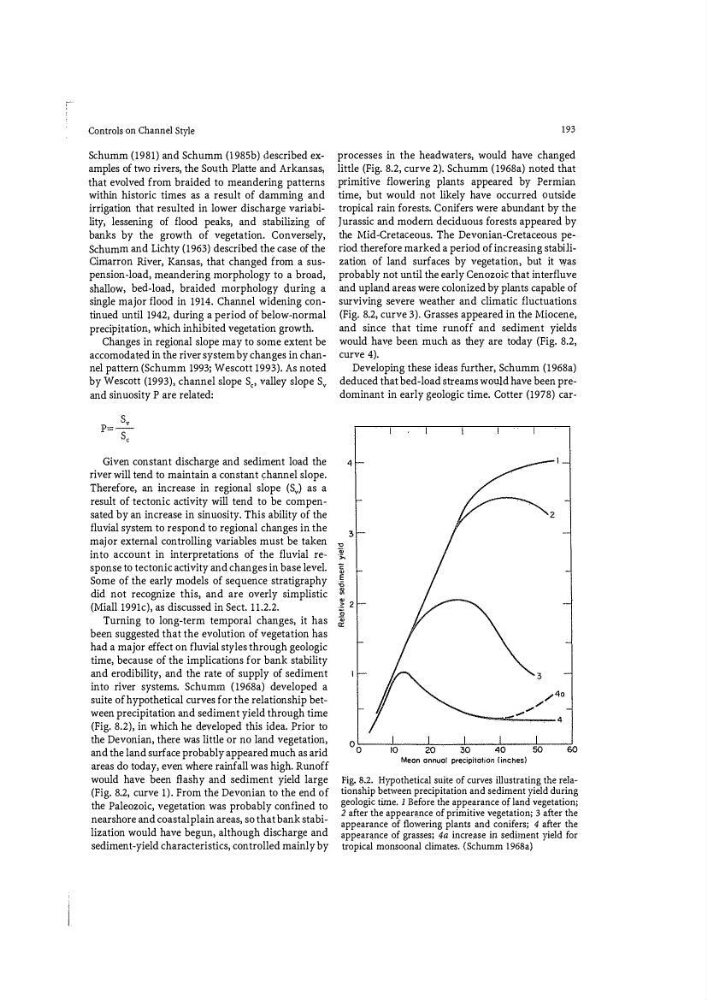
processes in the headwa,ters, would have changed
little (Fig. 8.2, curve 2). Schumm (1968a) noted that
primitive flowering plants appeared by Permian
time, but would not likely have occurred putside
tropical rain forests. Conifers were abundant by the
Jurassic and modern Q_eciduous fo rests appeared Py
the Mid-Creta(:eous. The Devonian-Cretaceous period therefore marked a period of in�reasing stabilization of land surfaces by vegetation, but it was
probably not until the early Cenozoi� that interfluve
and upland areas were colonized by plants capable of
surviving severe weather and climatic fluctuations
(Fig. 8.2, curve 3). Grasses appeared in the Miocene,
and since that time runoff and sediment yields
would have been much as they are today (Fig. 8.2,
curve 4).
Developing these ideas further, Schumm (1968a)
deduced that bed-load streams would have been predominant in early geologic time. Cotter (1978) car4
2
fluvial system to respond to regional changes in the
3
major external controlling variables must be taken -o
into account in interpretations of the fluvial re- :t
sponse to tectonic activity and changes in base level. c
�
Some of the early models of sequence stratigraphy ·did not recognize this, and are overly simplistic ]l
(Miall 1991c), as discussed in Sect. 11.2.2.
.� 2
g
Turning to long-term temporal changes, it has £
been suggested that the evolution of vegetation has
had a major effect on fluvial styles through geologic
3
Mean annual precipitation (inches)
time, because of the implications for bank stability
and erodibility, and the rate of supply of sediment
into river systems. Schumm (1968a) developed a
suite of hypothetical curves for the relationship between precipitation and sediment yield through time
(Fig. 8.2), in which he developed this idea. Prior to
the Devonian, there was little or no land vegetation,
and the land surface probably appeared much as arid
areas do today, even where rainfall was high. Runoff
would have been flashy and sediment yield large
(Fig. 8.2, curve 1). From the Devonian to the end of
the Paleozoic, vegetation was probably confined to
nearshore and coastal plain areas, so that bank stabilization would have begun, although discharge and
sediment-yield characteristics, controlled mainly by
Fig. 8.2. Hypothetical suite of curves illustrating the relationship between precipitation and sediment yield during
geologic time. 1 Before the appearance of land vegetation;
2 after the appear<,1nce of primitive vegetation; 3 after the
appearance of flowering plants and conifers; 4 after the
appeaq.nce of grasses; 4a incre . ase ip se
Schumm (1981) and Schumm (l985b) described examples of two rivers, the Soq.th Platte and Arkansas1
that evolved from braided to meandering patterns
within historic times as a result of damming and
irrigation that resulted in lower discharge variability, lessening of flood peaks, and stabilizing of
banks by the growth of vegetation. Conversely,
Schumm and Lichty (1963) described the case of the
Cimarron River, Kansas, that changed from a suspension-load, meandering morphology to a broad,
shallow, bed-load, braided morphology during a
single major flood in 1914. Channel widening continued until 1942, during a period of below-normal
precipitation, which inhibited vegetation growth.
Changes in regional slope may to some extent be
accomodatt;!d in the river system by changes in channel pattern (Schumm 1993; Wescott 1993). As noted
by Wescott (1993), channel slope S,, valley slope S,
and sinuosity P are related:
Given constant discharge and sediment load the
river will tend to maintain a constant c;:hannel slope.
Therefore, an increase in regional slope (S) as a
result of tectonic activity will tend to be compensated by an increase in sinuosity. This ability of the
193
processes in the headwa,ters, would have changed
little (Fig. 8.2, curve 2). Schumm (1968a) noted that
primitive flowering plants appeared by Permian
time, but would not likely have occurred putside
tropical rain forests. Conifers were abundant by the
Jurassic and modern Q_eciduous fo rests appeared Py
the Mid-Creta(:eous. The Devonian-Cretaceous period therefore marked a period of in�reasing stabilization of land surfaces by vegetation, but it was
probably not until the early Cenozoi� that interfluve
and upland areas were colonized by plants capable of
surviving severe weather and climatic fluctuations
(Fig. 8.2, curve 3). Grasses appeared in the Miocene,
and since that time runoff and sediment yields
would have been much as they are today (Fig. 8.2,
curve 4).
Developing these ideas further, Schumm (1968a)
deduced that bed-load streams would have been predominant in early geologic time. Cotter (1978) car4
2
fluvial system to respond to regional changes in the
3
major external controlling variables must be taken -o
into account in interpretations of the fluvial re- :t
sponse to tectonic activity and changes in base level. c
�
Some of the early models of sequence stratigraphy ·did not recognize this, and are overly simplistic ]l
(Miall 1991c), as discussed in Sect. 11.2.2.
.� 2
g
Turning to long-term temporal changes, it has £
been suggested that the evolution of vegetation has
had a major effect on fluvial styles through geologic
3
Mean annual precipitation (inches)
time, because of the implications for bank stability
and erodibility, and the rate of supply of sediment
into river systems. Schumm (1968a) developed a
suite of hypothetical curves for the relationship between precipitation and sediment yield through time
(Fig. 8.2), in which he developed this idea. Prior to
the Devonian, there was little or no land vegetation,
and the land surface probably appeared much as arid
areas do today, even where rainfall was high. Runoff
would have been flashy and sediment yield large
(Fig. 8.2, curve 1). From the Devonian to the end of
the Paleozoic, vegetation was probably confined to
nearshore and coastal plain areas, so that bank stabilization would have begun, although discharge and
sediment-yield characteristics, controlled mainly by
Fig. 8.2. Hypothetical suite of curves illustrating the relationship between precipitation and sediment yield during
geologic time. 1 Before the appearance of land vegetation;
2 after the appear<,1nce of primitive vegetation; 3 after the
appearance of flowering plants and conifers; 4 after the
appeaq.nce of grasses; 4a incre . ase ip se