

196
Fluvial Styles and Facies Models
Table 8.1. Classification of allUvial channels by sediment load. (Schumm 1963, 198Sb}
Type of
Bed load
Single�channel systems
Multiple�channel systems
channel
(% of total load)
Suspended load
<3
Mixed load
3-11
Bed load
>11
SuspendedMload channel
WID ratio< 10,
sinuosity> 2.0,
gradient relatively gentle
Mixed-load channel
WID ratio 10-40,
sinuosity< 2.0,
gradient moderate, may be braided
Bed-load channel
W /D ratio > 40,
sinuosity< 1.3, gradient relatively steep,
may be braided
W/D=width/depth ratio.
z
"'
w
...
...
""
a.
-'
w
z
z
""
J:
<.. >
CHANNEL TYPE
Suspended Load
Mixed Load
Bed Load
�{- 3_3 � -
� -
- =---= ��
"'
� t t
� �--�
0
"'
:g
z �
;;:: �"
w
a..�
0
.�
z oe
""
�
w
;;
"'
�
3a �
{ 3%>) Low- Bed Load/Total LOad Ratio -High (>II%)
Smo!! - Sediment Site - Larqe
Small - Sediment Load - Lorge
Low
- rrow Velocity
- High
Low
- Streom Power
- Hioh
Anastomosing system
Delta distributaries
Alluvial plain distributaries
Alluvial fan distributaries
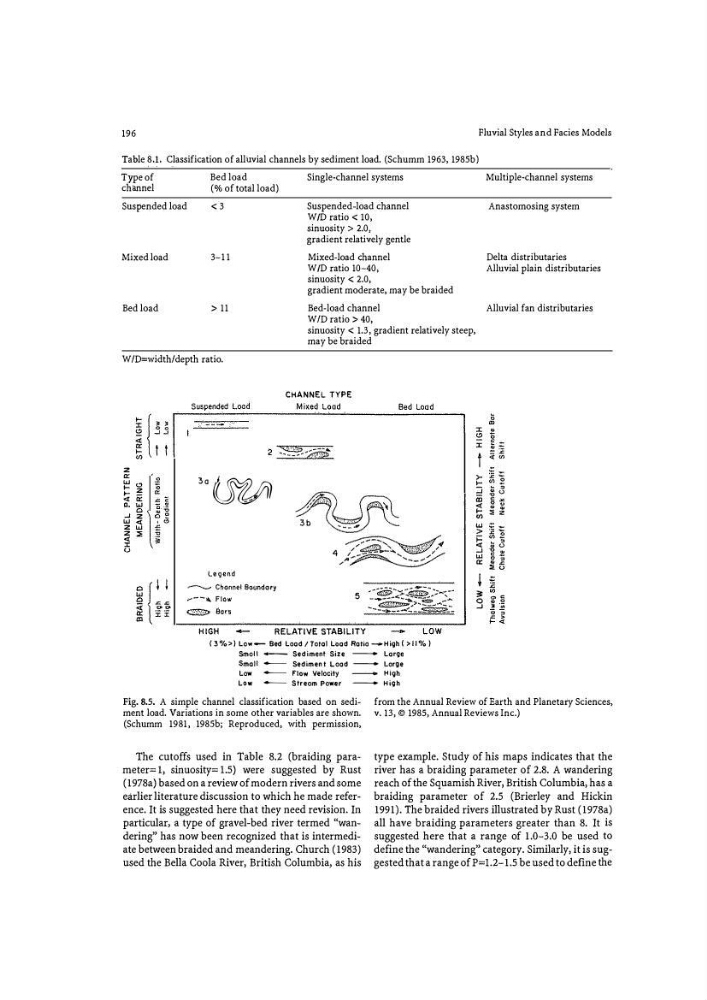
Fig. 8.5. A simple channel classification based on sediment load. Variations in some other variables are shown.
(Schumm 1981, 198Sb; Reproduced, with permission,
from the Annual Review of Earth and Planetary Sciences,
v. 13, © 1985, Annual Reviews Inc.)
The cutoffs used in Table 8.2 (braiding parameter=!, sinuosity=l.5) were suggested by Rust
(1978a) based on a review of modern rivers and some
earlier literature discussion to which he made reference. It is suggested here that they need revision. In
particular, a type of gravel-bed river termed "wandering" has now been recognized that is intermediate between braided and meandering. Church (1983)
used the Bella Coola River, British Columbia, as his
type example. Study of his maps indicates that the
river has a braiding parameter of 2.8. A wandering
reach of the Squamish River, British Columbia, has a
braiding parameter of 2.5 (Brierley and Hickin
1991). The braided rivers illustrated by Rust (1978a)
all have braiding parameters greater than 8. It is
suggested here that a range of 1.0-3.0 be used to
define the "wandering" category. Similarly, it is suggested that a range of P=L2-1.5 be used to define the
Fluvial Styles and Facies Models
Table 8.1. Classification of allUvial channels by sediment load. (Schumm 1963, 198Sb}
Type of
Bed load
Single�channel systems
Multiple�channel systems
channel
(% of total load)
Suspended load
<3
Mixed load
3-11
Bed load
>11
SuspendedMload channel
WID ratio< 10,
sinuosity> 2.0,
gradient relatively gentle
Mixed-load channel
WID ratio 10-40,
sinuosity< 2.0,
gradient moderate, may be braided
Bed-load channel
W /D ratio > 40,
sinuosity< 1.3, gradient relatively steep,
may be braided
W/D=width/depth ratio.
z
"'
w
...
...
""
a.
-'
w
z
z
""
J:
<.. >
CHANNEL TYPE
Suspended Load
Mixed Load
Bed Load
�{- 3_3 � -
� -
- =---= ��
"'
� t t
� �--�
0
"'
:g
z �
;;:: �"
w
a..�
0
.�
z oe
""
�
w
;;
"'
�
3a �
{ 3%>) Low- Bed Load/Total LOad Ratio -High (>II%)
Smo!! - Sediment Site - Larqe
Small - Sediment Load - Lorge
Low
- rrow Velocity
- High
Low
- Streom Power
- Hioh
Anastomosing system
Delta distributaries
Alluvial plain distributaries
Alluvial fan distributaries
Fig. 8.5. A simple channel classification based on sediment load. Variations in some other variables are shown.
(Schumm 1981, 198Sb; Reproduced, with permission,
from the Annual Review of Earth and Planetary Sciences,
v. 13, © 1985, Annual Reviews Inc.)
The cutoffs used in Table 8.2 (braiding parameter=!, sinuosity=l.5) were suggested by Rust
(1978a) based on a review of modern rivers and some
earlier literature discussion to which he made reference. It is suggested here that they need revision. In
particular, a type of gravel-bed river termed "wandering" has now been recognized that is intermediate between braided and meandering. Church (1983)
used the Bella Coola River, British Columbia, as his
type example. Study of his maps indicates that the
river has a braiding parameter of 2.8. A wandering
reach of the Squamish River, British Columbia, has a
braiding parameter of 2.5 (Brierley and Hickin
1991). The braided rivers illustrated by Rust (1978a)
all have braiding parameters greater than 8. It is
suggested here that a range of 1.0-3.0 be used to
define the "wandering" category. Similarly, it is suggested that a range of P=L2-1.5 be used to define the