

180
Architectural Elements of the Overbank Environment
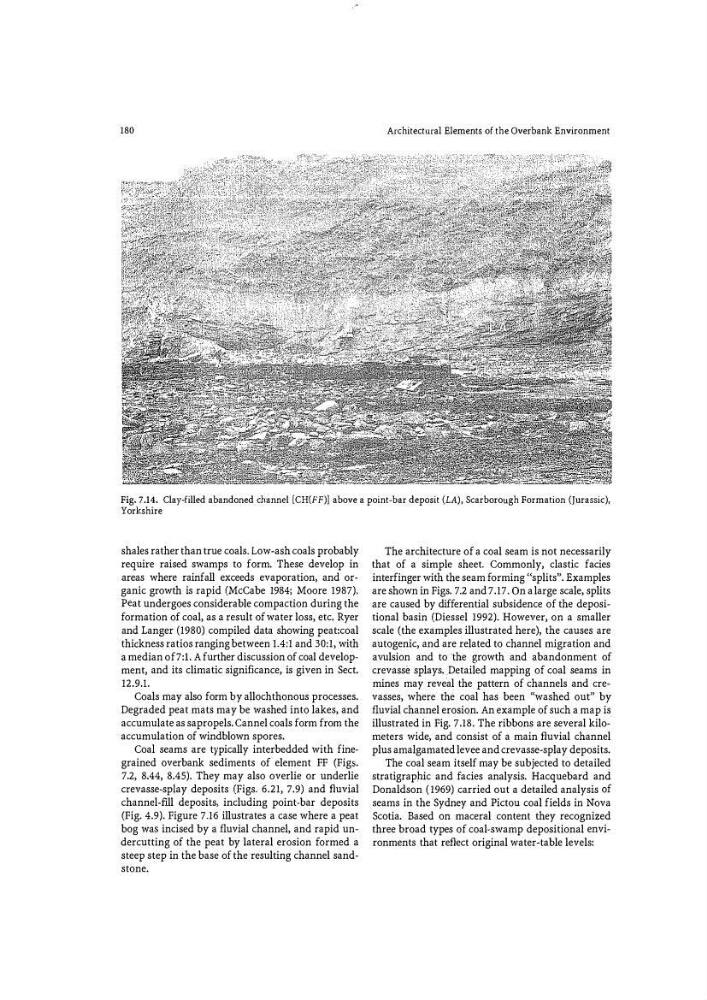
Fig. 7.14. Clay�filled abandoned channel [CH(FF)] above a point�bar deposit (LA), Scarborough Formation (Jurassic),
Yorkshire
shales rather than true coals. Low-ash coals probably
require raised swamps to form. These develop in
areas where rainfall exceeds evaporation, and organic growth is rapid (McCabe 1984; Moore 1987).
Peat undergoes considerable compaction during the
formation of coal, as a result of water loss, etc. Ryer
and Langer (1980) compiled data showing peat:coal
thickness ratios ranging between 1.4:1 and 30:1, with
a median of7:1. A further discussion of coal development, and its climatic significance, is given in Sect.
12.9.!.
Coals may also form by allochthonous processes.
Degraded peat mats may be washed into lakes, and
accumulate as sapropels. Cannel coals form from the
accumulation of windblown spores.
Coal seams are typically interbedded with finegrained overbank sediments of element FF (Figs.
7.2, 8.44, 8.45). They may also overlie or underlie
crevasse-splay deposits (Figs. 6.21, 7.9) and fluvial
channel-fill deposits> including point-bar deposits
(Fig. 4.9). Figure 7.16 illustrates a case where a peat
bog wa!) incised by a fluvial channel, and rapid undercutting of the peat by lateral erosion fo rmed a
steep step in the base of the resulting channel sandstone.
The architecture of a coal seam is not necessarily
that of a simple sheet. Commonly, clastic facies
interfinger with the seam fo rming ('splits». Examples
are shown in Figs. 7.2 and 7.17. On a large scale, splits
are caused by differential subsidence of the depositional basin (Diessel 1992). However, on a smaller
scale (the examples illustrated here), the causes are
autogenic, and are related to channel migration and
avulsion and to "the g rowth and abandonment of
crevasse splays. Detailed mapping of coal seams in
mines may reveal the pattern of channels and crevasses, where the coal has been "washed ouf' by
fluvial channel erosion. An example of such a map is
illustrated in Fig. 7.18. The ribbons are several kilometers wide, and consist of a main fluvial channel
plus amalgamated levee and crevasse-splay deposits.
The coal seam itself may be subjected to detailed
stratigraphic and fa cies analysis. Hacquebard and
Donaldson (1969) carried out a detailed analysis of
seams in the Sydney and Pictou coal fields in Nova
Scotia. Based on maceral content they recognized
three broad types of coal-swamp depositional environments that reflect original water-table levels:
Architectural Elements of the Overbank Environment
Fig. 7.14. Clay�filled abandoned channel [CH(FF)] above a point�bar deposit (LA), Scarborough Formation (Jurassic),
Yorkshire
shales rather than true coals. Low-ash coals probably
require raised swamps to form. These develop in
areas where rainfall exceeds evaporation, and organic growth is rapid (McCabe 1984; Moore 1987).
Peat undergoes considerable compaction during the
formation of coal, as a result of water loss, etc. Ryer
and Langer (1980) compiled data showing peat:coal
thickness ratios ranging between 1.4:1 and 30:1, with
a median of7:1. A further discussion of coal development, and its climatic significance, is given in Sect.
12.9.!.
Coals may also form by allochthonous processes.
Degraded peat mats may be washed into lakes, and
accumulate as sapropels. Cannel coals form from the
accumulation of windblown spores.
Coal seams are typically interbedded with finegrained overbank sediments of element FF (Figs.
7.2, 8.44, 8.45). They may also overlie or underlie
crevasse-splay deposits (Figs. 6.21, 7.9) and fluvial
channel-fill deposits> including point-bar deposits
(Fig. 4.9). Figure 7.16 illustrates a case where a peat
bog wa!) incised by a fluvial channel, and rapid undercutting of the peat by lateral erosion fo rmed a
steep step in the base of the resulting channel sandstone.
The architecture of a coal seam is not necessarily
that of a simple sheet. Commonly, clastic facies
interfinger with the seam fo rming ('splits». Examples
are shown in Figs. 7.2 and 7.17. On a large scale, splits
are caused by differential subsidence of the depositional basin (Diessel 1992). However, on a smaller
scale (the examples illustrated here), the causes are
autogenic, and are related to channel migration and
avulsion and to "the g rowth and abandonment of
crevasse splays. Detailed mapping of coal seams in
mines may reveal the pattern of channels and crevasses, where the coal has been "washed ouf' by
fluvial channel erosion. An example of such a map is
illustrated in Fig. 7.18. The ribbons are several kilometers wide, and consist of a main fluvial channel
plus amalgamated levee and crevasse-splay deposits.
The coal seam itself may be subjected to detailed
stratigraphic and fa cies analysis. Hacquebard and
Donaldson (1969) carried out a detailed analysis of
seams in the Sydney and Pictou coal fields in Nova
Scotia. Based on maceral content they recognized
three broad types of coal-swamp depositional environments that reflect original water-table levels: