

176
Architectural Elements of the Overbank Environment
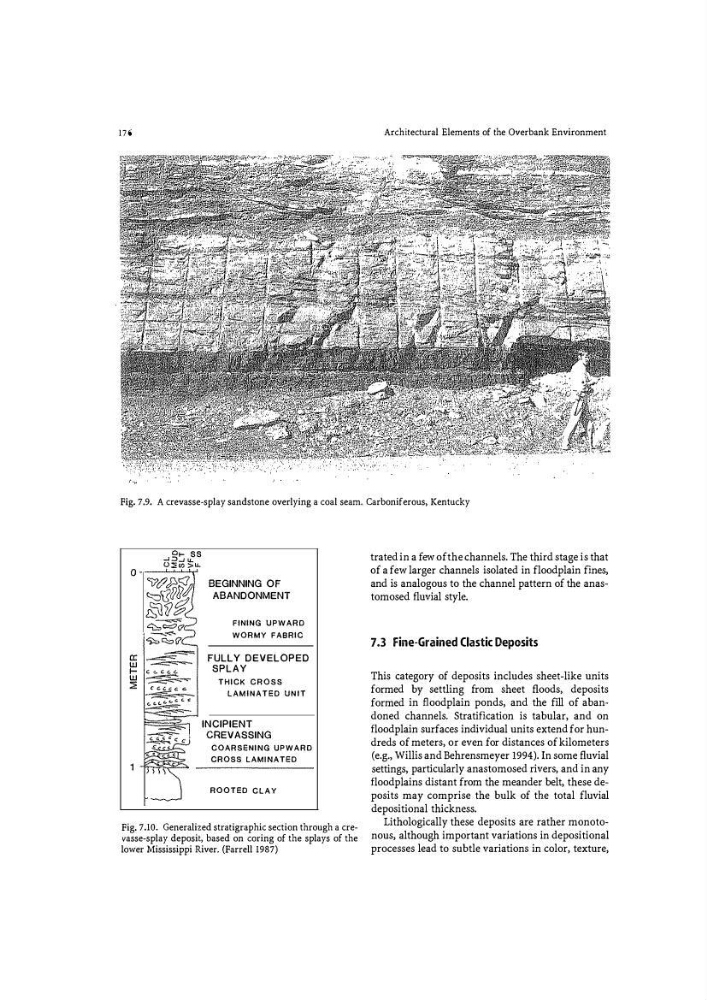
Fig. 7 .9. A crevasse-splay sandstone overlying a coal seam. Carboniferous, Kentucky
0;- ss
-1 ;:)_; u..
U::?:Cf.l > U..
0 "i? J" P &> J:
BEGINNING OF
�'\?<1' {::1
ABANDONMENT
!§!,'fl 2?.
�
FINING UPWARD
"""' �"'
' �-<'WORMY FABRIC
"""' ""' I?
a:
� FULLY DEVELOPED
--===
w
�
SPLAY
f- C c.. CG<:.
w �-.:THICK CROSS
:2
CGCcc .::.
��
LAMINATED UNIT
0:. G <,.. C C <:
�
�
INCIPIENT
CREVASSING
�__L .:
COARSENING UPWARD
<
«
CROSS LAMINATED
1
':J
ROOTED CLAY
Fig. 7.10. Generalized stratigraphic section through a crevasse-splay deposit, based on coring of the splays of the
lower Mississippi River. (Farrell 1987)
trated in a few of the channels. The third stage is that
of a few larger channels isolated in floodplain fines,
and is analogous to the channel pattern of the anastomosed fluvial style.
7.3 Fine-Grained Clastic Deposits
This category of deposits includes sheet-like units
formed by settling fr om sheet floods, deposits
formed in floodplain ponds, and the fill of abandoned channels. Stratification is tabular, and on
floodplain surfaces individual units extend for hundreds of meters, or even for distances of kilometers
(e.g., Willis and Behrensmeyer !994). In some fluvial
settings, particularly anastomosed rivers, and in any
floodplains distant from the meander belt, these deposits may comprise the bulk of tbe total fluvial
depositional thickness.
Lithologically these deposits are rather monotonous, although important variations in depositional
processes lead to subtle variations in color, texture,
Architectural Elements of the Overbank Environment
Fig. 7 .9. A crevasse-splay sandstone overlying a coal seam. Carboniferous, Kentucky
0;- ss
-1 ;:)_; u..
U::?:Cf.l > U..
0 "i? J" P &> J:
BEGINNING OF
�'\?<1' {::1
ABANDONMENT
!§!,'fl 2?.
�
FINING UPWARD
"""' �"'
' �-<'WORMY FABRIC
"""' ""' I?
a:
� FULLY DEVELOPED
--===
w
�
SPLAY
f- C c.. CG<:.
w �-.:THICK CROSS
:2
CGCcc .::.
��
LAMINATED UNIT
0:. G <,.. C C <:
�
�
INCIPIENT
CREVASSING
�__L .:
COARSENING UPWARD
<
«
CROSS LAMINATED
1
':J
ROOTED CLAY
Fig. 7.10. Generalized stratigraphic section through a crevasse-splay deposit, based on coring of the splays of the
lower Mississippi River. (Farrell 1987)
trated in a few of the channels. The third stage is that
of a few larger channels isolated in floodplain fines,
and is analogous to the channel pattern of the anastomosed fluvial style.
7.3 Fine-Grained Clastic Deposits
This category of deposits includes sheet-like units
formed by settling fr om sheet floods, deposits
formed in floodplain ponds, and the fill of abandoned channels. Stratification is tabular, and on
floodplain surfaces individual units extend for hundreds of meters, or even for distances of kilometers
(e.g., Willis and Behrensmeyer !994). In some fluvial
settings, particularly anastomosed rivers, and in any
floodplains distant from the meander belt, these deposits may comprise the bulk of tbe total fluvial
depositional thickness.
Lithologically these deposits are rather monotonous, although important variations in depositional
processes lead to subtle variations in color, texture,