

Levee and Crevasse Deposits
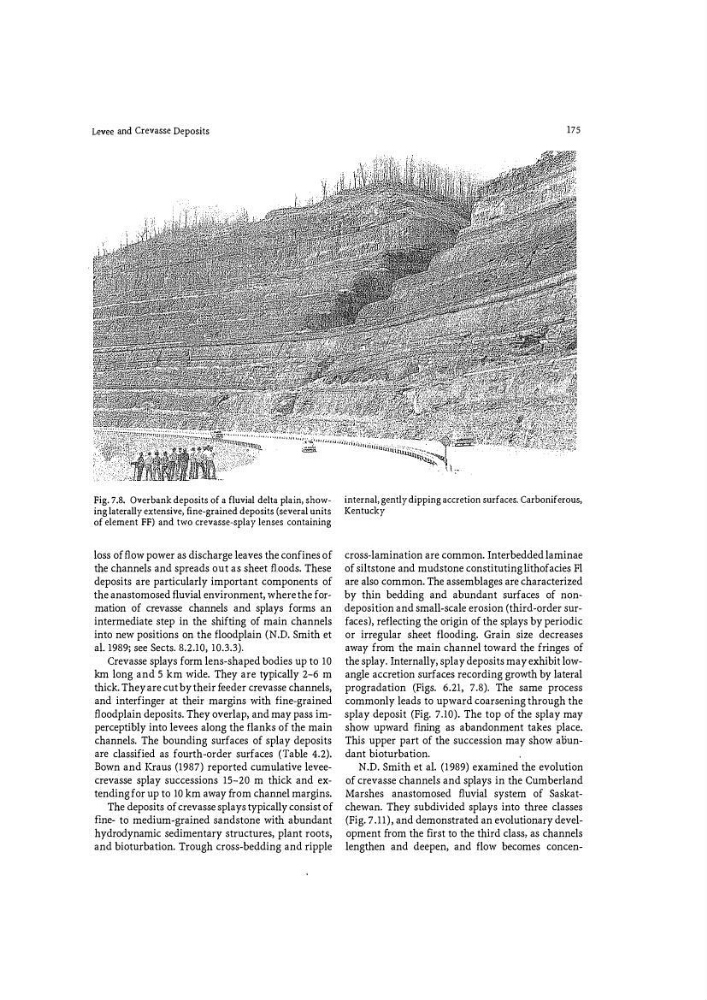
Fig. 7.8. Overbank deposits of a fluvial delta plain, showing laterally extensive, fi ne-grained deposits (several units
of element FF) and two crevasse-splay lenses containing
loss of flow power as discharge leaves the confines of
the channels and spreads out as sheet floods. These
deposits are particularly important components of
the anastomosed fluvial environment, where the formation of crevasse channels and splays forms an
intermediate step in the shifting of main channels
into new positions on the floodplain (N.D. Smith et
al. 1989; see Sects. 8.2.10, 10.3.3).
Crevasse splays form lens-shaped bodies up to 10
km long and 5 km wide. They are typically 2-6 m
thick. They are cut by their fe eder crevasse channels,
and interfinger at their margins with fine�grained
floodplain deposits. They overlap, and may pass imperceptibly into levees along the flanks of the main
channels. The bounding surfaces of splay deposits
are classified as fourth-order surfaces (Table 4.2).
Bown and Kraus (1987) reported cumulative leveecrevasse splay successions 15-20 m thick and extending for up to 10 km away fr om channel margins.
The deposits of crevasse splays typically consist of
fine- to medium-grained sandstone with abundant
hydrodynamic sedimentary structures, plant roots,
and bioturbation. Trough cross-bedding and ripple
175
internal, gently dipping accretion surfaces. Carboniferous,
Kentucky
cross�lamination are common. Interbedded laminae
of siltstone and mudstone constituting lithofacies Fl
are also common. The assemblages are characterized
by thin bedding and abundant surfaces of nondeposition and small-scale erosion (third-order surfaces), reflecting the origin of the splays by periodic
or irregular sheet flooding. Grain size decreases
away from the main channel toward the fringes of
the splay. Internally, splay deposits may exhibit lowangle accretion surfaces recording growth by lateral
progradation (Figs. 6.21, 7.8). The same process
commonly leads to upward coarsening through the
splay deposit (Fig. 7.!0). The top of the splay may
show upward fining as abandonment takes place.
This upper part of the succession may show al:5undant bioturbation.
N.D. Smith et al. (1989) examined the evolution
of crevasse channels and splays in the Cumberland
Marshes anastomosed fl uvial system of Saskatchewan. They subdivided splays into three classes
(Fig. 7.11), and demonstrated an evolutionary development fr om the first to the third class, as channels
lengthen and deepen, and flow becomes concen-
Fig. 7.8. Overbank deposits of a fluvial delta plain, showing laterally extensive, fi ne-grained deposits (several units
of element FF) and two crevasse-splay lenses containing
loss of flow power as discharge leaves the confines of
the channels and spreads out as sheet floods. These
deposits are particularly important components of
the anastomosed fluvial environment, where the formation of crevasse channels and splays forms an
intermediate step in the shifting of main channels
into new positions on the floodplain (N.D. Smith et
al. 1989; see Sects. 8.2.10, 10.3.3).
Crevasse splays form lens-shaped bodies up to 10
km long and 5 km wide. They are typically 2-6 m
thick. They are cut by their fe eder crevasse channels,
and interfinger at their margins with fine�grained
floodplain deposits. They overlap, and may pass imperceptibly into levees along the flanks of the main
channels. The bounding surfaces of splay deposits
are classified as fourth-order surfaces (Table 4.2).
Bown and Kraus (1987) reported cumulative leveecrevasse splay successions 15-20 m thick and extending for up to 10 km away fr om channel margins.
The deposits of crevasse splays typically consist of
fine- to medium-grained sandstone with abundant
hydrodynamic sedimentary structures, plant roots,
and bioturbation. Trough cross-bedding and ripple
175
internal, gently dipping accretion surfaces. Carboniferous,
Kentucky
cross�lamination are common. Interbedded laminae
of siltstone and mudstone constituting lithofacies Fl
are also common. The assemblages are characterized
by thin bedding and abundant surfaces of nondeposition and small-scale erosion (third-order surfaces), reflecting the origin of the splays by periodic
or irregular sheet flooding. Grain size decreases
away from the main channel toward the fringes of
the splay. Internally, splay deposits may exhibit lowangle accretion surfaces recording growth by lateral
progradation (Figs. 6.21, 7.8). The same process
commonly leads to upward coarsening through the
splay deposit (Fig. 7.!0). The top of the splay may
show upward fining as abandonment takes place.
This upper part of the succession may show al:5undant bioturbation.
N.D. Smith et al. (1989) examined the evolution
of crevasse channels and splays in the Cumberland
Marshes anastomosed fl uvial system of Saskatchewan. They subdivided splays into three classes
(Fig. 7.11), and demonstrated an evolutionary development fr om the first to the third class, as channels
lengthen and deepen, and flow becomes concen-