

Levee and Crevasse Deposits
Levees typically consist of rhythmically bedded
units of silty, ripple�laminated sand a few decimeters
thick (lithofacies Fl; Fig. 7.5). Bioturbation or root
development commonly obscures lamination.
Abundant vertebrate remains may be present (Bown
and Kraus 1987). Each sedimentary rhythm represents a fl ood event. The levee element may reach 10
m in thickness, and constitutes a tapering wedge of
deposit, thinning and fining away from the channel
margin. Paleocurrent measurements made on con�
tained ripple cross�lamination indicate flow perpendicular to the channel or obliquely downstream,
away from the channel margin (e.g., Coleman 1969).
7 .2.2 Crevasse-Channel Deposits (Element CR)
The scale of crevasse channels depends on the scale
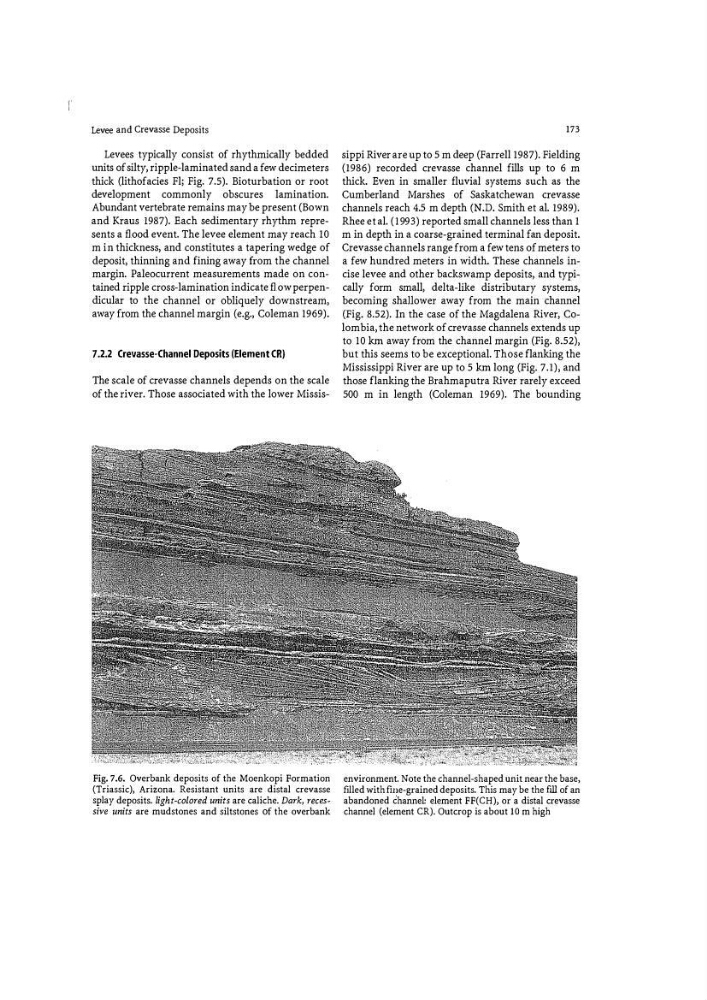
of the river. Those associated with the lower MissisFig. 7.6. Overbank deposits of the Moenkopi Formation
(Triassic), Arizona. Resistant units are distal crevasse
splay deposits. ligh t-colored units are caliche. Dark, recessive units are mudstones and siltstones of the overbank
173
sippi River are up to 5 m deep (Farrell 1987). Fielding
(1986) recorded crevasse channel fills up to 6 m
thick. Even in smaller fluvial systems such as the
Cumberland Marshes of Saskatchewan crevasse
channels reach 4.5 m depth (N.D. Smith et al. 1989).
Rhee et al. (1993) reported small channels less than 1
min depth in a coarse-grained terminal fan deposit.
Crevasse channels range from a few tens of meters to
a few hundred meters in width. These channels incise levee and other backswamp deposits> and typically form small, delta-like distributary systems,
becoming shallower away from the main channel
(Fig. 8.52). In the case of the Magdalena River, Colombia, the network of crevasse channels extends up
to 10 km away from the channel margin (Fig. 8.52),
but this seems to be exceptional. Those flanking the
Mississippi River are up to 5 km long (Fig. 7.1), and
those flanking the Brahmaputra River rarely exceed
500 m in length (Coleman 1969). The bounding
environment. Note the channel-shaped unit near the base,
fllled with fiJ?-e-grained deposits. This may be the f ill of an
abandoned channel: element FF(CH), or a distal crevasse
channel (element CR). Outcrop is about 10 m high
Levees typically consist of rhythmically bedded
units of silty, ripple�laminated sand a few decimeters
thick (lithofacies Fl; Fig. 7.5). Bioturbation or root
development commonly obscures lamination.
Abundant vertebrate remains may be present (Bown
and Kraus 1987). Each sedimentary rhythm represents a fl ood event. The levee element may reach 10
m in thickness, and constitutes a tapering wedge of
deposit, thinning and fining away from the channel
margin. Paleocurrent measurements made on con�
tained ripple cross�lamination indicate flow perpendicular to the channel or obliquely downstream,
away from the channel margin (e.g., Coleman 1969).
7 .2.2 Crevasse-Channel Deposits (Element CR)
The scale of crevasse channels depends on the scale
of the river. Those associated with the lower MissisFig. 7.6. Overbank deposits of the Moenkopi Formation
(Triassic), Arizona. Resistant units are distal crevasse
splay deposits. ligh t-colored units are caliche. Dark, recessive units are mudstones and siltstones of the overbank
173
sippi River are up to 5 m deep (Farrell 1987). Fielding
(1986) recorded crevasse channel fills up to 6 m
thick. Even in smaller fluvial systems such as the
Cumberland Marshes of Saskatchewan crevasse
channels reach 4.5 m depth (N.D. Smith et al. 1989).
Rhee et al. (1993) reported small channels less than 1
min depth in a coarse-grained terminal fan deposit.
Crevasse channels range from a few tens of meters to
a few hundred meters in width. These channels incise levee and other backswamp deposits> and typically form small, delta-like distributary systems,
becoming shallower away from the main channel
(Fig. 8.52). In the case of the Magdalena River, Colombia, the network of crevasse channels extends up
to 10 km away from the channel margin (Fig. 8.52),
but this seems to be exceptional. Those flanking the
Mississippi River are up to 5 km long (Fig. 7.1), and
those flanking the Brahmaputra River rarely exceed
500 m in length (Coleman 1969). The bounding
environment. Note the channel-shaped unit near the base,
fllled with fiJ?-e-grained deposits. This may be the f ill of an
abandoned channel: element FF(CH), or a distal crevasse
channel (element CR). Outcrop is about 10 m high