

Hollows (Element HO)
165
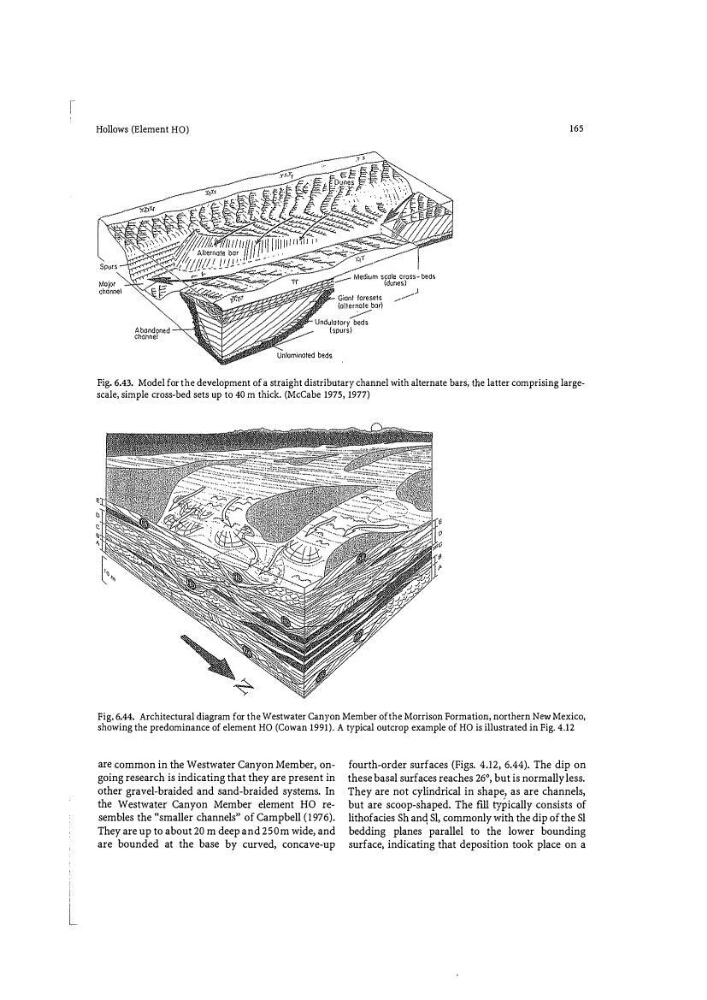
Fig. 6.43. Model for the development of a stJ;aight distributary channel with alternate bars, the latter comprising large�
scale, simple cross-bed sets up to 40 m thick. (McCabe 1975, 1977)
Fig. 6.44. Architectural diagram for the Westwater Canyon Member ofthe Morrison Formation, northern New Mexico,
showing the predominance of element HO (Cowan 1991). A typical outcrop example of HO is illustrated in Fig. 4.12
are common in the Westwater Canyon Member, ongoing research is indicating that they are present in
other gravel-braided and sand-braided systems. In
the Westwater· Canyon Member element HO resembles the "smaller channels" of Campbell (1976).
They are up to about 20 m deep and 250m wide, and
are bounded at the base by curved, concave-up
fourth-order surfaces (Figs. 4.12, 6.44). The dip on
these basal surfaces reaches 26", but is normally less.
They are not cylindrical in shape, as are channels,
but are scoop-shaped. The fill typically consists of
lithofacies Sh and Sl, commonly with the dip of the Sl
bedding planes parallel to the lower bounding
surface, indicating that deposition took place on a
165
Fig. 6.43. Model for the development of a stJ;aight distributary channel with alternate bars, the latter comprising large�
scale, simple cross-bed sets up to 40 m thick. (McCabe 1975, 1977)
Fig. 6.44. Architectural diagram for the Westwater Canyon Member ofthe Morrison Formation, northern New Mexico,
showing the predominance of element HO (Cowan 1991). A typical outcrop example of HO is illustrated in Fig. 4.12
are common in the Westwater Canyon Member, ongoing research is indicating that they are present in
other gravel-braided and sand-braided systems. In
the Westwater· Canyon Member element HO resembles the "smaller channels" of Campbell (1976).
They are up to about 20 m deep and 250m wide, and
are bounded at the base by curved, concave-up
fourth-order surfaces (Figs. 4.12, 6.44). The dip on
these basal surfaces reaches 26", but is normally less.
They are not cylindrical in shape, as are channels,
but are scoop-shaped. The fill typically consists of
lithofacies Sh and Sl, commonly with the dip of the Sl
bedding planes parallel to the lower bounding
surface, indicating that deposition took place on a