

166
'"a
Widdale �
Beck
� ' o o
. '-... � %0
c
d
d
River Ure
sca!e1or
cross-sectlom;
sol �!� ticot
o�oggerouan x4
0
"'
Architectural Elements Formed Within Channels
KEY
bed elevation contours (em)
avalanche face adges
0 e line of section
* bose of scour (Ocm elevation)
10
20 motro�
ob
:�� 0 -
•
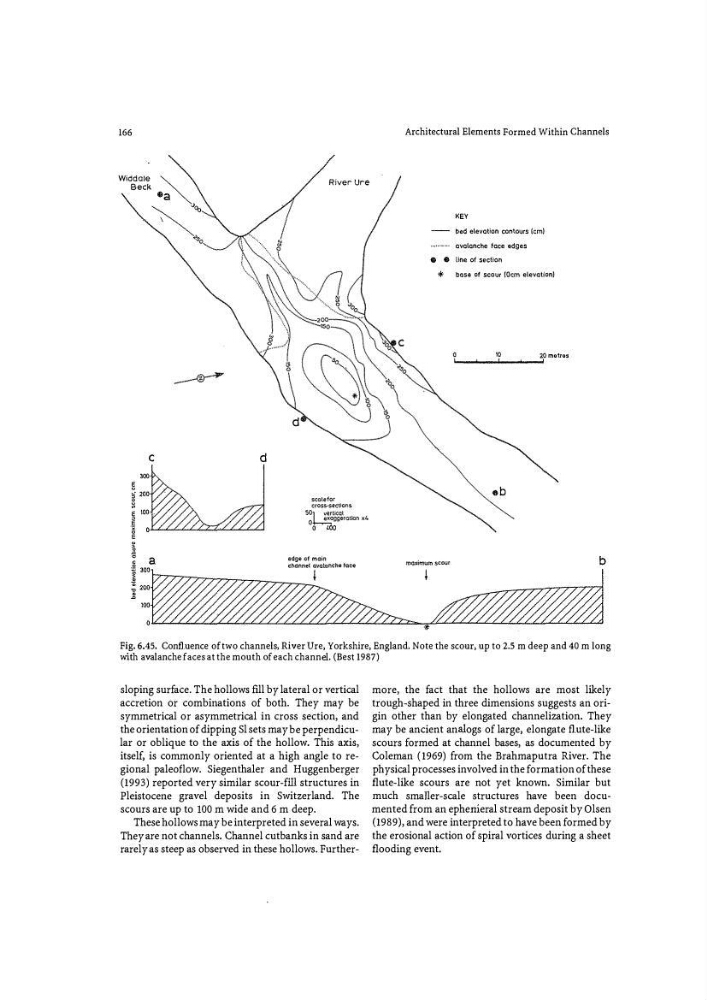
Fig. 6.45. Confluence of two channels> River Ure, Yorkshire, England. Note the scour, up to 2.5 m deep and 40 m long
with avalanche faces at the mouth of each channel. (Best 1987)
sloping surface. The hollows fill by lateral or vertical
accretion or combinations of both. They may be
symmetrical or asymmetrical in cross section, and
the orientation of dipping Sl sets may be perpendicular or oblique to the axis of the hollow. This axis,
itself, is commonly oriented at a high angle to re�
gional paleoflow. Siegenthaler and Huggenberger
(1993) reported very similar scour-fill structures in
Pleistocene gravel deposits in Switzerland. The
scours are up to 100 m wide and 6 m deep.
These hollows may be interpreted in several ways.
They are not channels. Channel cutbanks in sand are
rarely as steep as observed in these hollows. Furthermore, the fact that the hollows are most likely
trough-shaped in three dimensions suggests an origin other than by elongated channelization. They
may be ancient analogs of large, elongate flute-like
scours formed at channel bases, as documented by
Coleman (1969) from the Brahmaputra River. The
physical processes involved in the formation of these
flute-like scours are not yet known. Similar but
much smaller-scale structures have been documented from an epherrieral stream deposit by Olsen
(1989), and were interpreted to have been formed by
the erosional action of spiral vortices during a sheet
flooding event.
'"a
Widdale �
Beck
� ' o o
. '-... � %0
c
d
d
River Ure
sca!e1or
cross-sectlom;
sol �!� ticot
o�oggerouan x4
0
"'
Architectural Elements Formed Within Channels
KEY
bed elevation contours (em)
avalanche face adges
0 e line of section
* bose of scour (Ocm elevation)
10
20 motro�
ob
:�� 0 -
•
Fig. 6.45. Confluence of two channels> River Ure, Yorkshire, England. Note the scour, up to 2.5 m deep and 40 m long
with avalanche faces at the mouth of each channel. (Best 1987)
sloping surface. The hollows fill by lateral or vertical
accretion or combinations of both. They may be
symmetrical or asymmetrical in cross section, and
the orientation of dipping Sl sets may be perpendicular or oblique to the axis of the hollow. This axis,
itself, is commonly oriented at a high angle to re�
gional paleoflow. Siegenthaler and Huggenberger
(1993) reported very similar scour-fill structures in
Pleistocene gravel deposits in Switzerland. The
scours are up to 100 m wide and 6 m deep.
These hollows may be interpreted in several ways.
They are not channels. Channel cutbanks in sand are
rarely as steep as observed in these hollows. Furthermore, the fact that the hollows are most likely
trough-shaped in three dimensions suggests an origin other than by elongated channelization. They
may be ancient analogs of large, elongate flute-like
scours formed at channel bases, as documented by
Coleman (1969) from the Brahmaputra River. The
physical processes involved in the formation of these
flute-like scours are not yet known. Similar but
much smaller-scale structures have been documented from an epherrieral stream deposit by Olsen
(1989), and were interpreted to have been formed by
the erosional action of spiral vortices during a sheet
flooding event.