

Later al-Accretion Deposits (Element LA)
A
Fig. 6.34. Models of meander migration. Arrows show
migration paths. A Translation; B expansion; C rotation; D
wavelength variation; E complex evolution. (Willis 1989)
and channels-, and this obscures the simple geometry
of the LA element (e.g., Schwartz 1978). Lateralaccretion surfaces may be difficult to identify in such
deposits.
Lithofacies assemblages within lateral-accretion
deposits vary markedly, depending on the caliber of
the sediment load, and on discharge variability. LA
elements can be classified into four groups, according to grain size and facies. Earlier classifications by
Jackson (1981) and Smith (1987) have been incorporated into the present subdivision. Gradations between the four groups are to be expected even within
a single fluvial deposit, as a result of variations in the
energy of discharge events, meander evolution, etc.
(some of these variations are discussed in Chap. 8),
plus longer-term changes in tectonic and climatic
control. Examples of descriptions of these groups are
as follows, with the fluvial-style model numbers of
Miall (1985) indicated:
Gravel Rivers (Mode/ 4). Gravel-dominated deposits are
relatively rare, ap.d in most gravelly fluvial deposits
(f)
�
(e)
(a-e)
�CZ§i;
�
if)
159
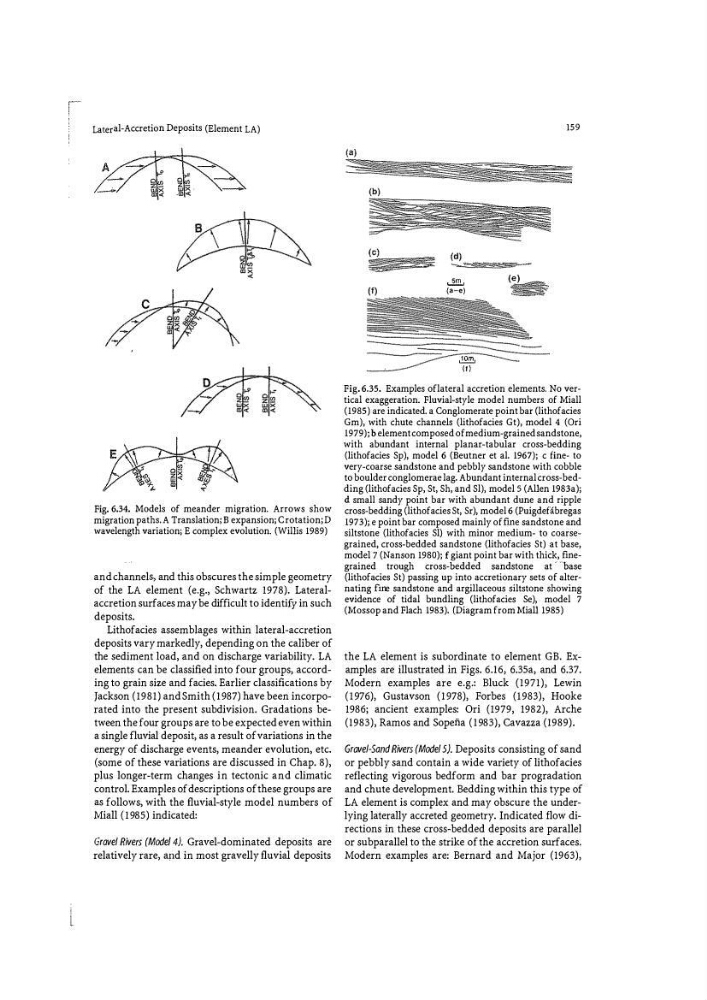
Fig. 6.35. Examples oflateral accretion elements. No vertical exaggeration. Fluvial-style model numbers of Miall
(1985) are indicated. a Conglomerate point bar (lithofacies
Gm), with chute channels (lithofacies Gt), model 4 (Ori
1979); b element composed of medium-grained sandstone,
with abundant internal planar-tabular cross-bedding
(lithofacies Sp), model 6 (Beutner et al. 1967); c fine- to
very-coarse sandstone and pebbly sandstone with cobble
to boulder conglomerae lag. Abundant internal cross-bedding (lithofacies Sp, St, Sh, and Sl), model s (Allen 1983a);
d small sandy point bar with abundant dune and ripple
cross-bedding (lithofacies St, Sr), model 6 (Puigdefabregas
1973); e point bar composed mainly of fm e sandstone and
siltstone (lithofacies Sl) with minor medium- to coarsegrained, cross-bedded sandstone (lithofacies St) at base,
model ? (Nanson 1980); f giant point bar with thick, fm egrained trough cross-bedded sandstone at · �·base
(lithofacies St) passing up into accretionary sets of alternating fme sandstone and argillaceous siltstone showing
evidence of tidal bundling (lithofacies Se), model 7
(Mossop and Flach 1983). {Diagram from Miall l985)
the LA element is subordinate to element GB. Examples are illustrated in Figs. 6.16, 6.35a, and 6.37.
Modern examples are e.g.: Bluck (1971), Lewin
(1976), Gustavson (1978), Forbes (1983), Hooke
1986; ancient examples: Ori (1979, 1982), Arche
(1983), Ramos and Sopefia (1983), Cavazza (1989).
Gravel-Sand Rivers (Mode/ 5). Deposits consisting of sand
or pebbly sand contain a wide variety of lithofacies
reflecting vigorous bedform and bar progradation
and chute development. Bedding within this type of
LA element is complex and may obscure the underlying laterally accreted geometry. Indicated flow directions in these cross-bedded deposits are parallel
or subparallel to the strike of the accretion surfaces.
Modern examples are: Bernard and Major (1963),
A
Fig. 6.34. Models of meander migration. Arrows show
migration paths. A Translation; B expansion; C rotation; D
wavelength variation; E complex evolution. (Willis 1989)
and channels-, and this obscures the simple geometry
of the LA element (e.g., Schwartz 1978). Lateralaccretion surfaces may be difficult to identify in such
deposits.
Lithofacies assemblages within lateral-accretion
deposits vary markedly, depending on the caliber of
the sediment load, and on discharge variability. LA
elements can be classified into four groups, according to grain size and facies. Earlier classifications by
Jackson (1981) and Smith (1987) have been incorporated into the present subdivision. Gradations between the four groups are to be expected even within
a single fluvial deposit, as a result of variations in the
energy of discharge events, meander evolution, etc.
(some of these variations are discussed in Chap. 8),
plus longer-term changes in tectonic and climatic
control. Examples of descriptions of these groups are
as follows, with the fluvial-style model numbers of
Miall (1985) indicated:
Gravel Rivers (Mode/ 4). Gravel-dominated deposits are
relatively rare, ap.d in most gravelly fluvial deposits
(f)
�
(e)
(a-e)
�CZ§i;
�
if)
159
Fig. 6.35. Examples oflateral accretion elements. No vertical exaggeration. Fluvial-style model numbers of Miall
(1985) are indicated. a Conglomerate point bar (lithofacies
Gm), with chute channels (lithofacies Gt), model 4 (Ori
1979); b element composed of medium-grained sandstone,
with abundant internal planar-tabular cross-bedding
(lithofacies Sp), model 6 (Beutner et al. 1967); c fine- to
very-coarse sandstone and pebbly sandstone with cobble
to boulder conglomerae lag. Abundant internal cross-bedding (lithofacies Sp, St, Sh, and Sl), model s (Allen 1983a);
d small sandy point bar with abundant dune and ripple
cross-bedding (lithofacies St, Sr), model 6 (Puigdefabregas
1973); e point bar composed mainly of fm e sandstone and
siltstone (lithofacies Sl) with minor medium- to coarsegrained, cross-bedded sandstone (lithofacies St) at base,
model ? (Nanson 1980); f giant point bar with thick, fm egrained trough cross-bedded sandstone at · �·base
(lithofacies St) passing up into accretionary sets of alternating fme sandstone and argillaceous siltstone showing
evidence of tidal bundling (lithofacies Se), model 7
(Mossop and Flach 1983). {Diagram from Miall l985)
the LA element is subordinate to element GB. Examples are illustrated in Figs. 6.16, 6.35a, and 6.37.
Modern examples are e.g.: Bluck (1971), Lewin
(1976), Gustavson (1978), Forbes (1983), Hooke
1986; ancient examples: Ori (1979, 1982), Arche
(1983), Ramos and Sopefia (1983), Cavazza (1989).
Gravel-Sand Rivers (Mode/ 5). Deposits consisting of sand
or pebbly sand contain a wide variety of lithofacies
reflecting vigorous bedform and bar progradation
and chute development. Bedding within this type of
LA element is complex and may obscure the underlying laterally accreted geometry. Indicated flow directions in these cross-bedded deposits are parallel
or subparallel to the strike of the accretion surfaces.
Modern examples are: Bernard and Major (1963),