

Gravel Bars and Bedforms (Element GB)
fining and coarsening within the gravel deposits are
discussed in Sect. 5.2.1.2. Gustavson (1978) and
Massari (1983) noted the close relationship between
the three main gravel lithofacies and confirmed the
general model developed by Rein and Walker
(1977).
These gravel mesoforms are amalgamated into
macroforms (bars) in several ways. Our present understanding of gravel macro forms follows from the
classic work of Leopold and Wolman (1957), who
modeled the formation of midchannel bars in a
flume. Observations in modern rivers by Hickin
(1969), Bluck (1971), Lewin (1976), Gustavson
(1978), Forbes ( 1983), Ferguson and Werritty ( 1983),
Hooke (1986), and Carson (1986) were synthesized
by Ashmore (1991), who carried out a series of flume
runs to demonstrate the major processes. Ferguson
( 1993) also provided a useful review of braiding processes in gravel-bed rivers.
Bar types include midchannel and bank-attached
types. The latter are termed point, alternate, or
lateral bars depending on their shape and position.
Transverse bar margin (with slip !ace)
--•••• ---...
Sed·load sheet margin (no sli!)lace)
Flow direction
EX{losed or inactive bar surfaces
�
Cut bank
..,.,_...,_, Scour hole or pool
Scour chute
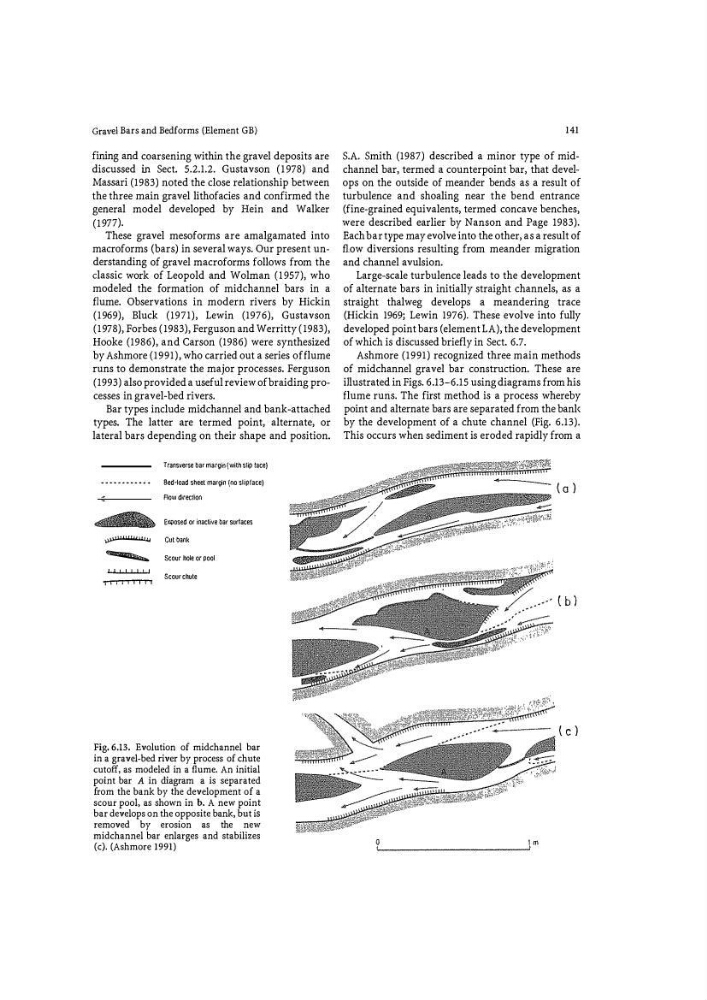
Fig. 6.13. Evolution of midchannel bar
in a gravel-bed river by process of chute
cutoff, as modeled in a flume. An initial
point bar A in diagram a is separated
fr om the bank by the development of a
scour pool, as shown in b. A new point
bar develops on the opposite bank, but is
removed by erosion as the new
midchannel bar enlarges and stabilizes
(c). (Ashmore 1991)
141
S.A. Smith (1987) described a minor type of midchannel bar, termed a counterpoint bar, that develops on the outside of meander bends as a result of
turbulence and shoaling near the bend entrance
(fine-grained equivalents, termed concave benches )
were described earlier by Nanson and Page 1983).
Each bar type may evolve into the other, as a result of
flow diversions resulting from meander migration
and channel avulsion.
Large-scale turbulence leads to the development
of alternate bars in initially straight channels, as a
straight thalweg develops a meandering trace
(Hickin 1969; Lewin 1976). These evolve into fully
developed point bars (element LA), the development
of which is discussed briefly in Sect. 6.7.
Ashmore (1991) recognized three main methods
of midchannel gravel bar construction. These are
illustrated in Figs. 6.13-6.15 using diagrams from his
flume runs. The first method is a process whereby
point and alternate bars are separated from the banlc
by the development of a chute channel (Fig. 6.13).
This occurs when sediment is eroded rapidly from a
(a )
( b)
( c )
0
1m
c__ ______ _,
fining and coarsening within the gravel deposits are
discussed in Sect. 5.2.1.2. Gustavson (1978) and
Massari (1983) noted the close relationship between
the three main gravel lithofacies and confirmed the
general model developed by Rein and Walker
(1977).
These gravel mesoforms are amalgamated into
macroforms (bars) in several ways. Our present understanding of gravel macro forms follows from the
classic work of Leopold and Wolman (1957), who
modeled the formation of midchannel bars in a
flume. Observations in modern rivers by Hickin
(1969), Bluck (1971), Lewin (1976), Gustavson
(1978), Forbes ( 1983), Ferguson and Werritty ( 1983),
Hooke (1986), and Carson (1986) were synthesized
by Ashmore (1991), who carried out a series of flume
runs to demonstrate the major processes. Ferguson
( 1993) also provided a useful review of braiding processes in gravel-bed rivers.
Bar types include midchannel and bank-attached
types. The latter are termed point, alternate, or
lateral bars depending on their shape and position.
Transverse bar margin (with slip !ace)
--•••• ---...
Sed·load sheet margin (no sli!)lace)
Flow direction
EX{losed or inactive bar surfaces
�
Cut bank
..,.,_...,_, Scour hole or pool
Scour chute
Fig. 6.13. Evolution of midchannel bar
in a gravel-bed river by process of chute
cutoff, as modeled in a flume. An initial
point bar A in diagram a is separated
fr om the bank by the development of a
scour pool, as shown in b. A new point
bar develops on the opposite bank, but is
removed by erosion as the new
midchannel bar enlarges and stabilizes
(c). (Ashmore 1991)
141
S.A. Smith (1987) described a minor type of midchannel bar, termed a counterpoint bar, that develops on the outside of meander bends as a result of
turbulence and shoaling near the bend entrance
(fine-grained equivalents, termed concave benches )
were described earlier by Nanson and Page 1983).
Each bar type may evolve into the other, as a result of
flow diversions resulting from meander migration
and channel avulsion.
Large-scale turbulence leads to the development
of alternate bars in initially straight channels, as a
straight thalweg develops a meandering trace
(Hickin 1969; Lewin 1976). These evolve into fully
developed point bars (element LA), the development
of which is discussed briefly in Sect. 6.7.
Ashmore (1991) recognized three main methods
of midchannel gravel bar construction. These are
illustrated in Figs. 6.13-6.15 using diagrams from his
flume runs. The first method is a process whereby
point and alternate bars are separated from the banlc
by the development of a chute channel (Fig. 6.13).
This occurs when sediment is eroded rapidly from a
(a )
( b)
( c )
0
1m
c__ ______ _,