

142
Architectural Elements Formed Within Channels
-�- :.;,;;,; ;;.
� ( a l
:- · · · ··· ·· · · ·
""'-'
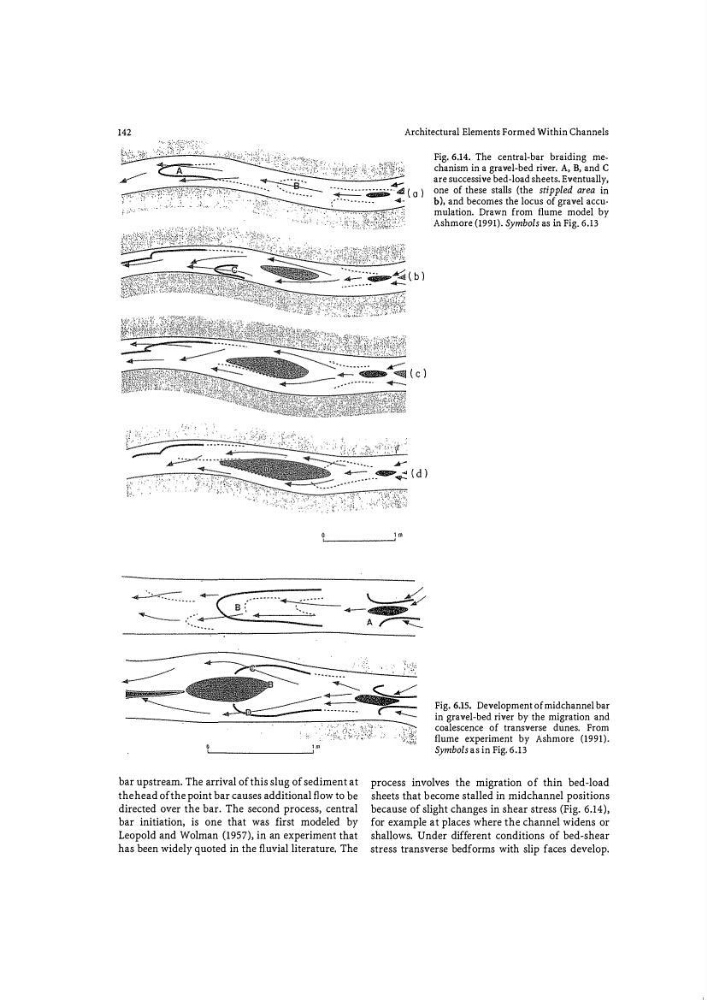
Fig. 6.14. The central�bar braiding mechanism in a gravel�bed river. A, B, and C
are successive bed-load sheets. Eventually,
one of these stalls (the stippled area in
b), and becomes the locus of gravel accumulation. Drawn from flume model by
Ashmore (1991). Sy mbols as in Fig. 6.13
··� :"
··.JY"'
---- �(d)
'--- --�
'm
· - - - �
-
. . .. --- - -
- � -- ·····
B:
' -
-.___ _ .-.- _- _- __ __ _
'
·-->m
�--- -�
bar upstream. The arrival of this slug of sediment at
the head of the point bar causes additional fl ow to be
directed over the bar. The second process, central
bar initiation, is one that was first modeled by
Leopold and Wolman (1957), in an experiment that
has been widely quoted in the fluvial literature, The
Fig. 6.15. Development of midchannel bar
in gravel-bed river by the migration and
coalescence of transverse dunes. From
flume experiment by Ashmore (1991).
Sy mbols as in Fig. 6.13
process involves the migration of thin bed�load
sheets that become stalled in midchannel positions
because of slight changes in shear stress (Fig. 6.14),
for example at places where the channel widens or
shallows. Under different conditions of bed-shear
stress transverse bedforms with slip faces develop.
Architectural Elements Formed Within Channels
-�- :.;,;;,; ;;.
� ( a l
:- · · · ··· ·· · · ·
""'-'
Fig. 6.14. The central�bar braiding mechanism in a gravel�bed river. A, B, and C
are successive bed-load sheets. Eventually,
one of these stalls (the stippled area in
b), and becomes the locus of gravel accumulation. Drawn from flume model by
Ashmore (1991). Sy mbols as in Fig. 6.13
··� :"
··.JY"'
---- �(d)
'--- --�
'm
· - - - �
-
. . .. --- - -
- � -- ·····
B:
' -
-.___ _ .-.- _- _- __ __ _
'
·-->m
�--- -�
bar upstream. The arrival of this slug of sediment at
the head of the point bar causes additional fl ow to be
directed over the bar. The second process, central
bar initiation, is one that was first modeled by
Leopold and Wolman (1957), in an experiment that
has been widely quoted in the fluvial literature, The
Fig. 6.15. Development of midchannel bar
in gravel-bed river by the migration and
coalescence of transverse dunes. From
flume experiment by Ashmore (1991).
Sy mbols as in Fig. 6.13
process involves the migration of thin bed�load
sheets that become stalled in midchannel positions
because of slight changes in shear stress (Fig. 6.14),
for example at places where the channel widens or
shallows. Under different conditions of bed-shear
stress transverse bedforms with slip faces develop.