

140
(!992) showed that transport is not regular at any
point in a braided system, but occurs as a series of
pulses or sediment ·�slugs'' at different spatial and
temporal scales. Stochastic variations in entrainment are responsible for some pulses, and bar erosion, channel avulsion, and tributary supply may
feed gravel into the system at irregular rates. In
natural systems, these sediment pulses are several
hours in duration, and have a significant effect on
channel and bar development, as summarized below.
The simplest deposits are the thin, diffuse gravel
sheets of Hein and Walker (!977), which are a few
clasts thick, have diffuse, lobate margins, and move
only during peak fl ow (lithofacies Gh). During epiArchitectural Elements Formed Within Channels
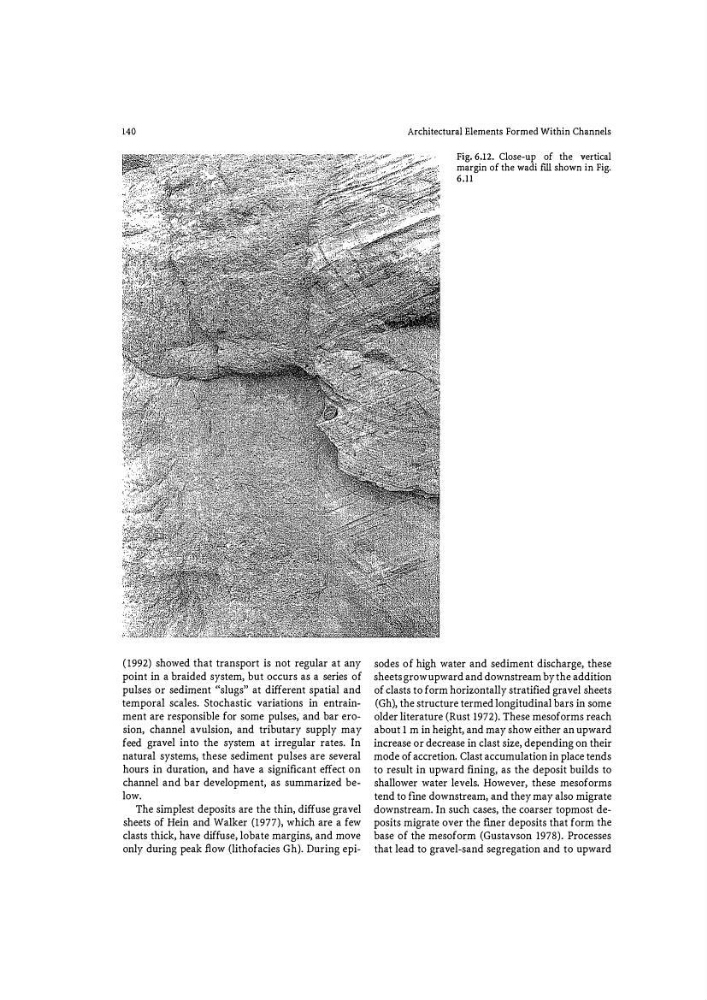
Fig. 6.12. Close-up of the vertical
margin of the wadi fill shown in Fig.
6.11
sodes of high water and sediment discharge, these
sheets grow upward and downstream by the addition
of clasts to form horizontally stratified gravel sheets
(Gh), the structure termed longitudinal bars in some
older literature (Rust 1972). These mesoforms reach
about 1 min height, and may show either an upward
increase or decrease in clast size, dt:!pending on their
mode of accretion. Clast accumulation in place tends
to result in upward fining, as the deposit builds to
shallower water levels. However, these mesoforms
tend to fine downstream, and they may also migrate
downstream. In such cases, the coarser topmost deposits migrate over the fm er deposits that form the
base of the mesoform (Gustavson 1978). Processes
that lead to gravel-sand segregation and to upward
(!992) showed that transport is not regular at any
point in a braided system, but occurs as a series of
pulses or sediment ·�slugs'' at different spatial and
temporal scales. Stochastic variations in entrainment are responsible for some pulses, and bar erosion, channel avulsion, and tributary supply may
feed gravel into the system at irregular rates. In
natural systems, these sediment pulses are several
hours in duration, and have a significant effect on
channel and bar development, as summarized below.
The simplest deposits are the thin, diffuse gravel
sheets of Hein and Walker (!977), which are a few
clasts thick, have diffuse, lobate margins, and move
only during peak fl ow (lithofacies Gh). During epiArchitectural Elements Formed Within Channels
Fig. 6.12. Close-up of the vertical
margin of the wadi fill shown in Fig.
6.11
sodes of high water and sediment discharge, these
sheets grow upward and downstream by the addition
of clasts to form horizontally stratified gravel sheets
(Gh), the structure termed longitudinal bars in some
older literature (Rust 1972). These mesoforms reach
about 1 min height, and may show either an upward
increase or decrease in clast size, dt:!pending on their
mode of accretion. Clast accumulation in place tends
to result in upward fining, as the deposit builds to
shallower water levels. However, these mesoforms
tend to fine downstream, and they may also migrate
downstream. In such cases, the coarser topmost deposits migrate over the fm er deposits that form the
base of the mesoform (Gustavson 1978). Processes
that lead to gravel-sand segregation and to upward