

114
-2
100
10
E
>:t
w
0.1
:t
0.01
0.001
-1
0
H • 0.0677 L
0·8098
n = 1491
r = 0.98
Lithofacies
log L
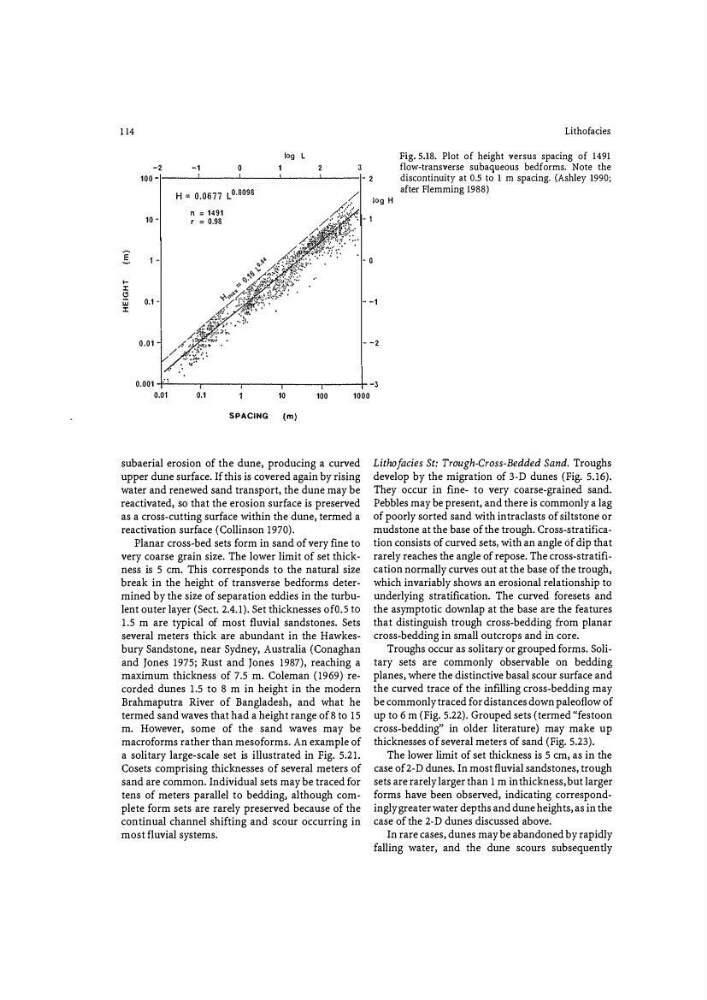
Fig. 5.18. Plot of height versus spacing of 1491
1
2
3
flow�transverse subaqueous bedforms. Note the
2
discontinuity at 0.5 to 1 m spacing. (Ashley 1990;
after Flemming 1988)
log H
-1
-2
-3
0.01
0.1
10
100
1000
SPACING
(m)
subaerial erosion of the dune, producing a curved
upper dune surface. If this is covered again by rising
water and renewed sand transport, the dune may be
reactivated, so that the erosion surface is preserved
as a cross-cutting surface within the dune, termed a
reactivation surface (Collinson 1970).
Planar cross-bed sets form in sand of very fine to
very coarse grain size. The lower limit of set thickness is 5 em. This corresponds to the natural size
break in the height of transverse bedforms determined by the size of separation eddies in the turbulent outer layer (Sect. 2.4.1). Set thicknesses ofO.S \0
1.5 m are typical of most fluvial sandstones. Sets
several meters thick are abundant in the Hawkesbury Sandstone, near Sydney, Australia ( Conaghan
and jones 1975; Rust and jones 1987), reaching a
maximum thickness of 7.5 m. Coleman (1969) recorded dunes 1.5 to 8 m in height in the modern
Brahmaputra River of Bangladesh, and what he
termed sand waves that had a height range of 8 to 15
m. However, some of the sand waves may be
macroforms rather than mesoforms. An example of
a solitary large-scale set is illustrated in Fig. 5.21.
Cosets comprising thicknesses of several meters of
sand are common. Individual sets may be traced for
tens of meters parallel to bedding, although complete form sets are rarely preserved because of the
continual channel shifting and scour occurring in
most fluvial systems.
Lithofacies St: Trough-Cross-Bedded Sand. Troughs
develop by the migration of 3-D dunes (Fig. 5.16).
They occur in fine- to very coarse-grained sand.
Pebbles may be present, and there is commonly a lag
of poorly sorted sand with intraclasts of siltstone or
mudstone at the base of the trough. Cross-stratification consists of curved sets1 with an angle Of dip that
rarely reaches the angle of repose. The cross-stratification normally curves out at the base of the trough,
which invariably shows an erosional relationship to
underlying stratification. The curved foresets and
the asymptotic downlap at the base are the features
that distinguish trough cross-bedding from planar
cross-bedding in small outcrops and in core.
Troughs occur as solitary or grouped forms. Solitary sets are commonly observable on bedding
planes, where the distinctive basal scour surface and
the curved trace of the infilling cross-bedding may
be commonly traced for distances down paleo flow of
up to 6 m (Fig. 5.22). Grouped sets (termed "festoon
cross-bedding'' in older literature) may make up
thicknesses of several meters of sand (Fig. 5.23).
The lower limit of set thickness is 5 em, as in the
case of 2-D dunes. In most fluvial sandstones, trough
sets are rarely larger than 1 min thickness, but larger
forms have been observed, indicating correspondingly greater water depths and dune heights, as in tbe
case of the 2-D dunes discussed above.
In rare cases, dunes may be abandoned by rapidly
falling water, and the dune scours subsequently
-2
100
10
E
>:t
w
0.1
:t
0.01
0.001
-1
0
H • 0.0677 L
0·8098
n = 1491
r = 0.98
Lithofacies
log L
Fig. 5.18. Plot of height versus spacing of 1491
1
2
3
flow�transverse subaqueous bedforms. Note the
2
discontinuity at 0.5 to 1 m spacing. (Ashley 1990;
after Flemming 1988)
log H
-1
-2
-3
0.01
0.1
10
100
1000
SPACING
(m)
subaerial erosion of the dune, producing a curved
upper dune surface. If this is covered again by rising
water and renewed sand transport, the dune may be
reactivated, so that the erosion surface is preserved
as a cross-cutting surface within the dune, termed a
reactivation surface (Collinson 1970).
Planar cross-bed sets form in sand of very fine to
very coarse grain size. The lower limit of set thickness is 5 em. This corresponds to the natural size
break in the height of transverse bedforms determined by the size of separation eddies in the turbulent outer layer (Sect. 2.4.1). Set thicknesses ofO.S \0
1.5 m are typical of most fluvial sandstones. Sets
several meters thick are abundant in the Hawkesbury Sandstone, near Sydney, Australia ( Conaghan
and jones 1975; Rust and jones 1987), reaching a
maximum thickness of 7.5 m. Coleman (1969) recorded dunes 1.5 to 8 m in height in the modern
Brahmaputra River of Bangladesh, and what he
termed sand waves that had a height range of 8 to 15
m. However, some of the sand waves may be
macroforms rather than mesoforms. An example of
a solitary large-scale set is illustrated in Fig. 5.21.
Cosets comprising thicknesses of several meters of
sand are common. Individual sets may be traced for
tens of meters parallel to bedding, although complete form sets are rarely preserved because of the
continual channel shifting and scour occurring in
most fluvial systems.
Lithofacies St: Trough-Cross-Bedded Sand. Troughs
develop by the migration of 3-D dunes (Fig. 5.16).
They occur in fine- to very coarse-grained sand.
Pebbles may be present, and there is commonly a lag
of poorly sorted sand with intraclasts of siltstone or
mudstone at the base of the trough. Cross-stratification consists of curved sets1 with an angle Of dip that
rarely reaches the angle of repose. The cross-stratification normally curves out at the base of the trough,
which invariably shows an erosional relationship to
underlying stratification. The curved foresets and
the asymptotic downlap at the base are the features
that distinguish trough cross-bedding from planar
cross-bedding in small outcrops and in core.
Troughs occur as solitary or grouped forms. Solitary sets are commonly observable on bedding
planes, where the distinctive basal scour surface and
the curved trace of the infilling cross-bedding may
be commonly traced for distances down paleo flow of
up to 6 m (Fig. 5.22). Grouped sets (termed "festoon
cross-bedding'' in older literature) may make up
thicknesses of several meters of sand (Fig. 5.23).
The lower limit of set thickness is 5 em, as in the
case of 2-D dunes. In most fluvial sandstones, trough
sets are rarely larger than 1 min thickness, but larger
forms have been observed, indicating correspondingly greater water depths and dune heights, as in tbe
case of the 2-D dunes discussed above.
In rare cases, dunes may be abandoned by rapidly
falling water, and the dune scours subsequently