

Sand Facies
E
:r:
120.0
10.0
5.0
BJ !.0
0
"
0
-'
"0.50
-
'
00
6
I
�
<9 • •
go 0 • •
o
�e 0
0
0 °
<&
0
• �
0
�·
o
0 9:; ea
e
0
•
0 1/!fl'
�·
0
0
•
" 6
A A
A
6
A
6 6
6
A A
6
6
..
ooco
A
=�
6
�
� 2
-
-
113
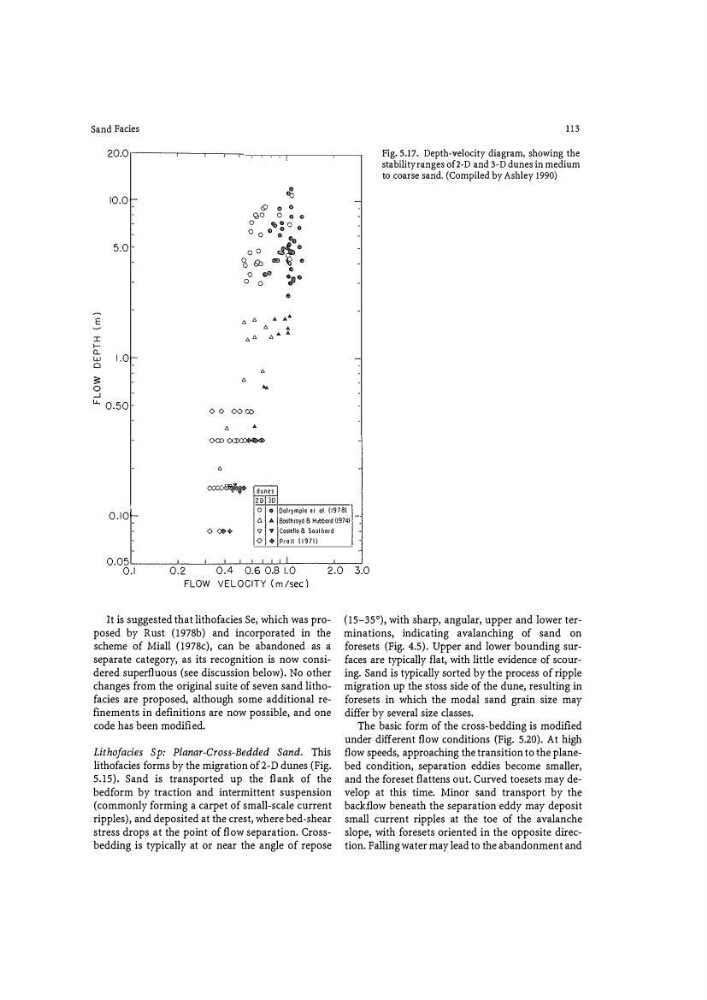
Fig. 5.17. Depth-velocity diagram, showing the
stability ranges of2-D and 3-D dunes in medium
to coarse sand. (Compiled by Ashley 1990)
0
o ! �olrymple et ol. (19781
�
6 : l :oo l h my ;B H�o"
0.10
001>9
9 v Costello a Soul hord
0 <$> Pro II ( 1971)
I
0.05
0.1
0.2
0.4 0.6 0.8 1.0
2.0 3.0
FLOW VELOCITY (m/sec )
It is suggested that lithofacies Se, which was proposed by Rust (1978b) and incorporated in the
scheme of Miall (1978c), can be abandoned as a
separate category, as its recognition is now considered superfluous (see discussion below). No other
changes from the original suite of seven sand lithofacies are proposed, although some additional refinements in definitions are now possible, and one
code has been modified.
Lithofa cies Sp: Planar-Cross-Bedded Sand. This
lithofacies forms by the migration of 2-D dunes (Fig.
5.15). Sand is transported up the flank of the
bedform by traction and intermittent suspension
(commonly forming a carpet of small-scale current
ripples), and deposited at the crest, where bed-shear
stress drops at the point of flow separation. Crossbedding is typically at or near the angle of repose
(15-35°), with sharp, angular, upper and lower terminations, indicating avalanching of sand on
foresets (Fig. 4.5). Upper and lower bounding surfaces are typically flat, with little evidence of scouring. Sand is typically sorted by the process of ripple
migration up the stoss side of the dune, resulting in
foresets in which the modal sand grain size may
differ by several size classes.
The basic form of the cross-bedding is modified
under different flow conditions (Fig. 5.20). At high
fl ow speeds, approaching the transition to the planebed condition, separation eddies become smaller,
and the foreset flattens out. Curved toesets may develop at this time. Minor sand transport by the
backflow beneath the separation eddy may deposit
small current ripples at the toe of the avalanche
slope, with foresets oriented in the opposite direction. Falling water may lead to the abandonment and
E
:r:
120.0
10.0
5.0
BJ !.0
0
"
0
-'
"0.50
-
'
00
6
I
�
<9 • •
go 0 • •
o
�e 0
0
0 °
<&
0
• �
0
�·
o
0 9:; ea
e
0
•
0 1/!fl'
�·
0
0
•
" 6
A A
A
6
A
6 6
6
A A
6
6
..
ooco
A
=�
6
�
� 2
-
-
113
Fig. 5.17. Depth-velocity diagram, showing the
stability ranges of2-D and 3-D dunes in medium
to coarse sand. (Compiled by Ashley 1990)
0
o ! �olrymple et ol. (19781
�
6 : l :oo l h my ;B H�o"
0.10
001>9
9 v Costello a Soul hord
0 <$> Pro II ( 1971)
I
0.05
0.1
0.2
0.4 0.6 0.8 1.0
2.0 3.0
FLOW VELOCITY (m/sec )
It is suggested that lithofacies Se, which was proposed by Rust (1978b) and incorporated in the
scheme of Miall (1978c), can be abandoned as a
separate category, as its recognition is now considered superfluous (see discussion below). No other
changes from the original suite of seven sand lithofacies are proposed, although some additional refinements in definitions are now possible, and one
code has been modified.
Lithofa cies Sp: Planar-Cross-Bedded Sand. This
lithofacies forms by the migration of 2-D dunes (Fig.
5.15). Sand is transported up the flank of the
bedform by traction and intermittent suspension
(commonly forming a carpet of small-scale current
ripples), and deposited at the crest, where bed-shear
stress drops at the point of flow separation. Crossbedding is typically at or near the angle of repose
(15-35°), with sharp, angular, upper and lower terminations, indicating avalanching of sand on
foresets (Fig. 4.5). Upper and lower bounding surfaces are typically flat, with little evidence of scouring. Sand is typically sorted by the process of ripple
migration up the stoss side of the dune, resulting in
foresets in which the modal sand grain size may
differ by several size classes.
The basic form of the cross-bedding is modified
under different flow conditions (Fig. 5.20). At high
fl ow speeds, approaching the transition to the planebed condition, separation eddies become smaller,
and the foreset flattens out. Curved toesets may develop at this time. Minor sand transport by the
backflow beneath the separation eddy may deposit
small current ripples at the toe of the avalanche
slope, with foresets oriented in the opposite direction. Falling water may lead to the abandonment and