

112
Lithofacies
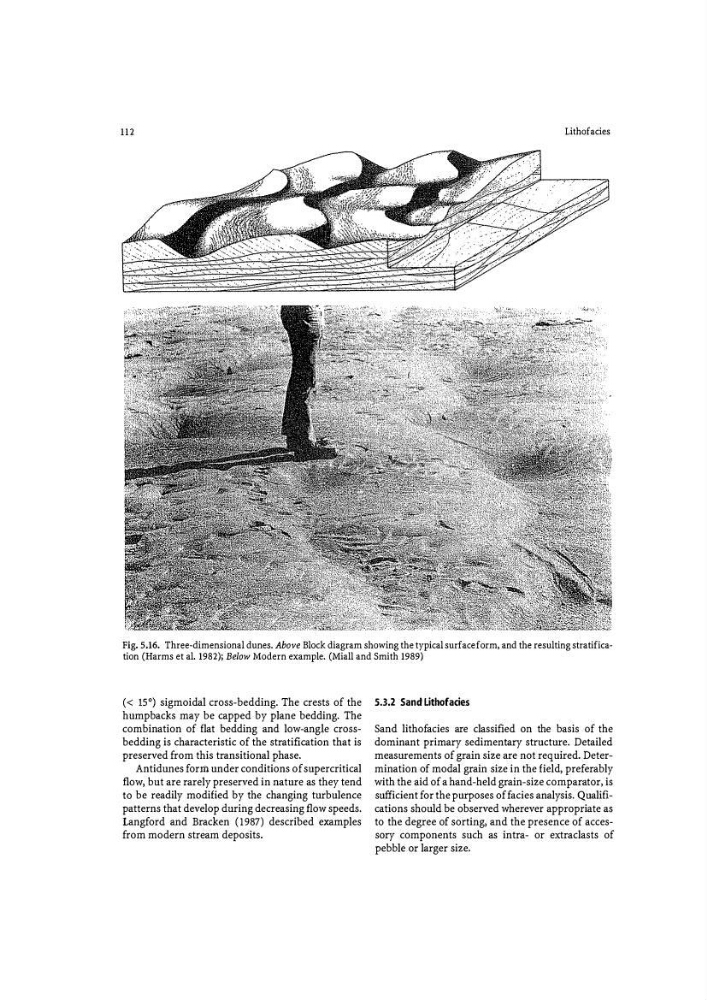
Fig. 5.16. Three-dimensional dunes. Above Block diagram showing the typical surface form, and the resulting stratification (Harms et al. 1982); Below Modern example. (Miall and Smith 1989)
( < !5°) sigmoidal cross-bedding. The crests of the
humpbacks may be capped by plane bedding. The
combination of flat bedding and low-angle crossbedding is characteristic of the stratification that is
preserved from this transitional phase.
Antidunes form under conditions of supercritical
flow, but are rarely preserved in nature as they tend
to be readily modified by the changing turbulence
patterns that develop during decreasing flow speeds.
Langford and Bracken (1987) described examples
from modern stream deposits.
5.3.2 Sand lithofacies
Sand lithofacies are classified on the basis of the
dominant primary sedimentary structure. Detailed
measurements of grain size are not required. Determination of modal grain size in the field, preferably
with the aid of a hand-held grain-size comparator, is
sufficient for the purposes of facies analysis. Qualifications should be observed wherever appropriate as
to the degree of sorting, and the presence of accessory components such as intra- or extraclasts of
pebble or larger size.
Lithofacies
Fig. 5.16. Three-dimensional dunes. Above Block diagram showing the typical surface form, and the resulting stratification (Harms et al. 1982); Below Modern example. (Miall and Smith 1989)
( < !5°) sigmoidal cross-bedding. The crests of the
humpbacks may be capped by plane bedding. The
combination of flat bedding and low-angle crossbedding is characteristic of the stratification that is
preserved from this transitional phase.
Antidunes form under conditions of supercritical
flow, but are rarely preserved in nature as they tend
to be readily modified by the changing turbulence
patterns that develop during decreasing flow speeds.
Langford and Bracken (1987) described examples
from modern stream deposits.
5.3.2 Sand lithofacies
Sand lithofacies are classified on the basis of the
dominant primary sedimentary structure. Detailed
measurements of grain size are not required. Determination of modal grain size in the field, preferably
with the aid of a hand-held grain-size comparator, is
sufficient for the purposes of facies analysis. Qualifications should be observed wherever appropriate as
to the degree of sorting, and the presence of accessory components such as intra- or extraclasts of
pebble or larger size.