

L
sand Facies
111
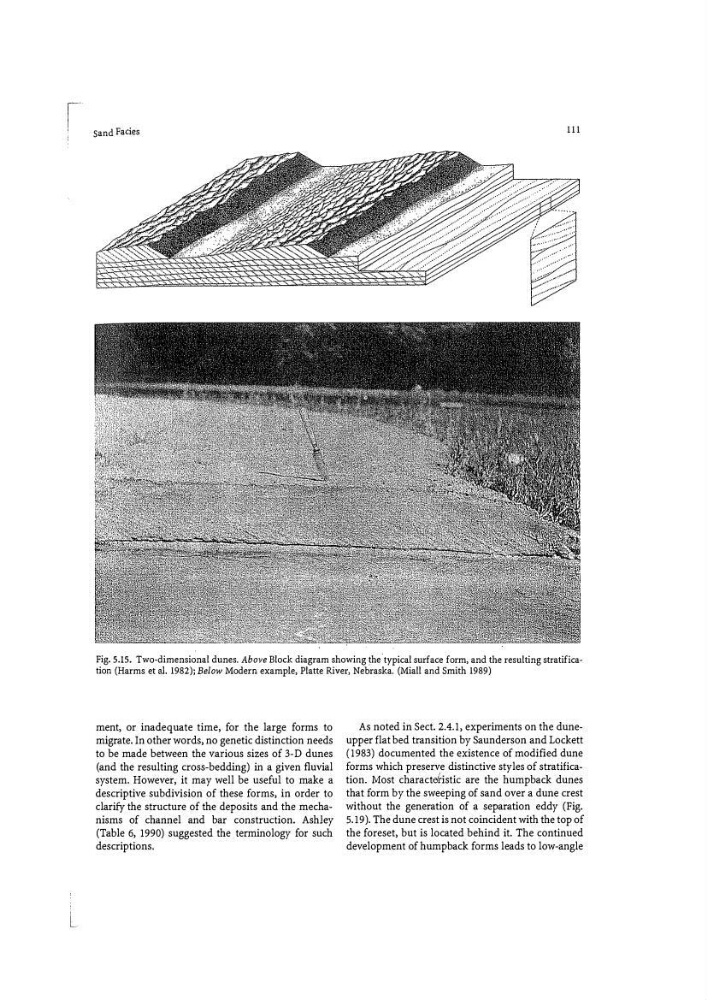
Fig. 5.15. Two-dimensional dunes. Above Block diagram showing the
· typical surface form, and the resulting stratification (Harms et al. 1982); Below Modem example, Platte River, Nebraska. (Miall and Smith 1989)
ment, or inadequate time, for the large forms to
migrate. In other words, no genetic distinction needs
to be made between the various sizes of 3-D dunes
(and the resulting cross-bedding) in a given fluvial
system. However, it may well be useful to make a
descriptive subdivision of these forms, in order to
clarify the structure of the deposits and the mechanisms of channel and bar construction. Ashley
(Table 6, 1990) suggested the terminology for such
descriptions.
As noted in Sect. 2.4.1, experiments on the duneupper flat bed transition by Saunderson and Lockett
(1983) documented the existence of modified dune
forms which preserve distinctive styles of stratification. Most charact ef istk are the humpback dunes
that form by the sweeping of sand over a dune crest
without the generation of a separation eddy (Fig.
5.19). The dune crest is not coincident with the top of
the foreset, but is located behind it. The continued
development of humpback forms leads to low-angle
sand Facies
111
Fig. 5.15. Two-dimensional dunes. Above Block diagram showing the
· typical surface form, and the resulting stratification (Harms et al. 1982); Below Modem example, Platte River, Nebraska. (Miall and Smith 1989)
ment, or inadequate time, for the large forms to
migrate. In other words, no genetic distinction needs
to be made between the various sizes of 3-D dunes
(and the resulting cross-bedding) in a given fluvial
system. However, it may well be useful to make a
descriptive subdivision of these forms, in order to
clarify the structure of the deposits and the mechanisms of channel and bar construction. Ashley
(Table 6, 1990) suggested the terminology for such
descriptions.
As noted in Sect. 2.4.1, experiments on the duneupper flat bed transition by Saunderson and Lockett
(1983) documented the existence of modified dune
forms which preserve distinctive styles of stratification. Most charact ef istk are the humpback dunes
that form by the sweeping of sand over a dune crest
without the generation of a separation eddy (Fig.
5.19). The dune crest is not coincident with the top of
the foreset, but is located behind it. The continued
development of humpback forms leads to low-angle