

110
Lithofacies
(i) 2.0
•
+
+
�
-Fr=1.0 �-i++
+
.2
+
+ +
; - - -- - - -
"'
�
. � -
"
c.
+
1:.
ou-a. \ •
E
•
"' "
e
�
•
•
�
2l 0.8
i "'
:;:
·a
0 (.)
Qj
0
>
0
0
0
�
0 �
:;:
0
.s
0 0
0
8 0
"'" "
0
Oo
" '"
0
('(I. !::: :!
0 0
""
0
::; i;
0
0
"0
0
"
g
0 0
� 0.2
c §
•
•
•
•
•
�·
.
•
·"'
;
• •
Iii
�· DUNES
:
..
0
0
0
' .
�6,..,
•
'2 ... ... .
.
0 0
M
"'
0
.
0
RIPPLES
'b
0
0
B
/
/
.
•
/
i
•
•
'i
�
\ ••
..
!!
.. �
•
MOVEMENT
' ' '
'
'
'
'
Mean flow depth
0.25·0.40 m
1.0
Median sediment size, mm
{standardized to 10°C water temperature )
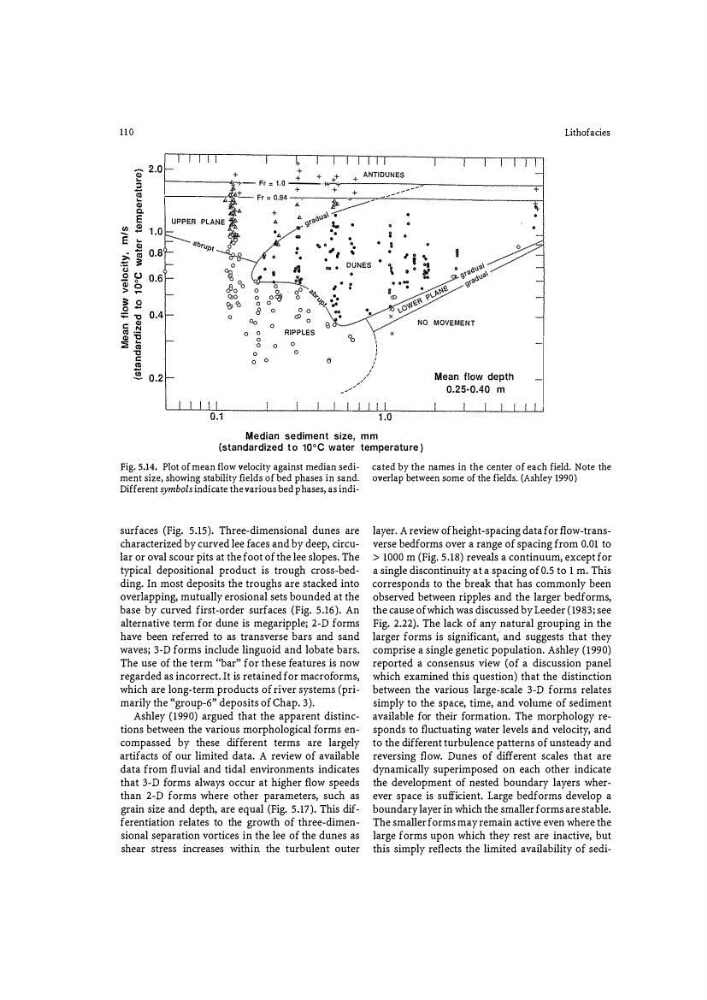
Fig. 5.14. Plot of mean flow velocity against median sediment size, showing stability fields of bed phases in sand.
Different sy mbols indicate the various bed p·hases, as indisurfaces (Fig. 5.15). Three-dimensional dunes are
characterized by curved lee faces and by deep, circular or oval scour pits at the foot of the lee slopes. The
typical depositional product is trough cross-bedding. In most deposits the troughs are stacked into
overlapping, mutually erosional sets bounded at the
base by curved first-order surfaces (Fig. 5.16). An
alternative term for dune is megaripple; 2-D forms
have been referred to as transverse bars and sand
waves; 3-D forms include linguoid and lobate bars.
The use of the term ('bar" for these fe atures is now
regarded as incorrect. It is retained for macl"oforms,
which are long-term products of river systems (primarily the "group-6" deposits of Chap. 3).
Ashley (1990) argued that the apparent distinctions between the various morphological fo rms encompassed by these different terms are largely
artifacts of our limited data. A review of available
data from fluvial and tidal environments indicates
that 3-D forms always occur at higher flow speeds
than 2-D forms where other parameters, such as
grain size and depth, are equal (Fig. 5.17). This differentiation relates to the growth of three-dimensional separation vortices in the lee of the dunes as
shear stress increases within the turbulent outer
cated by the names in the center of each field. Note the
overlap between some of the fields. (Ashley 1990)
layer. A review of height-spacing data for flow-transverse bedforms over a range of spacing from 0.01 to
> 1000 m (Fig. 5.18) reveals a continuum, except for
a single discontinuity at a spacing of 0.5 to 1 m. This
corresponds to the break that has commonly been
observed between ripples and the larger bedforms,
the cause of which was discussed by Leeder ( 1983; see
Fig. 2.22). The lack of any natural grouping in the
larger forms is significant,· and suggests that they
comprise a single genetic population. Ashley (1990)
reported a consensus view (of a discussion panel
which examined this question) that the distinction
between the various large-scale 3-D forms relates
simply to the space, time, and volume of sediment
available for their formation. The morphology responds to fl uctuating water levels and velocity, and
to the different turbulence patterns of unsteady and
reversing flow. Dunes of different scales that are
dynamically superimposed on each other indicate
the development of nested boundary layers wherever space is sufficient. Large bedforms develop a
boundary layer in which the smaller forms are stable.
The smaller forms may remain active even where the
large forms upon which they rest are inactive, but
this simply reflects the limited availability of sedi-
Lithofacies
(i) 2.0
•
+
+
�
-Fr=1.0 �-i++
+
.2
+
+ +
; - - -- - - -
"'
�
. � -
"
c.
+
1:.
ou-a. \ •
E
•
"' "
e
�
•
•
�
2l 0.8
i "'
:;:
·a
0 (.)
Qj
0
>
0
0
0
�
0 �
:;:
0
.s
0 0
0
8 0
"'" "
0
Oo
" '"
0
('(I. !::: :!
0 0
""
0
::; i;
0
0
"0
0
"
g
0 0
� 0.2
c §
•
•
•
•
•
�·
.
•
·"'
;
• •
Iii
�· DUNES
:
..
0
0
0
' .
�6,..,
•
'2 ... ... .
.
0 0
M
"'
0
.
0
RIPPLES
'b
0
0
B
/
/
.
•
/
i
•
•
'i
�
\ ••
..
!!
.. �
•
MOVEMENT
' ' '
'
'
'
'
Mean flow depth
0.25·0.40 m
1.0
Median sediment size, mm
{standardized to 10°C water temperature )
Fig. 5.14. Plot of mean flow velocity against median sediment size, showing stability fields of bed phases in sand.
Different sy mbols indicate the various bed p·hases, as indisurfaces (Fig. 5.15). Three-dimensional dunes are
characterized by curved lee faces and by deep, circular or oval scour pits at the foot of the lee slopes. The
typical depositional product is trough cross-bedding. In most deposits the troughs are stacked into
overlapping, mutually erosional sets bounded at the
base by curved first-order surfaces (Fig. 5.16). An
alternative term for dune is megaripple; 2-D forms
have been referred to as transverse bars and sand
waves; 3-D forms include linguoid and lobate bars.
The use of the term ('bar" for these fe atures is now
regarded as incorrect. It is retained for macl"oforms,
which are long-term products of river systems (primarily the "group-6" deposits of Chap. 3).
Ashley (1990) argued that the apparent distinctions between the various morphological fo rms encompassed by these different terms are largely
artifacts of our limited data. A review of available
data from fluvial and tidal environments indicates
that 3-D forms always occur at higher flow speeds
than 2-D forms where other parameters, such as
grain size and depth, are equal (Fig. 5.17). This differentiation relates to the growth of three-dimensional separation vortices in the lee of the dunes as
shear stress increases within the turbulent outer
cated by the names in the center of each field. Note the
overlap between some of the fields. (Ashley 1990)
layer. A review of height-spacing data for flow-transverse bedforms over a range of spacing from 0.01 to
> 1000 m (Fig. 5.18) reveals a continuum, except for
a single discontinuity at a spacing of 0.5 to 1 m. This
corresponds to the break that has commonly been
observed between ripples and the larger bedforms,
the cause of which was discussed by Leeder ( 1983; see
Fig. 2.22). The lack of any natural grouping in the
larger forms is significant,· and suggests that they
comprise a single genetic population. Ashley (1990)
reported a consensus view (of a discussion panel
which examined this question) that the distinction
between the various large-scale 3-D forms relates
simply to the space, time, and volume of sediment
available for their formation. The morphology responds to fl uctuating water levels and velocity, and
to the different turbulence patterns of unsteady and
reversing flow. Dunes of different scales that are
dynamically superimposed on each other indicate
the development of nested boundary layers wherever space is sufficient. Large bedforms develop a
boundary layer in which the smaller forms are stable.
The smaller forms may remain active even where the
large forms upon which they rest are inactive, but
this simply reflects the limited availability of sedi-