

102
Lithofacies
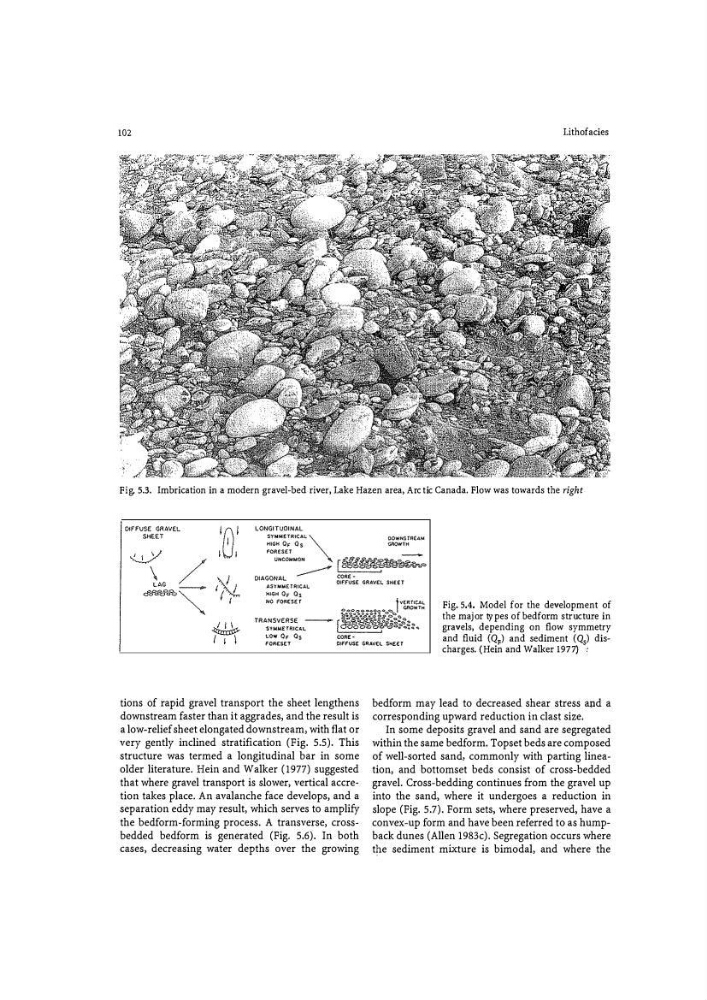
Fig. 5.3. Imbrication in a modern gravel�bed river, Lake Hazen area, Arctic Canada. Flow was towards the right
lions of rapid gravel transport the sheet lengthens
downstream faster than it aggrades, and the result is
a low-relief sheet elongated downstream, with flat or
very gently inclined stratification (Fig. 5.5). This
structure was termed a longitudinal bar in some
older literature. Hein and Walker (1977) suggested
that where gravel transport is slower, vertical accre�
tion takes place. An avalanche face develops, and a
separation eddy may result, which serves to amplify
the bedform-forming process. A transverse, crossbedded bedform is generated (Fig. 5.6). In both
cases, decreasing water depths over the growing
Fig. 5.4. Model for the development of
the major types of bedfo rm stru ctur e in
gravels, depending on flow symmetry
and fluid ( Q F ) and sediment ( Q 5 ) dis�
charges. (Hein and Walke r 1977) ·:
bedform may lead to decreased shear stress and a
corresponding upward reduction in clast size.
In some deposits gravel and sand are segregated
within the same bedform. Topset beds are composed
of well-sorted sand, commonly with parting lineation, and bottomset beds consist of cross-bedded
gravel. Cross-bedding continues from the gravel up
into the sand, where it undergoes a reduction in
slope (Fig. 5.7). Form sets, where preserved, have a
convex-up form and have been referred to as humpback dunes (Allen 1983c). Segregation occurs where
tp.e sediment mixture is bimodal, and where the
Lithofacies
Fig. 5.3. Imbrication in a modern gravel�bed river, Lake Hazen area, Arctic Canada. Flow was towards the right
lions of rapid gravel transport the sheet lengthens
downstream faster than it aggrades, and the result is
a low-relief sheet elongated downstream, with flat or
very gently inclined stratification (Fig. 5.5). This
structure was termed a longitudinal bar in some
older literature. Hein and Walker (1977) suggested
that where gravel transport is slower, vertical accre�
tion takes place. An avalanche face develops, and a
separation eddy may result, which serves to amplify
the bedform-forming process. A transverse, crossbedded bedform is generated (Fig. 5.6). In both
cases, decreasing water depths over the growing
Fig. 5.4. Model for the development of
the major types of bedfo rm stru ctur e in
gravels, depending on flow symmetry
and fluid ( Q F ) and sediment ( Q 5 ) dis�
charges. (Hein and Walke r 1977) ·:
bedform may lead to decreased shear stress and a
corresponding upward reduction in clast size.
In some deposits gravel and sand are segregated
within the same bedform. Topset beds are composed
of well-sorted sand, commonly with parting lineation, and bottomset beds consist of cross-bedded
gravel. Cross-bedding continues from the gravel up
into the sand, where it undergoes a reduction in
slope (Fig. 5.7). Form sets, where preserved, have a
convex-up form and have been referred to as humpback dunes (Allen 1983c). Segregation occurs where
tp.e sediment mixture is bimodal, and where the