

Gravel Facies
In this section, we consider the develoment of
textures and structures and the resulting lithofacies
variatio ns. Gravel macroforms are described and
interpre ted in Chap. 6.
Variations in the texture and structure of gravel
deposited from traction currents reflect the extreme
unsteadiness of flow and transport rates in natural
gravel-bed rivers. Gravel tends to be transported in
repeated pulses as loosely defined (slugs' or (lobes'.
This reflects turbulence patterns in the river, and
also reflects the way in which gravel is released spasmodically intO the river from bedform migration
and cutbank erosion. Under conditions of high bedshear stress only the coarsest clasts are deposited,
leading to open-work, clast-supported gravels. Finer
clasts, and sand, infiltrate the clast framework at
lower flow velocities. Changes in flow velocity and
shear stress can occur over very short periods, reflecting changes in river discharge and responses to
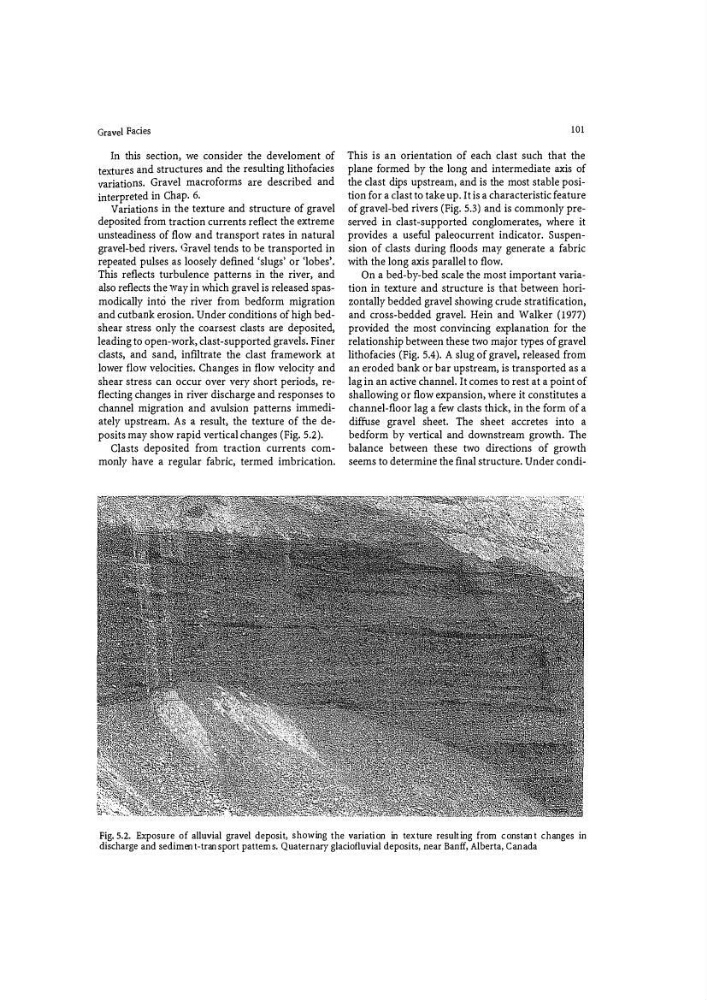
channel migration and avulsion patterns immediately upstream. As a result, the texture of the deposits may show rapid vertical changes (Fig. 5.2).
Clasts deposited from traction currents commonly have a regular fabric, termed imbrication.
101
This is an orientation of each clast such that the
plane formed by the long and intermediate axis of
the clast dips upstream, and is the most stable position for a clast to take up. It is a characteristic feature
of gravel-bed rivers (Fig. 5.3) and is commonly preserved in clast-supported conglomerates, where it
provides a useful paleocurrent indicator. Suspension of clasts during floods may generate a fabric
with the long axis parallel to flow.
On a bed-by-bed scale the most important variation in texture and structure is that between horizontally bedded gravel showing crude stratification,
and cross-bedded gravel. Hein and Walker (1977)
provided the most convincing explanation for the
relationship between these two major types of gravel
lithofacies (Fig. 5.4). A slug of gravel, released from
an eroded bank or bar upstream, is transported as a
lag in an active channel. It comes to rest at a point of
shallowing or flow expansion, where it constitutes a
channel-floor lag a few clasts thick, in the form of a
diffuse gravel sheet. The sheet accretes into a
bedform by vertical and downstream growth. The
balance between these two directions of growth
seems to determine the final structure. Under condiFig. 5.2. Exposure of alluvial gravel deposit, showing the variation in te xture resulting from constant changes in
discharge and sediment-transport patterns. Quater nary glaciofluvial deposits, ne ar Ba nff, Alberta, Canada
In this section, we consider the develoment of
textures and structures and the resulting lithofacies
variatio ns. Gravel macroforms are described and
interpre ted in Chap. 6.
Variations in the texture and structure of gravel
deposited from traction currents reflect the extreme
unsteadiness of flow and transport rates in natural
gravel-bed rivers. Gravel tends to be transported in
repeated pulses as loosely defined (slugs' or (lobes'.
This reflects turbulence patterns in the river, and
also reflects the way in which gravel is released spasmodically intO the river from bedform migration
and cutbank erosion. Under conditions of high bedshear stress only the coarsest clasts are deposited,
leading to open-work, clast-supported gravels. Finer
clasts, and sand, infiltrate the clast framework at
lower flow velocities. Changes in flow velocity and
shear stress can occur over very short periods, reflecting changes in river discharge and responses to
channel migration and avulsion patterns immediately upstream. As a result, the texture of the deposits may show rapid vertical changes (Fig. 5.2).
Clasts deposited from traction currents commonly have a regular fabric, termed imbrication.
101
This is an orientation of each clast such that the
plane formed by the long and intermediate axis of
the clast dips upstream, and is the most stable position for a clast to take up. It is a characteristic feature
of gravel-bed rivers (Fig. 5.3) and is commonly preserved in clast-supported conglomerates, where it
provides a useful paleocurrent indicator. Suspension of clasts during floods may generate a fabric
with the long axis parallel to flow.
On a bed-by-bed scale the most important variation in texture and structure is that between horizontally bedded gravel showing crude stratification,
and cross-bedded gravel. Hein and Walker (1977)
provided the most convincing explanation for the
relationship between these two major types of gravel
lithofacies (Fig. 5.4). A slug of gravel, released from
an eroded bank or bar upstream, is transported as a
lag in an active channel. It comes to rest at a point of
shallowing or flow expansion, where it constitutes a
channel-floor lag a few clasts thick, in the form of a
diffuse gravel sheet. The sheet accretes into a
bedform by vertical and downstream growth. The
balance between these two directions of growth
seems to determine the final structure. Under condiFig. 5.2. Exposure of alluvial gravel deposit, showing the variation in te xture resulting from constant changes in
discharge and sediment-transport patterns. Quater nary glaciofluvial deposits, ne ar Ba nff, Alberta, Canada