

Gravel Facies
103
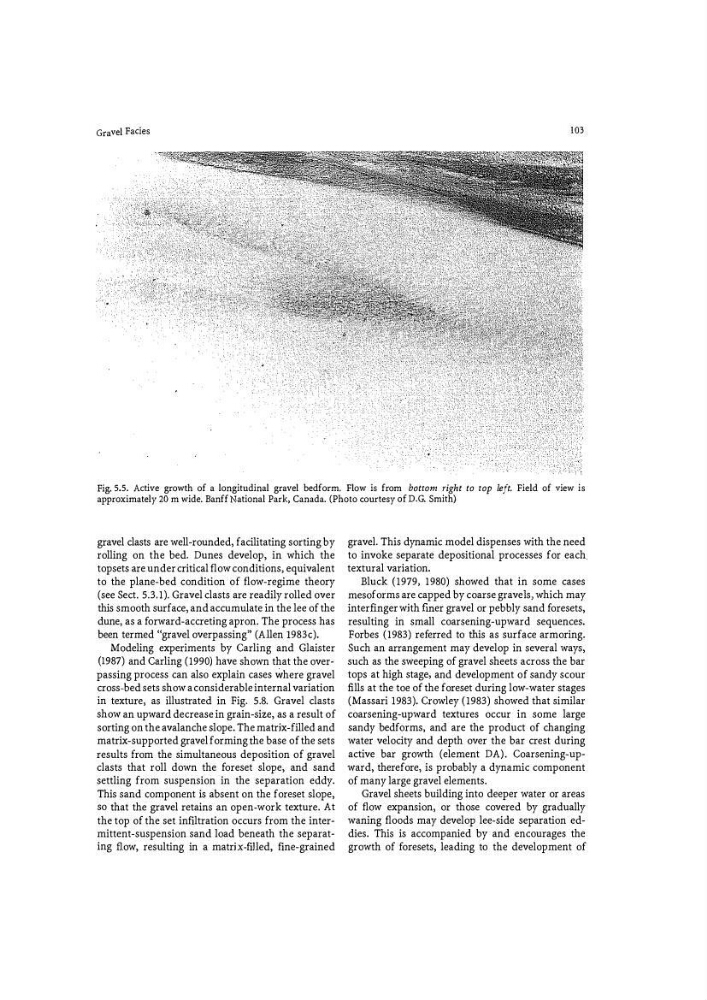
Fig. 5.5. Active growth of a longitudinal gravel bedform. Flow is from bottom right to top left. Field of view is
approximately 20 m wide. Banff National Park, Canada. (Photo courtesy of D.G. Smith)
gravel clasts are well-rounded, facilitating sorting by
rolling on the bed. Dunes develop, in which the
topsets are under critical flow conditions, equivalent
to the plane-bed condition of flow-regime theory
(see Sect. 5.3.1). Gravel clasts are readily rolled over
this smooth surface, and accumulate in the lee of the
dune, as a fo rward-accreting apron. The process has
been termed ((gravel overpassing" (Allen 1983c).
Modeling experiments by Carling and Glaister
(1987) and Carling (1990) have shown that the overpassing process can also explain cases W here gravel
cross-bed sets show a considerable internal variation
in texture, as illustrated in Fig. 5.8. Gravel clasts
show an upward decrease in grain-size, as a result of
sorting on the avalanche slope. The matrix-filled and
matrix-supported gravel forming the base of the sets
results from the simultaneous deposition of gravel
clasts that roll down the fo reset slope, and sand
settling from suspension in the separation eddy.
This sand component is absent on the foreset slope,
so that the gravel retains an open-work texture. At
the top of the set infiltration occurs from the intermittent-suspension sand load beneath the separating flow, resulting in a matrix-filled, fine-grained
gravel. This dynamic model dispenses with the need
to invoke separate depositional processes for each.
textural variation.
Bluck (1979, 1980) showed that in some cases
meso forms are capped by coarse grave1s1 which may
interfinger with fm er gravel or pebbly sand fo resets,
resulting in small coarsening-upward sequences.
Forbes (1983) referred to this as surface armoring.
Such an arrangement may develop in several ways,
such as the sweeping of gravel sheets across the bar
tops at high stage, and development of sandy scour
fi lls at the toe of the foreset during low-water stages
(Massari 1983). Crowley (1983) showed that similar
coarsening-upward textures occur in some large
sandy bedforms, and are the product of changing
water velocity and depth over the bar crest during
active bar growth (element DA). Coarsening-upward, therefore, is probably a dynamic component
of many large gravel elements.
Gravel sheets building into deeper water or areas
of flow expansion, or those covered by gradually
waning floods may develop lee-side separation eddies. This is accompanied by and encourages the
growth of fo resets, leading to the development of
103
Fig. 5.5. Active growth of a longitudinal gravel bedform. Flow is from bottom right to top left. Field of view is
approximately 20 m wide. Banff National Park, Canada. (Photo courtesy of D.G. Smith)
gravel clasts are well-rounded, facilitating sorting by
rolling on the bed. Dunes develop, in which the
topsets are under critical flow conditions, equivalent
to the plane-bed condition of flow-regime theory
(see Sect. 5.3.1). Gravel clasts are readily rolled over
this smooth surface, and accumulate in the lee of the
dune, as a fo rward-accreting apron. The process has
been termed ((gravel overpassing" (Allen 1983c).
Modeling experiments by Carling and Glaister
(1987) and Carling (1990) have shown that the overpassing process can also explain cases W here gravel
cross-bed sets show a considerable internal variation
in texture, as illustrated in Fig. 5.8. Gravel clasts
show an upward decrease in grain-size, as a result of
sorting on the avalanche slope. The matrix-filled and
matrix-supported gravel forming the base of the sets
results from the simultaneous deposition of gravel
clasts that roll down the fo reset slope, and sand
settling from suspension in the separation eddy.
This sand component is absent on the foreset slope,
so that the gravel retains an open-work texture. At
the top of the set infiltration occurs from the intermittent-suspension sand load beneath the separating flow, resulting in a matrix-filled, fine-grained
gravel. This dynamic model dispenses with the need
to invoke separate depositional processes for each.
textural variation.
Bluck (1979, 1980) showed that in some cases
meso forms are capped by coarse grave1s1 which may
interfinger with fm er gravel or pebbly sand fo resets,
resulting in small coarsening-upward sequences.
Forbes (1983) referred to this as surface armoring.
Such an arrangement may develop in several ways,
such as the sweeping of gravel sheets across the bar
tops at high stage, and development of sandy scour
fi lls at the toe of the foreset during low-water stages
(Massari 1983). Crowley (1983) showed that similar
coarsening-upward textures occur in some large
sandy bedforms, and are the product of changing
water velocity and depth over the bar crest during
active bar growth (element DA). Coarsening-upward, therefore, is probably a dynamic component
of many large gravel elements.
Gravel sheets building into deeper water or areas
of flow expansion, or those covered by gradually
waning floods may develop lee-side separation eddies. This is accompanied by and encourages the
growth of fo resets, leading to the development of