

84
Methods of ArchitectUral-Element Analys is
7 (FORMATtON BOUNDARY)
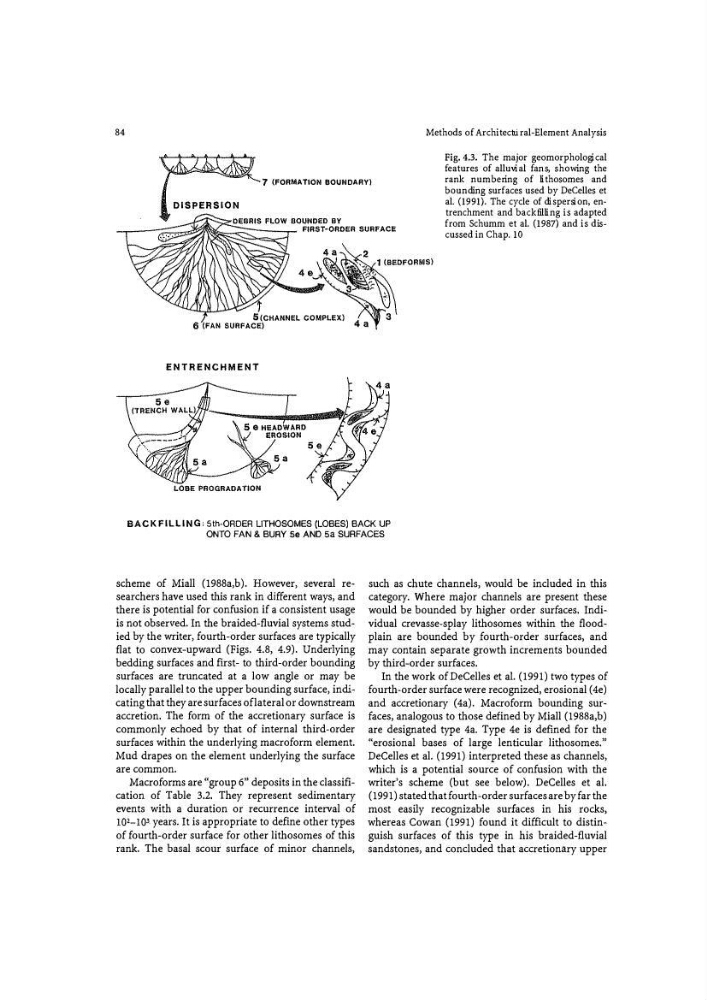
Fig. 4.3. The major geomorphological
fe atures of alluvial fans, showing the
rank numbering of lithosomes and
bounding surfaces used by DeCelles et
al. (1991). The cycle of dispersion, entrenchment and backfi lling is adapted
from Schumm et al. (1987) and is di scussed in Chap. 10
DISPERSION
ENTRENCHMENT
BACKFILLING' 5th-ORDER LITHOSOMES (LOBES) BACK UP
ONTO FAN & BURY 5e AND Sa SURFACES
scheme of Miall (1988a,b). However, several researchers have used this rank in different ways, and
there is potential for confusion if a consistent usage
is not observed. In the braided-fluvial systems studied by the writer, fourth-order surfaces are typically
flat to convex-upward (Figs. 4.8, 4.9). Underlying
bedding surfaces and first- to third-order bounding
surfaces are truncated at a low angle or may be
locally parallel to the upper bounding surface, indicating that they are surfaces of lateral or downstream
accretion. The form of the accretionary surface is
commonly echoed by that of internal third-order
surfaces within the underlying macroform element.
Mud drapes on the element underlying the surface
are common.
Macro forms are «group 6, deposits in the classification of Table 3.2. They represent sedimentary
events with a duration or recurrence interval of
1Q2-IQ3. years. It is appropriate to define other types
of fourth-order surface for other lithosomes of this
rank. The basal scour surface of minor channels,
such as chute channels, would be included in this
category. Where major channels are present these
would be bounded by higher order surfaces. Individual crevasse-splay lithosomes within the floodplain are bounded by fourth-order surfaces, and
may contain separate grovvth increments bounded
by third-order surfaces.
In the work of DeCelles et a!. (1991) two types of
fourth �order surface were recognized, erosional ( 4e)
and accretionary (4a). Macroform bounding surfaces, analogous to those defined by Miall (1988a,b)
are designated type 4a. Type 4e is defined for the
«erosional bases of large lenticular lithosomes."
DeCelles et al. (1991) interpreted these as channels,
which is a potential source of confusion with the
writer's scheme (but see below). DeCelles et al.
(1991) stated that fourth'order surfaces are by far the
most easily recognizable surfaces in his rocks,
whereas Cowan (1991) found it difficult to distinguish surfaces of this type in his braided-fluvial
sandstones, and concluded that accretionary upper
Methods of ArchitectUral-Element Analys is
7 (FORMATtON BOUNDARY)
Fig. 4.3. The major geomorphological
fe atures of alluvial fans, showing the
rank numbering of lithosomes and
bounding surfaces used by DeCelles et
al. (1991). The cycle of dispersion, entrenchment and backfi lling is adapted
from Schumm et al. (1987) and is di scussed in Chap. 10
DISPERSION
ENTRENCHMENT
BACKFILLING' 5th-ORDER LITHOSOMES (LOBES) BACK UP
ONTO FAN & BURY 5e AND Sa SURFACES
scheme of Miall (1988a,b). However, several researchers have used this rank in different ways, and
there is potential for confusion if a consistent usage
is not observed. In the braided-fluvial systems studied by the writer, fourth-order surfaces are typically
flat to convex-upward (Figs. 4.8, 4.9). Underlying
bedding surfaces and first- to third-order bounding
surfaces are truncated at a low angle or may be
locally parallel to the upper bounding surface, indicating that they are surfaces of lateral or downstream
accretion. The form of the accretionary surface is
commonly echoed by that of internal third-order
surfaces within the underlying macroform element.
Mud drapes on the element underlying the surface
are common.
Macro forms are «group 6, deposits in the classification of Table 3.2. They represent sedimentary
events with a duration or recurrence interval of
1Q2-IQ3. years. It is appropriate to define other types
of fourth-order surface for other lithosomes of this
rank. The basal scour surface of minor channels,
such as chute channels, would be included in this
category. Where major channels are present these
would be bounded by higher order surfaces. Individual crevasse-splay lithosomes within the floodplain are bounded by fourth-order surfaces, and
may contain separate grovvth increments bounded
by third-order surfaces.
In the work of DeCelles et a!. (1991) two types of
fourth �order surface were recognized, erosional ( 4e)
and accretionary (4a). Macroform bounding surfaces, analogous to those defined by Miall (1988a,b)
are designated type 4a. Type 4e is defined for the
«erosional bases of large lenticular lithosomes."
DeCelles et al. (1991) interpreted these as channels,
which is a potential source of confusion with the
writer's scheme (but see below). DeCelles et al.
(1991) stated that fourth'order surfaces are by far the
most easily recognizable surfaces in his rocks,
whereas Cowan (1991) found it difficult to distinguish surfaces of this type in his braided-fluvial
sandstones, and concluded that accretionary upper