

Classifi cation of Bounding Surfaces
85
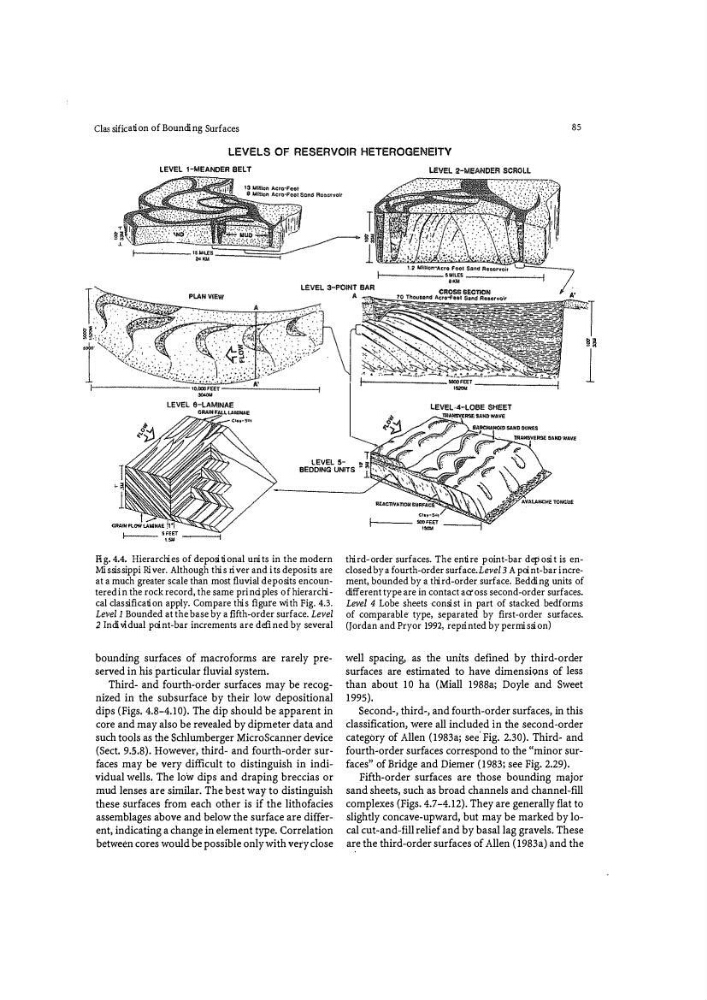
LEVELS OF RESERVOIR HETEROGENEITY
LEVEL 1-MEANDER BELT
LEVEL 5t.
BEDDING UNITS -
Fig. 4.4. Hierarchies of depositional units in the modern
Mississi pp i River. Although this river and its depos its are
at a much greater scale than most fluv ial deposits encoun�
tered in the rock record, the same pr inciples ofhierarchi�
cal classifi cation apply. Compare this figure With Fi g. 4.3.
Levell Bounded at the base by a ftfth-order surface. Level
2 In dividual point-bar increments are defined by several
bounding surfaces of macroforms are rarely preserved in his -particular fluvial system.
Third- and fourth-order surfaces may be recognized in the subsurface by their low depositional
dips (Figs. 4.8-4.10). The dip should be apparent in
core and may also be revealed by dipmeter data and
such tools as the Schlumberger MicroScanner device
(Sect. 9.5.8). However, thitd- and fourth-order surfaces may be very difficult to distinguish in individual wells. The low dips and draping breccias or
mud lenses are similar. The best way to distinguish
these surfaces from each other is if the lithofacies
assemblages above and below the surface are different, indicating a change in element type. Correlation
between cores would be possible only with very close
third -order surfaces. The entire point-bar deposit is enclosed by a fo urth-order surface.Level3 A point-bar increment, bounded by a third-order surface. Bedding units of
different type are in contact across second-order surfaces.
Level 4 Lobe sheets -consist in part of stacked bedforms
of comparable· type, separated by fi rst-order surfaces.
(Jordan and Pryor 1992, reprinted by permission )
well spacing, as the units defined by third-order
surfaces are estimated to have dimensions of less
than about 10 ha (Miall 1988a; Doyle and Sweet
1995).
Second-, third-, and fourth-order surfaces, in this
classification, were all included in the second-order
category of Allen (1983a; see Fig. 2.30). Third- and
fourth-order surfaces correspond to the «minor surfaces" of Bridge and Diemer (1983; see Fig. 2.29).
Fifth-order surfaces are those bounding major
sand sheets, such as broad channels and channel-fill
complexes (Figs. 4.7 -4.12). They are generally fiat to
slightly concave-upward, but may be marked by local cut-and-fill relief and by basal lag gravels. These
are the third-order surfaces of Allen (1983a) and the
85
LEVELS OF RESERVOIR HETEROGENEITY
LEVEL 1-MEANDER BELT
LEVEL 5t.
BEDDING UNITS -
Fig. 4.4. Hierarchies of depositional units in the modern
Mississi pp i River. Although this river and its depos its are
at a much greater scale than most fluv ial deposits encoun�
tered in the rock record, the same pr inciples ofhierarchi�
cal classifi cation apply. Compare this figure With Fi g. 4.3.
Levell Bounded at the base by a ftfth-order surface. Level
2 In dividual point-bar increments are defined by several
bounding surfaces of macroforms are rarely preserved in his -particular fluvial system.
Third- and fourth-order surfaces may be recognized in the subsurface by their low depositional
dips (Figs. 4.8-4.10). The dip should be apparent in
core and may also be revealed by dipmeter data and
such tools as the Schlumberger MicroScanner device
(Sect. 9.5.8). However, thitd- and fourth-order surfaces may be very difficult to distinguish in individual wells. The low dips and draping breccias or
mud lenses are similar. The best way to distinguish
these surfaces from each other is if the lithofacies
assemblages above and below the surface are different, indicating a change in element type. Correlation
between cores would be possible only with very close
third -order surfaces. The entire point-bar deposit is enclosed by a fo urth-order surface.Level3 A point-bar increment, bounded by a third-order surface. Bedding units of
different type are in contact across second-order surfaces.
Level 4 Lobe sheets -consist in part of stacked bedforms
of comparable· type, separated by fi rst-order surfaces.
(Jordan and Pryor 1992, reprinted by permission )
well spacing, as the units defined by third-order
surfaces are estimated to have dimensions of less
than about 10 ha (Miall 1988a; Doyle and Sweet
1995).
Second-, third-, and fourth-order surfaces, in this
classification, were all included in the second-order
category of Allen (1983a; see Fig. 2.30). Third- and
fourth-order surfaces correspond to the «minor surfaces" of Bridge and Diemer (1983; see Fig. 2.29).
Fifth-order surfaces are those bounding major
sand sheets, such as broad channels and channel-fill
complexes (Figs. 4.7 -4.12). They are generally fiat to
slightly concave-upward, but may be marked by local cut-and-fill relief and by basal lag gravels. These
are the third-order surfaces of Allen (1983a) and the