

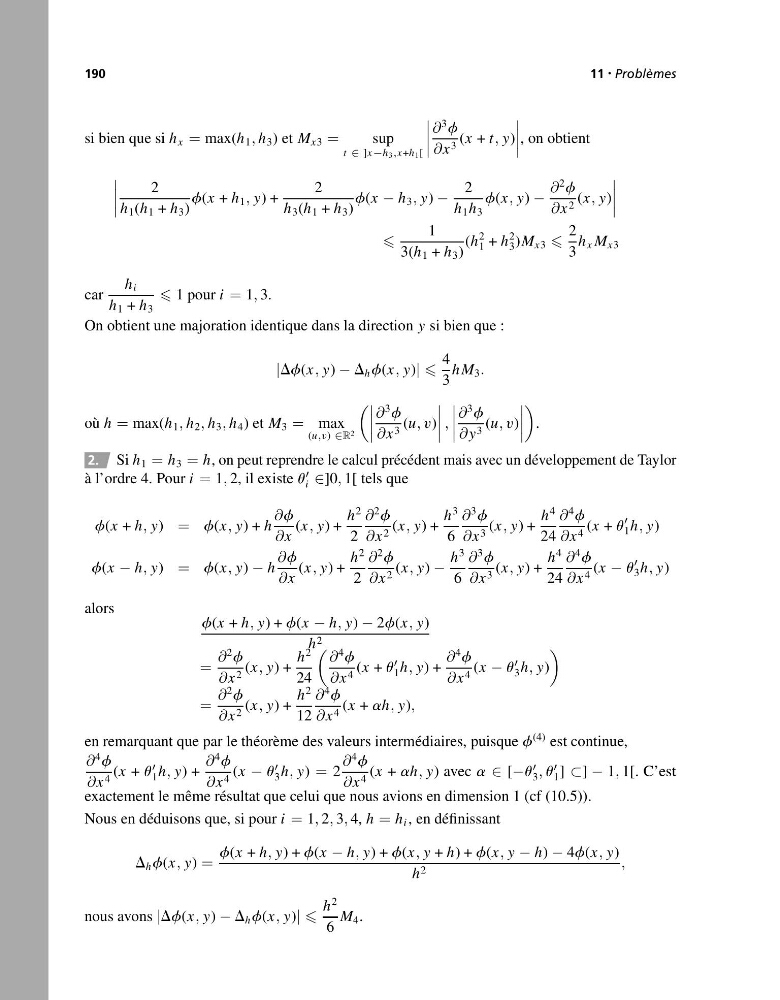
190
11
•
Problèmes
si bien quesi h x = max(h 1 , h 3 )et M x 3 =
sup
t ∈ ] x − h 3 , x + h 1 [
∂
3
f
∂ x 3 ( x + t , y )
,onobtient
2
h 1 ( h 1 + h 3 )
f ( x + h 1 , y )+
2
h 3 ( h 1 + h 3 )
f ( x − h 3 , y ) −
2
h 1 h 3
f ( x , y ) −
∂
2
f
∂ x 2 ( x , y )
1
3(h 1 + h 3 )
( h
2
1 + h
2
3 ) M x 3
2
3
h x M x 3
car
h i
h 1 + h 3
1pour i = 1 , 3.
On obtient une majoration identique dans la direction y si bien que :
| D f ( x , y ) − D h f ( x , y ) |
4
3
hM 3 .
où h = max(h 1 , h 2 , h 3 , h 4 )et M 3 = max
( u , v ) ∈ R 2
∂
3
f
∂ x 3 ( u , v )
,
∂
3
f
∂ y 3 ( u , v )
.
2. Si h 1 = h 3 = h ,onpeut reprendre le calcul précédent mais avec un développement de Taylor
àl’ordre 4. Pour i = 1 , 2, il existe u
i ∈ ]0, 1[ tels que
f ( x + h , y ) = f ( x , y )+h
∂ f
∂ x
( x , y )+
h
2
2
∂
2
f
∂ x 2 ( x , y )+
h
3
6
∂
3
f
∂ x 3 ( x , y )+
h
4
24
∂
4
f
∂ x 4 ( x + u
1 h , y )
f ( x − h , y ) = f ( x , y ) − h
∂ f
∂ x
( x , y )+
h
2
2
∂
2
f
∂ x 2 ( x , y ) −
h
3
6
∂
3
f
∂ x 3 ( x , y )+
h
4
24
∂
4
f
∂ x 4 ( x − u
3 h , y )
alors
f ( x + h , y )+f ( x − h , y ) − 2 f ( x , y )
h 2
=
∂
2
f
∂ x 2 ( x , y )+
h
2
24
∂
4
f
∂ x 4 ( x + u
1 h , y )+
∂
4
f
∂ x 4 ( x − u
3 h , y )
=
∂
2
f
∂ x 2 ( x , y )+
h
2
12
∂
4
f
∂ x 4 ( x + a h , y ) ,
en remarquant que par le théorème des valeurs intermédiaires, puisque f
(4)
estcontinue,
∂
4
f
∂ x 4 ( x + u
1 h , y )+
∂
4
f
∂ x 4 ( x − u
3 h , y ) = 2
∂
4
f
∂ x 4 ( x + a h , y )a vec a ∈ [ − u
3 , u
1 ] ⊂ ] − 1 , 1[. C’est
exactement le même résultat que celui que nous avions en dimension 1(cf (10.5)).
Nous en déduisons que, si pour i = 1 , 2 , 3 , 4, h = h i ,endéfinissant
D h f ( x , y ) =
f ( x + h , y )+f ( x − h , y )+f ( x , y + h )+f ( x , y − h ) − 4 f ( x , y )
h 2
,
nous avons | D f ( x , y ) − D h f ( x , y ) |
h
2
6
M 4 .
11
•
Problèmes
si bien quesi h x = max(h 1 , h 3 )et M x 3 =
sup
t ∈ ] x − h 3 , x + h 1 [
∂
3
f
∂ x 3 ( x + t , y )
,onobtient
2
h 1 ( h 1 + h 3 )
f ( x + h 1 , y )+
2
h 3 ( h 1 + h 3 )
f ( x − h 3 , y ) −
2
h 1 h 3
f ( x , y ) −
∂
2
f
∂ x 2 ( x , y )
1
3(h 1 + h 3 )
( h
2
1 + h
2
3 ) M x 3
2
3
h x M x 3
car
h i
h 1 + h 3
1pour i = 1 , 3.
On obtient une majoration identique dans la direction y si bien que :
| D f ( x , y ) − D h f ( x , y ) |
4
3
hM 3 .
où h = max(h 1 , h 2 , h 3 , h 4 )et M 3 = max
( u , v ) ∈ R 2
∂
3
f
∂ x 3 ( u , v )
,
∂
3
f
∂ y 3 ( u , v )
.
2. Si h 1 = h 3 = h ,onpeut reprendre le calcul précédent mais avec un développement de Taylor
àl’ordre 4. Pour i = 1 , 2, il existe u
i ∈ ]0, 1[ tels que
f ( x + h , y ) = f ( x , y )+h
∂ f
∂ x
( x , y )+
h
2
2
∂
2
f
∂ x 2 ( x , y )+
h
3
6
∂
3
f
∂ x 3 ( x , y )+
h
4
24
∂
4
f
∂ x 4 ( x + u
1 h , y )
f ( x − h , y ) = f ( x , y ) − h
∂ f
∂ x
( x , y )+
h
2
2
∂
2
f
∂ x 2 ( x , y ) −
h
3
6
∂
3
f
∂ x 3 ( x , y )+
h
4
24
∂
4
f
∂ x 4 ( x − u
3 h , y )
alors
f ( x + h , y )+f ( x − h , y ) − 2 f ( x , y )
h 2
=
∂
2
f
∂ x 2 ( x , y )+
h
2
24
∂
4
f
∂ x 4 ( x + u
1 h , y )+
∂
4
f
∂ x 4 ( x − u
3 h , y )
=
∂
2
f
∂ x 2 ( x , y )+
h
2
12
∂
4
f
∂ x 4 ( x + a h , y ) ,
en remarquant que par le théorème des valeurs intermédiaires, puisque f
(4)
estcontinue,
∂
4
f
∂ x 4 ( x + u
1 h , y )+
∂
4
f
∂ x 4 ( x − u
3 h , y ) = 2
∂
4
f
∂ x 4 ( x + a h , y )a vec a ∈ [ − u
3 , u
1 ] ⊂ ] − 1 , 1[. C’est
exactement le même résultat que celui que nous avions en dimension 1(cf (10.5)).
Nous en déduisons que, si pour i = 1 , 2 , 3 , 4, h = h i ,endéfinissant
D h f ( x , y ) =
f ( x + h , y )+f ( x − h , y )+f ( x , y + h )+f ( x , y − h ) − 4 f ( x , y )
h 2
,
nous avons | D f ( x , y ) − D h f ( x , y ) |
h
2
6
M 4 .